Liquidity

April 30th, 2009 by Potato

Cash held beyond simple transactional needs exists solely to deal with fear.

That’s a very loose paraphrasing of John Hempton’s point in a recent post on banks hoarding cash.

Liquidity can be a very important thing, especially if you have to sell something in a hurry (whether that’s due to an emergency in your life, or a margin call). A lack of liquidity is a risk factor, whether individually or in a business. Recently I talked about investing in individual companies and some of the tools to research how to do that. I also mentioned something about efficient markets — the idea that there is a pool of well-informed investors out there buying and selling the same companies you want to buy and sell, so the market price should closely reflect the market’s assessment of the company’s value. That leads down the deductive path to the conclusion that you can’t beat the market, so the best thing to do is focus on reducing your costs when investing.

Now, like I said, I think that indexing is a great idea and is probably the best way to get investing in the stock market. A large portion of my investments are indexed (with TD’s e-series index funds), and that’s also the part of my portfolio where my new savings are going every month. Nonetheless, I try to beat the market with the half of my savings that are not indexed, which are invested in individual companies. Generally, I don’t bother trying to do this with large-cap blue chip stocks: while they are great investments, they’re followed by a lot of people, so I don’t think that’s an arena where I can get a leg up (sure, looking at the charts, especially in these volatile times, it looks like there are some inefficiencies to exploit, but I’m not sure I’m the one to pick them out). Plus, that’s largely what the indexes are made up of.

Instead, I tend to gravitate toward smaller stocks that are ignored. One of the reasons many of these are ignored is that they aren’t liquid enough. That is, there aren’t enough shares traded every day for a large investor to safely get in. If a large investor decided that to make following a company worthwhile they might need to buy say 10,000 shares, but if only 5,000 are generally traded each day then their actions could drastically affect the market. If they had to sell in a hurry for whatever reason, they might have to accept a much lower price for their shares to find the extra buyers. They could be trapped by the lack of liquidity, so they will often ignore smaller, thinly traded companies. Since a lack of liquidity adds to the risk, these companies should trade at a discount to reflect the additional risk. Extra risk (and inefficiency) can also come into play from the actions of insiders, who typically represent a larger portion of the overall float when dealing with small- and mid-caps.

Since I’m pretty much the smallest of the small investors, there are very few companies where the volume of shares I’d be dealing with would affect the daily volume, so I’m more willing to accept liquidity risk.

Of course, “very few” is not zero, as I found out with one particular company when liquidity dried up — it would go weeks without a single trade, and the bid/ask spread was over 100% (e.g.: bid $1.50, ask $3.50) [the company was later delisted, but not before I managed to bail with an impressive loss]. So it is important to be aware of the liquidity situation before you invest in something — not just stocks, but also some mutual funds can restrict your ability to bail (though usually with just a back-end fee if you don’t hold for some minimum period).

Liquidity, or rather lack thereof, is in fact a part of what triggered the collapse of the market last year. Asset-backed commercial paper (ABCP) was all over the news this time last year, and it wasn’t necessarily that all those bundled mortgages to people in torn vests were worthless (though they were almost certainly overvalued by a not-insignificant percentage), but rather that the market seized up: faced with uncertainty (and an inability to leverage) nobody wanted to buy any more, and those that had to sell were forced to accept very low bids. In times of stress and fear, liquidity (different from “liquid courage”, coincidentally also sought out in times of stress and fear) can become very important, and very valuable. This also helps to explain why earlier in the year banks were seemingly driving away their line of credit customers with a stick.

Investor Tools: Analyst Research

April 23rd, 2009 by Potato

Aside: I’m not 100% happy with this draft, and as you can see by the page number I’ve been sitting on it for a while. I was hoping MG would put it up as a Potato Wedges column at themoneygardener — perhaps with some suggestions for edits — but I sent it to him last Friday and haven’t heard anything back all week… Now TMW has a long interview up (with more to come) with Nurse Brad and Preet on analyst research, so the time seemed right!

There are a lot of important tools to tap when investing, especially if you’re going to go about trying to pick individual companies to invest in.

Of course, any discussion about picking individual stocks should start with a reference to efficient market theory, the idea that one can’t outperform the market as a whole with any certainty or consistency, so the best option is just to buy the index and relax. I personally don’t believe in efficient market theory: it’s pretty obvious that the market is not efficient. It’s emotional, with wild swings and overshoots in both directions, and corrections to news events — while quick — are not instantaneous. Plus the record of investors like Warren Buffet are too good to be due to chance alone, so they must be somehow outsmarting the market. However, while the markets may be inefficient in a theoretical sense, that does not mean that you could outperform the market. Indeed, I’ve been trying this, and it has lead to nothing but fail.

Nevertheless, if you think you’ve got what it takes to outperform and are going to try your hand at stockpicking, then you’re going to need a dartboard.

…Research! I meant you’re going to have to do some research! Not throw darts, that’d just be silly. You can go about your research in any fashion that you see fit — it’s your money, and I’m not particularly talented or qualified to be handing out advice in this area. That’s not going to stop me from writing about it, but faithful reader, you should be aware at all times of who is giving you your information and how trustworthy it is — and my issue is that I’m still fairly new at active investing and stock research in particular. So that said, your first step is to come up with an investment idea. There are simply too many companies out there to just start researching all of them, so the criteria here can be very loose, but somehow something about a company has got to catch your attention to make you want to look into them further: maybe a mention in the news , or a featurette in a blog you read every day, or just a good consumer experience in your everyday life (which would be the Peter Lynch philosophy). Then you can start looking for resources to make a decision: the economic environment, first-hand experience, the company’s financial reports, and other resources varying from technical analysis to analyst reports.

Odds are, your broker (especially if they’re an arm of a big bank) has some analysts on staff covering the larger, more liquid companies in Canada. They may also (or only) provide access to 3rd party analyst reports, such as those from S&P or morningside. These analyst reports are great things to read for the most part since they often highlight the important numbers in the fundamentals, they give you a sanity check on your own analysis, and they can also give you a summary of the business and the key outside influences. However, the thing they are best known for, the headline buy/sell/hold (or equivalent ranking) rating is, IMHO, one of the less valuable components of the reports. I have been impressed with TD’s record when they go out on a limb to rate something an “action list buy” instead of just a buy or hold, and if I see one of those in a morning report I will often have at least a cursory glance at a company before deciding to not bother… but generally, someone who relies on those ratings alone to make their investing decisions is asking for trouble.

First off, those headline ratings sometimes seem at odds with the detailed analysis. Whether this is caused by an overall sense of bearishness/bullishness at the broker (and RBC seems to suffer from these bouts of rating everything high or everything low in a given month, in my limited experience), or other less savoury factors is unknown. Most analysts do disclose conflicts of interest, for example when their firm is doing business with the rated company, but disclosing bias is not quite the same as being unbaised. Sometimes it’s pure momentum: a stock is hot, so they rate it a buy, even if it’s already overshot the fundamentals they talk about in the fine print.

Note that no where in there did I mention personal finance bloggers. They are actually a good resource to read to get new ideas and new perspectives on things, but for the love of all that is starchy, you must resist the urge to blindly follow their advice (especially mine — go back to my archives and see just how poor my advice has been over the last year!). Of course, my pleas to not blindly follow advice is becoming something of a mantra, so I’ll leave it at that. (Aside: one should read personal finance blogs daily, even if you don’t follow the advice. And click on the advertising links. Twice.) I suppose the important theme here is: can you follow the logic?

The issue of analyst coverage has come up a fair bit lately, which is what prompted me to try to dust off this column and actually get it out. If you haven’t yet heard of the minor spat between the John Stewart show and MSNBC/Jim Cramer’s Mad Money then you should watch at the very least the relevant episode of the Daily Show. I thought that John Stewart had a very good point to make, which was that the financial news shows were not asking the hard questions, they were not digging into the stories, and they were being naive about whether executives they were interviewing were lying to them. That they, like the corporate world in general, were too focused on the short-term movements and didn’t have the interests of the long-term investor (or the stability of the economy as a whole) in mind. If you call in to listen to a conference call for a company’s quarterly results, you often will hear the real analysts asking the hard questions. Sometimes they come out of the gate with an answer in mind, as I seem to recall an RBC analyst in full bearish mode harping on the Yellow Pages management about dividend cuts, how big they’d be, and when they’d come, and if they’d cut it just because the share price was low so the yield would then look more normal, and maybe they could cut, just to give some more breathing room, and the management having to brush all this off… but the analysts should, at some point, be getting the important questions answered for you.

Stock analysis reports were also the topic of discussion recently at Canadian Dream and Four Pillars. Nurse Brad, of Triaging My Way To Financial Success fame has started to sell some of his stock analysis reports, and there was some minor debate on what to charge, and whether they would sell.

Now, I haven’t read one of these yet (I probably should have dropped him a line and bugged him for a review copy before writing this column, but that would deprive me of the ability to make two columns out of the issue), but at the suggested price of $20, I have to wonder how worthwhile they’ll be. Don’t get me wrong, they sound like fantastic learning tools, and I’ve been very impressed by the depth of Brad’s research in the past, in particular his on-site visit to a brewery to uncover inefficiencies. It sounds like you’ll get plenty of content and research to show for your money. However, for a small-time investor like myself, a $20 fee can represent something like 1% of a position in a stock, so to be worthwhile this research would have to improve my returns by at least 1% just to break even*. And of course most analysts’ research comes to a “hold” conclusion — that a given stock doesn’t look like it will drastically over- or under-perform the market as a whole. That’s probably true for most companies, perhaps axiomatically, but that doesn’t make you feel any better if you shelled out $20 for “meh”.

* – that’s not quite true, since I could amortize the cost of the report over a few years, in which case I might only need say a quarter of a percent (per year) outperformance to make the research worthwhile; on the other hand if the data became stale in less than a year, then the improvement would have to be better.

Permalink to this post.

I Am Not Ben Graham

April 5th, 2009 by Potato

Well, time to fess up to another investing mistake: I’m not Ben Graham. The story behind the mistake is that I invested in a small biotech company shortly after it’s IPO (this is not the part where I thought I might be Ben Graham). As a scientist I thought that I understood their tech and that it looked good and that they could make it big, and essentially gambled a small amount of money on the stock.

Things went poorly, as they so often do, and the share price tanked. It tanked so far in fact that the company was trading at about one-tenth its remaining cash on hand. Since it was still fresh from the IPO it still had cash on hand and wasn’t neck-deep in debt or anything, so I figured that rather than bail on my initial position (which at that point was worth less than the commission it would have taken to sell out), I bought some more. This is where I did mistake myself for Ben Graham. I figured that since it was at such a discount to the cash it just made sense to buy it up while it was still in distress from the poor results. It was a one-trick pony, and that pony had just been brutally killed, so I saw no way that they could continue as a going concern. I figured that they were either going to raise more cash and take another go of it (which was contra-indicated by the wording of the announcement of the failed clinical trial), or close up shop and distribute the remaining cash back to the investors, with the second option being far more likely.

They just recently announced that they managed to sell their patents, for an amount that alone would have made the company worth five times what it was trading for at the bottom, but in the deal they were only going to distribute a tiny, tiny fraction of that as cash to the investors. The rest of the cash would sit in the company to “pursue other opportunities”. There’s been no prospectus or guidance yet as to what form those opportunities would take, but with no patents and a small (but not insignificant) mountain of cash I don’t see how a biotech company can really pursue any opportunities. I was just not seeing how this deal would return value to me, so I bailed today when the stock went up a bit. I ended up doubling the small amount I bought after the bad announcement, but it was a ~60% loss over all because of that larger first bet, and still only about 25% of the book value. I might have sold too early, and when the details of the arrangement come out along with the proxy forms then maybe I would have seen the light, but I was also eager to just get out and not see this 60% loss in my portfolio every day.

I was quite able to look at the (very simple) balance sheet and do the math as to how undervalued the shares were, but what I failed to realize is that I don’t have the power to actually get the value out of the corporate shell — I couldn’t buy up a majority of the shares and bring about a liquidation, or charm the board of directors. Even if I could have identified another 50 such companies to hope value returned in enough of them for it to be positive overall, I don’t have the resources to take a position in all of them…

As a small-time investor I’m just along for the ride.

Permalink to this post

Real Estate Rant

April 4th, 2009 by Potato

First off, a series of disclaimers.

1. I’m sick at the moment with a nasty hacking chest cold and I just chipped another tooth, so I’ll be looking at another stupid thousand-dollar crown in the near future. I didn’t even bite down on a tic-tac or anything like that: it was just that an old filling was starting to come apart, and I lost part of the tooth as the decay got in and there was only a small bit of natural, healthy enamel left holding the back quarter on. So it would be fair to say that I’m a little grouchy at the moment, so take anything you find offensive in the rant with that in mind.

2. Wayfare has accused me of wanting a housing crash and moreover of wanting reasons to delay buying a home for a few more years and having a case of confirmation bias where I seek out evidence and articles that support a crash coming to Canada. Likewise, I accuse her of the same thing, of wanting to fulfil the dream of homeownership right now so badly that she ignores the doom-and-gloomers and focuses on anything that indicates that now is the best time to buy (or better yet, that January 2010 will be). I hope that the downturn will be quick, like ripping off a bandaid, and that we’ll be back to decent values by then, but I fear it’ll take a few years, like it has in the States. Of course, our respective confirmation biases don’t really help the discussion one way or the other, but it’s important to acknowledge that I do look at the data with an eye to how that housing downturn is coming along.

3. I’ve ranted a few times before about the real estate market, so some of this may seem like a repeat. Hey, what can I say, I just don’t have that much new material, and it’s not that fast-moving a market.

On to the rant, which is really a series of interconnected mini-rants.

Rant #1: the Rent vs Buy rant. I talked a bit about the rent vs. buy calculations before, and discussed the merits of the two ways of finding shelter. In a comment at Bad Money Advice this was put even more plainly: you can rent your dwelling from your landlord, or rent the money for your dwelling from the bank. Anyhow, after talking with a few people (homeowners or hopeful homeowners) about how renting is not blindly throwing your money away some of them came back somewhat vehemently with two points: that you need to own so you can have control over the property, and the forced savings. For the latter a real-world example was used of several people (no one I know closely) who are unable to save unless forced to by a mortgage. Even though they knew owning would cost more than renting (thus depriving them of money they so love to spend) they would rather own because then they build equity. Now this is unfortunately the fault of the CMHC and zero-down mortgages, but someone who can’t save doesn’t need a house, they need help. Whether it’s a shrink or an inappropriately starchy friend with a calculator and some graphing paper, a mortgage is not the answer. For the near term, for the good times they will build equity by having to pay down that mortgage, but that isn’t enough. And, it puts them at risk: if they lose their job and can’t pay the mortgage and have no other savings they could get foreclosed on, lose their house, and their life savings along with it! Whereas someone with actual savings would just dip into that to pay the rent…

The other reason for needing to buy, to personalize your space, is way overstated. People don’t seem to appreciate both how much freedom you do have as a tenant and how little most people actually renovate. Heck, for the first three years after I moved out I had white, barren walls because I didn’t dare paint or put any holes in them. But you can paint however you want, the only stipulation in your lease agreement is usually that you have to paint back to white (or whatever it was) when you leave. Hell, look at my bedroom: the last tenant painted bugs on the walls for her daughter! (they were awesome, so we chose to keep them, which also let us take over the place a week earlier since they didn’t need to repaint, which made moving much easier) Likewise, you can put holes in the walls to hang pictures or install shelves, but you can’t get too ridiculous (I don’t have a legal definition on “ridiculous” though). Moreover, nearly anything is negotiable with your landlord: want a new fridge or stove? Heck, want a natural gas fireplace in the living room? If you’re going to stay there a while and were willing to pay for it anyway, why not discuss it with the landlord? Now of course it’s harder to bring yourself to spring for a full kitchen remodel, or to convince the landlord to bang out a wall to open things up, but those sorts of renovations are much rarer than people seem to feel they might be when they need to have that control — and vice-versa, people looking at condos will find they have much less control over radical renovations than they might think. Sure, at some point in your life you’ll probably want your dream home kitted out just the way you want, but you don’t necessarily need to get into that with the first place you move into after your parents’ basement.

Technicolour dragon flies watching me sleep

Rant #2: the Silly Real Estate Agents rant. It should be said that there are a number of real estate agents that just need to be taken out behind the shed and put down. It’s a field with very little repeat business, low barriers to entry, oh, and it’s commission-based. So there’s a lot of incentive for agents to be greasy sharks, and to be constitutionally unable to see past their own efforts to rationalize that now is always the best time to buy. They pass off their failures to properly price the market as victories, but the thing that really cheeses my nachos is that they charge tens of thousands of dollars for their services, the most important of which is access to their exclusive listing system, and they can’t even take a minute to proof-read, or spend the $5 to have a high-school student do it for them. That’s leaving alone the issue of not taking advantage of the ability to post pictures to MLS.

Of course, not all agents are all bad, but they can have a silly side. One has a blog that I just found and read a few posts on. He’s a decent writer, and for the most part has his head on his shoulders, but still says a few silly things about property values. In one post he talks about the difficulties of assuming a tenant can pose to selling a property. The points he makes are valid, but he ignores the elephant in the room: that the condo in question is flaberghastingly over-valued (and what rosy realtor(TM) glasses he must be wearing to call it “a very attractive price”). While it can be a pain to deal with a tenant if you just want to just live somewhere, having one who wants to stay can make the life of someone looking for an investment property much easier. In this case a potential investor can’t fool themselves about what market rent might be, it’s right there in the listing that this unit screams overpriced. The asking price of $575k is 230X the monthly rent of $2.5k. At a generous 5% interest rate/opportunity cost on the purchase, the cash flow is already down to about $100/mo, easily coming to a loss with just the condo fee, let alone maintenance or vacancy allowances. Yet just two weeks later this guy talks about a four-plex being overvalued and having poor cap-rates, and at the current rents it is rough, at 270 times rent — but if he’s right and the rent could be $1600/mo for each of the four units, then it’s just 203X, a better buy than the very attractively priced condo he talked about two weeks previously! (and it could be better yet since they added a 5th unit to the basement!) One more example with a price-to-rent of 260X, yet the conclusion is “I’m shocked that this house is available at a ‘paltry’ $1,299,000. But I’m not so shocked that nobody is banging down the door to rent it for $5,000 a month…” Yet again he doesn’t see the buy vs rent logic: if the interest cost alone is closing in on $5000 per month, why wouldn’t someone who wants to live there consider renting it at that price? The only reason I can think of is conspicuous consumption/pride — people don’t rent million-dollar mansions.

There are other factors to consider, of course, not the least of which being the cracked foundation mentioned. But one distinction is that one was a luxury condo, and the other was just a regular brick four-plex. For some reason condos make people in this city stupid. You’d be hardpressed to convince a group of homeowners to band together to pay monthly for services they didn’t really need, like having a surly security guard patrol the neighbourhood at night. But, call him a concierge and have him nap behind a desk and you’ll get condo owners springing for it in their monthly condo fees every time.

To give credit where credit is due, I think anyone thinking of buying a pre-construction condo (if any still exist, as many pre-construction projects have been cancelled) should read his post on why that ship has sailed.

Rant #3: A Conversation With My Dad: In the mid-80’s, my dad left a small job at a major accounting firm to start his own company. His financial consulting business covered a lot of bases, but developed a focus on assisting clients through bankruptcy (or skating around it). In the late 80’s and early 90’s this part of his business took off, and one thing he had to do a lot of was evaluate and dispose of properties. I knew he had been all over Ontario and parts of Alberta looking at houses and to a lesser extent, office buildings, helping to arrange for hundreds to be sold, but I was just a kid at the time and there wasn’t really much call to talk about it since. With the downturn in real estate coming though, it’s looking like old times to him, with the first sign being the freeze in sales, especially at the higher end (and around their house there are dozens of listings that are now closing in on over a year for sale; others that spent months on the markets and were delisted, but still don’t have drapes in the windows).

We took a walk around the neighbourhood one day with the dog pointing out houses for sale, and ones that obviously weren’t lived in. The beginnings of the end could be seen in some, for example one house a builder obviously ran out of money and has been sitting with the inside unfinished. For sale, as-is 1.2M, or 1.46M if finished, and over a year on the market (in another realtor blooper, the picture with the for-sale sign and snow on the ground has a date of February 2008).

Oh, that listing I linked to above with the spelling errors? It’s actually been relisted with a new price and a new host of spelling mistakes (and oops, he also forgot to take the old listing down). $600k to $520k, a 13% decrease. Still more than I’d pay for that house, but getting there. An improvement over the 2% drop for the other pair of houses that have have been sitting for over a year just down the street from that one, and it might actually move.

Back in the very beginning of the 90’s he was faced with a client’s home to dispose of. It was in a small town north of Toronto, and there were a dozen nearly-identical houses all sitting for about the same price — their 1988 price. And some of them had been on the market for over two years without entertaining an offer. But since the last completed sale in that small, illiquid market might have been in 1988, that was the only set of comparables the agents had to work from. It was clear at that point that the only way to get things to move was to “lead the market lower”. So they put the house up at 15% less than all the other homes were at, and they got a buyer. That got the whole market for that town moving again — generally lower and lower each sale until it bottomed out, but at least people who needed to sell could.

This time around it is a bit different. Things are still fairly seized up, and sellers are hoping that the nice weather of spring will make it all better and they can get what their house is “worth”, but the buyers aren’t buying. Someone will probably start leading the market lower before the volume picks up again, but the low interest rates are confounding that, making things appear affordable because the monthly payments are lower.*

We also had a long, painful discussion about what to do about the family cottage in northern Ontario. Last October the stock market was crashing, and it was looking like we would have to sell the cottage; Wayfare and I were up there on our honeymoon, and we very nearly had to hang the for sale shingle on our way out. When things stabilized (however temporarily) and my dad’s heart stopped racing, we were thrilled that, while things were not as good as they were last year, they were not so dire that we would be forced to give up things like the cottage just to keep my parents in retirement. However, over the winter we had some really nasty weather, with snow squalls pretty much every week. My parents didn’t make it up there even once a month, and with my dad’s poor health it’s not like they snowmobile or go boating anymore anyway.

So the issue went from having to sell the cottage to one of maybe we should. On the one hand the cottage costs a fair bit every month to keep up, money that’s just wasted if my parents are only going up once or twice a month now (they used to spend more time at the cottage than in the city, when they did snowmobile and swim and paint the deck or cut down a tree just for the sheer hell of it). They could spend a few months in South Carolina every winter just on the money saved in property tax and energy, let alone the opportunity cost of the equity in it. While they used to sometimes go up just for a few hours and drive back the same night, the cost of gas is not negligible anymore, and not getting cheaper. Plus as painful as it would be to sell now, as frozen as the market is, it’s not likely going to get better in my estimation. We could be the ones to lead the market in that area down, since it’s still frozen for now, and get a decent price (even if it is ~20% less than what we could have got last year). I figure if they’re not enjoying it like they used to, my parents might as well sell it. Being down in London I only make it up there once a year, and my brother only goes a few times a year himself, despite still living in Toronto. However, the other issue is the long-term destiny of the cottage. Despite the expenses, might it be worthwhile to hold onto through the next few years of limited use so it’s still in the family when us kids have the opportunity to go more, when my sister and I finish school and move back to the city?

* – I drafted this in London before leaving for my dentist appointment, but after arriving in Toronto I see that the market, bewilderingly, isn’t completely frozen. There are a half dozen “sold” signs up, and the place across the street from Wayfare’s parents, that had been up for so long the paint on the for sale sign was fading also finally sold (though we have no idea how much any of the properties sold for). Of course, in some cases I have to wonder if the agents weren’t just putting sold stickers up on houses that were merely delisted: one had Re/Max (I think) sign up for 6 months that now has “sold” plastered on it, and right beside it a new for sale sign from another brokerage has cropped up. Either someone is taking this house-flipping thing a little too seriously, or the representation changed after no action was had and a misleading sold sticker was put up (I kind of doubt CREA regulates the use of sold stickers). While I’m a big believer in the rent-vs-buy calculation and price-to-rent ratios for determining when things are overheated, which to me points to at least a 25% downturn needed in Toronto, perhaps 10-15% is all we’re going to get if that’s all the price reduction it took to get these properties moving again… I still feel it’s probably a “bear market rally” driven by low interest rates, nearly meaningless tax credits, and buyers that couldn’t out-wait the sellers… but I’m not as sure of it any more.
Log Transform

February 23rd, 2009 by Potato

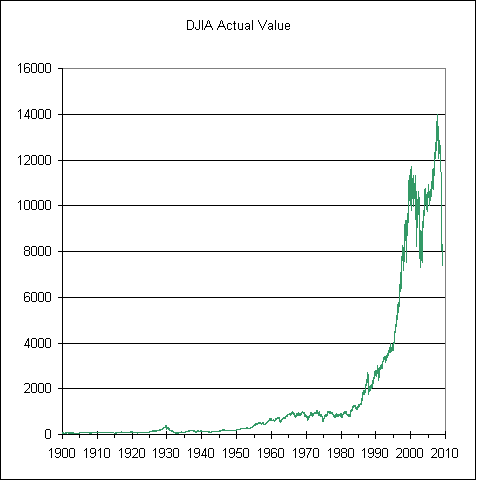
I was playing around with some data analysis here at work, and decided that I’d try to do a little log transform on some stock market data. Generally, you expect the market to increase exponentially over the long term. This leads to some pretty big numbers after some time, so a chart looks something* like this:

DJIA over 100 years

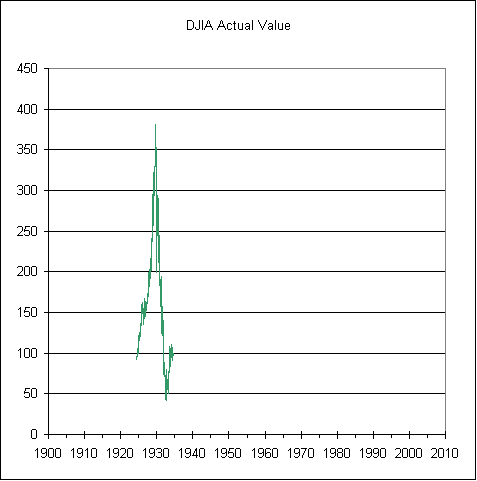
It’s an impressive chart, however the thing about exponential growth is that after a century we’re dealing with some very large numbers. In fact, the last few decades seem to dominate the chart: the recent market crash and the tech issues in the 2000’s appear, on that chart, to be way worse than the great depression, which looks like a small blip in the 30’s down in the bottom of the range. We could of course zoom in on that region:

DJIA focus on 1925-1934

Showing that there was a big nasty swing in there.

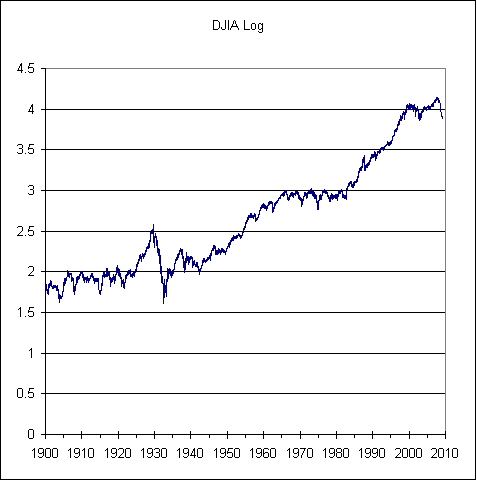
So one way to better look at data over the real long term like this is to do a log transform (in this case, I chose base 10). That takes an exponential growth curve and makes it linear. Now instead of being dollar value up the y-axis, we now have powers of 10.

Log (base 10) transformation of DJIA, 100 years

This is a different way to view the data. To my eye, the long-term trends seem to stick out more, and the current crisis can be put into perspective with past issues. The stock market crash of the 30’s, from about 380 to 41 was a fall of almost 90%, or about a drop of one power of ten, which would be 1 unit on the logarithmic scale. Right now we’re down about 50%, or 0.3 on the log scale.

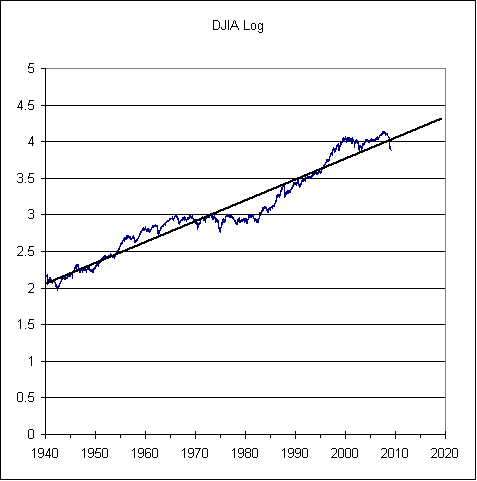
I like looking at the log plot, because it shows that over the span of multiple decades that there is some consistency to the stock market going up, and that while this recent disappointment is crushing (down another 3+% today!) it’s not totally unprecedented. It also helps restore my sanity after reading some extreme bears who point to that 100-year chart and say that the world went crazy in 1985 and everything that happened after that was crazy and volatile and that if we fit a line to the rest we’d be back down to 2000-4000 and that’s where the Dow is heading! Of course that’s really just an artifact of the magnification of exponential growth — you can’t fit a linear trend to an exponential curve (ok, for small values you can, which is exactly the error they’re making!). If you want to draw a straight line, then you should work from the log plot. While I don’t put too much faith in chart divination, I think I might have this one printed off:

DJIA 1940-present with trendline

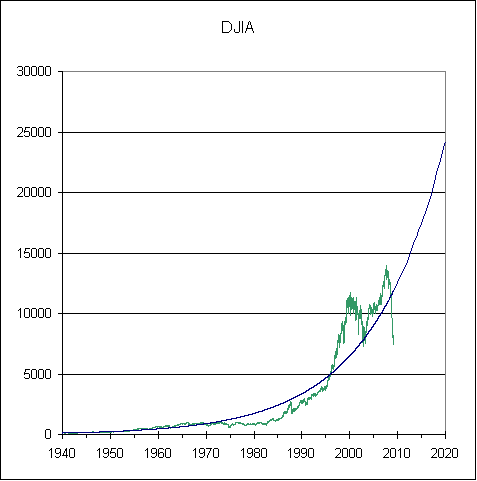
The market can underperform for a long time (the market can stay irrational longer than you can stay solvent, as the saying goes), but with a timespan of 20-30 years (when I’ll be 50-60) it should come back to that long-term trend. It doesn’t help me figure out when we’ll bottom, or when we’ll get back up, or even for sure if that’s an accurate projection of what will happen in the future, but it will help me sleep better knowing that essentially all of my net worth is subject to the whims of the market. For the curious, here’s what that same trendline looks like on the untransformed data:

DJIA with exponential trendline

Exponential growth is everywhere in nature, but I bet at least half of you are shaking your heads at that 25,000 by 2020 extrapolation! It’s just so hard to wrap your head around numbers that large, though that would only be a ~6% return per year from the peak (about 11% per year from where we are now).

* – Note, I was getting some Y2K errors with the data I have (starting from 1900 — I just did a Google search for DJIA historical data and took the first one), I think I fixed it up, but might have made some mistakes. Feel free to fix if you like. To improve on this analysis you can include dividends, inflation, and compare multiple countries (I doubt things would look as good in Japan, for example) or run a monte carlo with sample portfolios to get some confidence intervals. These are left as exercises for the reader.

Also, for those on the RSS feed, the images may not come through. Try viewing in your web browser.