The RRSP Home Buyer’s Plan

August 12th, 2026 by Potato

The RRSP is the most misunderstood tax shelter in Canada. It holds pre-tax money, which is not intuitive to think about at all. So when it comes to the Home Buyer’s Plan (HBP), there’s similarly a lot of conflicting articles out there that don’t quite analyze the options right.

First off, what is it? The Home Buyer’s Plan is a relief valve for RRSP investments, and an incentive for first-time home buyers: a first-time buyer can take up to $60,000 out of their RRSP when buying a house (presumably for the down payment but the funds can be used for anything — moving costs, furniture, renovations, just sticking in your savings account, the key test is that you bought a home, not specifically which dollar did which job). That relief valve means that people who aren’t sure if they should be saving for retirement or for a first house can utilize their RRSP for saving/investing, and still get a decent chunk of the money back out later if they end up buying a place. Then if you do take the money out of the RRSP, you have to put it back in over the course of 15 years, with a little delay (2 years) before you have to start. If you fail to make the repayments, the amount gets added to your income and you lose the RRSP room, just as though you had made an RRSP withdrawal in the year you skipped the repayment.

The FHSA is hands-down better in every way, but has limited contribution room, so a new buyer will likely have both a FHSA as well as some RRSP contributions made. And fortunately, you can use both.

Now if you’re cutting it close on having the funds for a downpayment, the HBP is a nice little incentive: because it’s pre-tax money, with a bit of planning ahead (you have to have had the funds in your RRSP for at least 90 days), you can take your downpayment savings, throw it in an RRSP, get your tax refund, then use both the original after-tax amount and the refund for a downpayment.

What if you don’t need that tax refund/pre-tax aspect to get more scraped together for your downpayment? That’s where it gets tricky: you’ll find articles describing the HBP as “an interest-free loan to yourself” (ignoring the opportunity cost of investing in your RRSP), or “like earning your mortgage rate in your RRSP”, which actually sounds worse than leaving it in and investing in equities. You may also see some comments saying if you don’t need it, don’t bother: if you’re going to have investments left over, wouldn’t you rather have investments in your tax shelter than out of it? And it’s never clear if these are the correct framings, or if someone is forgetting about the pre-tax nature of RRSPs, or just saying things to fill the silence.

So, let’s set up the analysis: you’ve been renting and investing the difference for over a decade, so have plenty saved up to put down on the house. If you don’t need that pre-tax boost to meet your desired down payment, does it make sense to use the HBP anyway? You need to figure out where to source the last $60,000 of downpayment (or land transfer tax, or pre-move-in-renos, whatever): from your non-registered, TFSA, or RRSP? Let’s put $60,000 (nominal) in each, and see how things work out for a simple model.

From our asset location breakthrough we should recall: the RRSP holds pre-tax money, so $60,000 coming from there is equivalent to less being taken from a non-registered or TFSA account. We should see this fall out when we calculate out the impacts. So this should work out best by taking advantage of the HBP. But that HBP also comes with a pesky repayment requirement and up-front paperwork and sitting on hold with your brokerage. Will it be worth the hassle and brainsweat?

Here are our three scenarios: take from the non-registered account; take from the TFSA; take from the RRSP-HBP. In each case, we’ll have 1/15th of the withdrawn amount ($4000) each year as cashflow to put into the account that was used (ignoring the grace period). In our tax shelters, our investments will increase at 6%. In our non-registered account, the tax rate will be 15% (i.e., a 30% tax bracket but with investments taxed at half the rate), for a 5.1% after-tax growth rate. In our RRSP, at the end of 15 years we’ll withdraw it and pay tax at 30% to get everything in after-tax dollars. I put everything in a Google sheet so you can follow along (no it’s not publicly editable — download a copy for yourself if you want to play with your own numbers).

1: Use the RRSP HBP

We pull the $60,000 out of the RRSP. The $60k in each of the non-registered and TFSAs keep growing. After 15 years, we have: The TFSA amount grew to $143,793. The non-reg, thanks to tax drag, grew to a just $126,530. The RRSP growth and slow rebuild over 15 years led to $93,104 pre-tax, but melting that down to make everything in after-tax dollars leaves us with $65,173. In total, the net worth at the end was $335,496.

2: Use the non-registered account

We use $60,000 of non-registered funds, leaving our tax shelters alone. The RRSP and TFSA each grow to $143,793 nominal (as the TFSA did before, good sanity check), but after melting down the RRSP was $100,655 after tax. Meanwhile the non-registered grew to $86,967. That leaves the total net worth for this case at $331,416.

3: Use the TFSA

Come on, you knew this was going to be the worst option — that logic of “if you have investments left over, wouldn’t you want them to be sheltered” is much more straightforward here. The re-built TFSA is worth just $93,104 at the end, with the other accounts that’s a final net worth of just $320,289.

Conclusion:

The HBP is useful for people who don’t have enough funds available for their downpayment: they can use pre-tax money for a little boost. Even if you do have enough, using pre-tax money and letting your after-tax non-registered investments grow does have an advantage: with fairly reasonable assumptions, about $4080 of future (i.e. 16 years from now) value — at that same rate of return, about $1850 of present day value. Now that is nothing to sneeze at, but for someone in the harried stress of buying a house, is that worth the headache of all the HBP paperwork and then repayment schedule? (Actually, yeah, it’s not that much work and not often you can get almost two grand just from tax optimization).

The (future) value of the HBP changes a bit as the assumed rate of return and tax rate change.
Rate of return 4%: $2885 and Tax rate 50%: $5101
Rate of return 5%: $3525 and Tax rate 50%: $6392
Rate of return 6%: $4080 and Tax rate 50%: $7636
Rate of return 7%: $4511 and Tax rate 50%: $8796
Rate of return 8%: $4774 and Tax rate 50%: $9829

But it’s always enough that the headache is likely worth it.

Not modelled: what happens if your tax rate changes over time.

Bonus:

What if you don’t invest in equities, and instead your non-registered is in bonds/GICs at your full tax rate? Then the HBP actually works against you: the tax drag on your non-registered account is too much for the pre-tax bonus of pulling the RRSP funds out to overcome, and you’re better off not using the HBP. So if you’re not going to invest the money (or use it on the house), don’t do it!

Rent-vs-Buy: Winner Winner, Chicken Dinner

August 10th, 2026 by Potato

In 2011 I refined my ranting about high house prices and released the rent-vs-buy calculator, helping people to model the complex moving parts of comparing owning to renting: both have unrecoverable costs, both have cashflow needs, both have ways of building equity. A few key innovations were that it allowed someone to model what might happen if interest rates re-normalized, and it explicitly estimated the cashflow and net worth differences so people could see the counterfactual: how much equity a renter could build up in the stock market by investing instead of buying a house.

Moreover, at the end of 2011 I faced the same decision point myself: after finishing grad school, I was moving back to Toronto, with a baby on the way. Were we going to hold our noses, buy an over-priced, under-sized place… or rent? In addition to the advantageous financial projections, the choice to rent had a few other key pros. One is that renting being cheaper meant we could afford a larger home: instead of trying to make a cramped condo or townhouse work, or driving ’til we qualified (which would have taken us right back to the L-dot), we managed to get a lovely 3-bedroom detached house walking distance from the subway (well, Line 4, but a subway nonetheless). It would also make the path to upgrading a bit easier if we had a second kid: we could focus on the house size we needed now rather than try to jump straight to a “forever home”. Though we put in a lot of analysis, it was all a bit moot: at the time of the move, I didn’t actually have a grown-up job yet. I was still a post-doc, making subsistence wages, hoping to find a job after landing in Toronto; Wayfare was self-employed, with all the complications that brings to getting a mortgage. So we never really had the option of buying a house, as we would have never qualified to borrow the insane amount of money one cost at the time.

So we rented, had Blueberry, and had relatively secure tenancy: it was 11 years before the dreaded notice came. But the notice to vacate came nonetheless, and one of the risks of renting reared its ugly head: we were forced to move. The timing was bad but not the worst: it was the summer between grade 5 and 6 for Blueberry, so she was moving schools anyway. But it was the summer: we only had a couple of weeks to find and secure a new place to get her registered in her new school, or risk having to up-end her partway through the school year. It was a sucky, stressful experience, but we did secure a new place on the last day before registration.

Over those 11 years, Toronto real estate went from pricey through ludicrous right into plaid1. Back in the early days of the debate, I used to say how crazy the bulls’ projections were: 6 or 7% appreciation per year was going to make it so the average house was over a million dollars in short order. A million! For a regular house you still had to commute an hour to downtown from! That was so much money to spend on a house. And it actually came to pass and people just normalized it and accepted it (and many even cheered it), and even in hindsight it seems crazy to me that this is the timeline we’re on.

Anyway, two years before we got notice to move, I did a ten-year check-in: Rent vs Buy: So How’d That Work Out for You? where we found out that after a decade, someone who chose to buy in Toronto came out ahead of someone who chose to rent. It was a lot closer than people who don’t do the math think: when a house goes from $750k to $1.4M, nearly doubling in a decade, it’s pretty easy to mistakenly think the homeowner was ahead by almost $650k (or more as many a person who has never mathed it out will be quick to chime in, “’cause the renter paid all that rent with “nothing to show for it””). But renting was cheaper from day 1, so there was cashflow for the renter to invest, alongside the downpayment. Rents increased in the city, accelerating around that time (and going ballistic in 2022 and 2023, then settling back down lately), but not actually that far off the predictions we started from (though condos and anything that could be converted to hotel rooms or rooming houses experiencing much worse rent inflation for a while, now outright deflation in the correction). A key point though is the stock market also had a hell of a decade with all that ZIRP money floating around. So while the buyer did come out ahead, at what in hindsight was just about the peak of the market, it was “only” by about half the headline house price appreciation: a hair over $350k.

So 2023 comes around, and we have to make the decision again thanks to that dreaded N12. Rents had a pop in 2022/2023, but house prices are just cresting the top, while interest rates are high. Again, buying a house is not in the cards — with the rates (nearly 6% in 2023!) and the stress test, we’d never qualify, even with hefty down payments from all that saving-and-investing the difference. The math says renting is expected to do better, and we want a detached house again regardless, so renting is the easy choice.

Here we are in 2026, and after just 3 years we are once again getting the heave-ho from the landlord: risk acknowledged a priori still sucks when it’s realized post hoc. But it’s a good time to check in: how’d that rent-vs-buy decision work out in the end?

Ben Felix has a video out called The Reckoning where he looks at the results using aggregate data across a number of metros up to 2025. But how did it actually work out specifically for a Toronto family-sized detached house?

Terrific, as it turns out. While things looked a little depressing in 2021, it has been all good news for the renting crowd since then. The stock market continued to go up: a basket of index funds is up roughly 80% over that time. House prices have come back down a hair: the $1.4M house at the peak is now about $1.3M. Aggregate stats for the city show more of a decline, but shoebox condos have been hit harder than suburban detached houses, and places like Brampton hit harder than North York or Markham, so for us in the north-east end of the GTA, it’s more of a slight decline/flatline than an outright market crash… this pocket also didn’t accelerate as badly in 2021/2022 in the first place.

But as I’ve said all along, The Big MisunderstandingTM is that prices had to crash for renters to come out ahead. They don’t. They just had to stop going up like crazy. Indeed, right from the very start the rent-vs-buy calculator said if you used sane assumptions for house price appreciation, renting would come out ahead. If you tweaked the numbers to see what buyers were implicitly assuming to make them choose to buy over renting, they were baking in roughly 6%/yr appreciation — forever. It was astounding that they got 6%/yr for so long (and more in some years!), but now a few years of zeros following that growth has brought the average long-term growth to closer to 3.5%/yr.

Over the 5 years since 2021, the owner paid off a bit more of the mortgage to build some equity… but lost $100k to the slight decline in market value. Meanwhile, the renter had more cashflow to work with because the owner was shelling out more for interest. Oh, and that spike of inflation also hit their property taxes. And insurance. The big thing helping the renter though is the stock market being up roughly 80%. The stock portfolio alone made something like $550k2 for the renter, dwarfing the cashflow differences. The renter has rocketed from behind, and can now buy that now-$1.3M house with just a 5-figure mortgage3 if they so choose, while the owner is still looking at a mortgage balance of $260k, and another $65k or so of transaction costs if they also have to move.

Factoring everything4 in (yes, including taxes on the investment gains), over the full 15 years, the renters are ahead by a little over $100k… pretty much exactly as originally forecasted (though the path to get there was absolutely nothing like that initial best guess at all the factors).

After a decade and a half of trying to approach housing rationally, and having a lot of internet (and in-person) arguments, and having so, so many smug home buyers quote the appreciation of the Toronto market, I’m happy to say: Winner Winner, Chicken Dinner. The rational choice to rent has indeed worked out post hoc5. I will try to be restrained with my told-you-sos.

To compare to Ben’s broader results, he presents it as a “wealth ratio”, which for Toronto was 1.37 in favour of the renter. That understates things: if the house price rocketed to $1.3M, with $1M of equity, that would imply the renter is $370k ahead, with a net worth of $1.37M (so our idiosyncratic results were worse, a wealth ratio of “just” 1.1, but house prices in North York/Markham have held up much better than those in the GTA aggregate). I think Ben really under-sold how impactful his results were with that table — those little decimals hide some pretty large effects and differences, especially with such high house prices. He’s also using a different period (25 years vs 15), though prices largely weren’t that expensive in 2005 so it’s amazing to see renters come out ahead at all in his example.

Anyway, there were of course some non-financial trade-offs. On the pro side, we didn’t have to worry about major house maintenance. When the ice storm hit and the pipes burst after the 7-day power outage, it was the landlord’s duty to fix it. I never had to call up a bunch of professionals, try to get a quote, then send 30 separate interac e-transfers for the job (which I’ve had to do to help my mom…). For a long part of our tenure, we didn’t even have to mow the lawn. Our cashflow needs were lower, so when Wayfare got sick we could still afford the house on one income (and weren’t facing a forced move/downsize on top of recovering from a rare disease). Those lower cashflow requirements also offered us the option of spending some of that surplus by getting a nice, fully detached house in a nice neighbourhood, which we never could have afforded if we bought. On the con side, there’s security of tenure: moving sucks. Moving because someone else is making you double sucks. Moving on a tight timeline because someone else is making you less than a month before school starts sucks triple. {scott_pilgrim_this_sucks.gif}

Framing it as a compensated risk makes it a little easier to handle. As much as moving sucked, and as much as I’m hating the search for a new place (esp. constrained to the same school district) and as much as I’m dreading the next move… we’re financially better off to the tune of $100k just for choosing to rent. Back then, $100k was considered a lot of money (now it’s just the extra a realtor will try to convince a buyer to throw at a place in a bidding war, barely a rounding error on today’s house prices). Outside the context of house prices, it’s still a lot of money. Moving was weeks of effort: nearly every moment outside of work was spent packing, tidying, shuffling things between houses, cleaning, unpacking, updating mailing addresses, updating bill payments… But for $100k ($50k/move), that’s the best-paid job I’ve ever had.

So to sum up, renting and investing the difference did leave a person in Toronto better off than holding their nose and buying. Prices are still way above where they started in 2011, but didn’t keep going at that white-hot 6-7%/yr rate, and with a bit of a correction ended up averaging out to just 3.5%/yr — only a hair higher than the long-term average assumption we started with. The stock market did amazeballs, and rents continued to take less cashflow than owning. As much as the big shift from being behind in the check-in 5 years ago to being ahead now was surprising, I’m really surprised this real estate market is still going: a tiny little correction, and no reckoning yet for the cap rates. After how far ahead the owners were in 2021, I’m shocked the scales flipped with just a soft landing. Zero blood in the streets and practically no industry bankruptcies.

Of course as nice as the vindication is, it’s highly bittersweet when sitting here with another N12 in our hands.

Still, let’s end the post on a high note: winner winner, chicken dinner! All the math and logic did eventually pan out!

1. I hate — hate — how Musk has tainted a perfectly good Spaceballs reference.
2. I had a fudge factor in there to account for paying taxes on the gains along the way, as some would be in a TFSA/RRSP/FHSA, some in a non-registered, but the gains are getting large enough that rough estimate likely isn’t enough, so maybe just $500k after tax.
3. Ok, a good chunk is tied up in RRSPs, so they’d need a larger mortgage in reality to actually buy a place.
4. And a rough penalty of a bit over ten thousand dollars in moving costs, but not accounting for the psychological toll of moving — that’s what we’re comparing the moving costs to.
5. I mean, whether the decision was good or not should be judged based on what was known when it was made, not the post hoc result, but after being a very, very tiny minority voice in an onslaught of housing bullishness, it’s very nice to have the post hoc result.

Real Estate Bear Spring

June 13th, 2022 by Potato

This spring looks like real estate prices are coming off the boil. People seem to be wondering if prices could possibly go down despite years of bulls and the FOMO crowd saying that it only ever goes up.

There have also been more people wondering about housing bears. “Remember housing bears? Didn’t they once say that housing could possibly go down in the future? Is this what ‘down’ is?” And of course the big one “So how bad could this get?” As us long-time housing bears come out of hibernation this spring, perhaps it’s worth a long (and snarky) review of the thesis.

A Low Growl

There are lots of ways to determine what a house is “worth” or what it “should” be priced at. You can look at historical relationships between incomes and debt and house prices, but that’s all very high-level stuff, and hard to apply to one specific house that you want to live in. The argument that has always resonated best for me is that a house is primarily a place to live, and shelter is also one of life’s greatest expenses, so it’s worth looking at all your options. Renting your shelter or buying it are the alternatives available.

So we can examine the relative costs between renting and buying, and I made a spreadsheet and a whole series of posts to do that and others made rules-of-thumb and YouTube videos. And basically house prices had gotten so expensive relative to rents that it looked like you were better off renting, and the only way buying would possibly come out ahead is if already-expensive housing became even more expensive at a very high clip and even then you needed cheap leverage.

Well, we got skyrocketing prices and cheap leverage, so people who bought anyway look like they came out ahead (for now). But it didn’t have to turn out that way, and the question is always how much further can those trends go before something breaks? The bigger the price:rent ratio gets, the harder it is to fix it through anything other than a housing crash (assuming of course, that these fundamentals matter at all).

But if doing a price-to-rent comparison is so easy anyone with a physics degree and insomnia can do it, why did prices get so detached from fundamentals in the first place?

Models of the World

The market is far from monolithic: there are many players in it. Not just buyers, sellers, and agents, but buyers with different pricing models at work – people are playing the game with different rules. We can build a thought experiment with different agents (agents in the sense of actors in a model, not the people whose job it is to sling houses) using different strategies and approaches, and how prices might change.

A decade ago we talked about supply and demand, and how speculative demand works: in a textbook economics market, as the price increases, fewer buyers demand the thing the textbook is discussing. Even if they disagree on the assumptions and arrive at different estimates of fair value, people who use a rent-vs-buy framework will, all else being equal, start to drop out of the market as the price gets too high, and choose to rent instead. But with speculative demand, you don’t get that: high prices beget high price expectations, which helps bring in new buyers to replace (or even exceed) those who got priced out.

So that’s one of our groups of buyers and their pricing models: prices going up is good, because they’ll continue to go up, so pay whatever you need to today as you’ll only be richer in the future. This group is what we’ll call the FOMO-MOMO group: fear of missing out/momentum. They expect that as prices go up, they will continue to go up. And the faster they go up and the closer housing gets to completely unaffordable, the more they will pull demand forward and buy more because they are more and more afraid of missing out or getting priced out (e.g., those stories of people buying places for their children). Their pricing model is basically to look at the last comparable price, see how many people show up for the bidding war, and add $10k for every nose on top of the last price.

It can have big positive-feedback cycles, as prices going up makes them feel wealthier, and feel more certain in their worldview, and gives them easier access to credit. A subset of them buy more and more properties: as the first purchase works out and goes up, they build equity, which they can drain with a refinance to buy another place, and another, helping to propel the market upward while adding leverage and fragility to the structure.

The bear case is of course that this is insanity, but we’ll get to that.

The next class of buyers are the ones who just want a place to live, but who skip step zero (i.e., the rent-vs-buy analysis). So they are only looking to buy, and they’re just simply going to go into the market at some pre-determined time point (say on their 30th birthdays for the sake of modelling) and buy as much as they possibly can (AMAP). They don’t care too much about what the price of housing is doing – up, down, or sideways – they just borrow as much as they are able and buy as much house as possible. Their only limit is their ability to service the debt used to finance the purchase and things like a stress test that affect their buying power.

Then you have the “rational” buyers (R): those who may want to buy a house, but want to do so at a “fair” price, and will go rent or GTFO if the prices get too extreme. They may use a price:rent or price:income basis, like dinosaurs, but they’re looking to buy without becoming house poor.

So if we have a group of price-insensitive buyers, and even a small supply/demand imbalance, the FOMO-MOMO and AMAP crowd can rapidly drive prices to crazy levels, and drive the R’s completely out of the market – the demand is strongly inelastic from those buyers. In addition to all the speculation about how this was working in Toronto and Vancouver’s run-ups, we saw more natural experiments with this in the pandemic: prices in many small exurb towns doubled with very small increases in the number of price-insensitive buyers hitting the region.

These pricing models used by the currently dominant agents lead to a powerful positive-feedback loop. But what happens when the market finally changes?

Eschatology

As soon as prices stop going up, the momentum buyers may hit pause, creating a reinforcing cycle in the other direction: fewer buyers, putting fear into others, as fewer and fewer believe it’s a dip and start to fear prices won’t be up so much in five years’ time that any price today can be justified. Plus, how do you even set a price if your model is to multiply X by the number of noses in the bidding war and nobody else shows up to bid?

If the FOMO-MOMO crowd disappears, the next marginal buyer is the AMAP, who simply will borrow as much as they can for a house and pay that. With interest rates rising, their ability to borrow is more limited, so prices will have to come down a bit to match their maximum affordability.

So our mental model suggests that the first new equilibrium point would be wherever the new constraint on buying power puts prices.

Take a house that’s currently selling for say $1.5M in Toronto. An AMAP buyer that could afford that place at 2.5% (a mortgage payment of ~$5400/mo) may only be able to pay $1.3M at 4%, or $1.2M at 5%. Not a huge difference, which is what a lot of people are saying now – a slowdown or correction is in the works from interest rate increases, but far from the crash the bears have been crying about that would be needed to restore actual affordability. We’re still in the post-pandemic bump there, and not even negative year-over-year thanks to that massive run-up at the end of 2021/start of 2022.

The true bear case is if the fomo momo crowd steps back, and there aren’t enough price-insensitive AMAP buyers (or their purchasing power is significantly impaired, which may happen for example if they need a down payment from the bank of mom and dad, which is also facing higher financing costs on their HELOC, or interest rates rise even more, or inflation hits all the other line items in the GDS calculation at the same time that interest rates rise) to move the needle. The next marginal buyer is then the “rational” buyer.

And the problem is that the price that the “rational” buyer or investor buyer steps in is far, far below the current prices. That $1.5M (peak) house might rent for $3200/mo, a price:rent of 469X. To get back to say 250X, the price has to come down to $800k – a big air gap below current prices.

So that’s how a crash could play out from too-high prices and a shock that breaks the momentum and psychology. It’s certainly plausible, but is it at all likely?

And that’s the problem with this mental model: it produces some narratives to help explain how we got here, and some potential future paths, and where some reasonable stopping points for bottoms might be (when the monthly payment for AMAPs balances out, when the price:rent gets back to historic norms, etc.). But it doesn’t make any actual predictions about what will happen – there isn’t survey data out there about how many AMAPs are left, for example.

The Turn

Though the market does seems to be turning now, with rising interest rates putting fear into the hearts of the fomo momo crowd, and reducing how much “as much as possible” is for the AMAP crowd – the “every 50 bp reduces the maximum amount you can borrow by X,” etc. articles that you’ve no doubt seen all over.

But wait, there’s more! In the calculation for the debt service ratios is also a line for heating costs. And natural gas has roughly tripled in price over the last few months, which will take another decent chunk ($100/mo or so?) out of the maximum borrowing capacity of buyers.

So in that example of a $1.5M house that an AMAP could reach for at 2.5% going to $1.2M at 5%, add in an extra $100/mo hit on heating costs and now their maximum serviceable price is hit by another $20k.

I see lots of people still saying that there’s no way it could crash though, and there’s a lot of good reason to think that way. The government explicitly said they wouldn’t allow even a 10% correction to happen, and they’ve made plenty of (deliberate?) policy errors to get us into this over-priced mess in the first place. And the market has gone straight up in the face of bear logic for so long that people believe that there must have been a mistake in the logic somewhere. Every time we’ve had a good reason to think a correction was at hand (2012, 2017, 2020), the market has given bears a thrashing and gone right back to resuming its lunar trajectory.

And maybe they’re right. The fundamentals have gotten worse (better if you want high prices): we do also have a supply problem now on top of the demand surge, and we can see it in rents that have gone up above the rate of inflation (esp. for product that makes for a good [illegal] AirBnB). However, the increase in rents isn’t even in the same solar system as the increase in prices. So the floor has been raised… but it’s still a long way down.

And the demand is still high: for all the demand that has been pulled forward, there are plenty of Canadians and newcomers who want to own, they’re simply priced out. Maybe there are hordes of would-be buyers on the sidelines who will come rushing in to buy on any weakness, and this will only be a gully, not a crash. But at what price can those priced-out hordes come in? If they are themselves AMAPs who were priced out, then prices need to drop enough that even with higher rates and heating costs that they can service the debt again (I am very carefully avoiding the word “afford”), so we’d need to see prices fall by at least 25-30%.

Six Impossible Things Before Breakfast

Through the years, many people have acknowledged how expensive Canada’s housing markets have become, but say that a crash is impossible for reasons.

Back in the day when Alberta was even bubblier than Toronto, people said Toronto could crash, but no way Calgary would because its house prices were supported by the oil industry, and demand for oil wasn’t going anywhere. Just a few years later, the price of oil crashed, though miraculously Alberta experienced a soft landing rather than a crash. Record-low interest rates (which drove Vancouver and Toronto to new heights as they stabilized Alberta) likely helped a lot with that feat.

In Toronto, interest rates have been one of the key impossible things supporting the market: people can afford the payments to keep the market elevated as long as interest rates stay low. And far past the crisis days of 2008, emergency rates stayed with us, and even went lower and lower. It didn’t seem like the BoC was ever going to raise rates, and there are only so many years financial pundits can warn people that rates will eventually go back up before buyers tune the warning out and just go hog wild on debt. Even as inflation started to rage at the end of 2021 and beginning of 2022, the BoC stood its cowardly ground, and bulls became even more emboldened in their call that rates would never go up.

And besides, the argument went, “theycouldn’t raise rates: we’re too indebted as a society, higher rates would crash prices and cause a recession, and they would never do anything to endanger house prices.

Well, it looks like we’re in for some rising rates. [Ed. note: since the first draft of this post and the enormous amount of time it took me to hit publish, the BoC has raised rates 100 bp in two 50-bp steps after the first cowardly 25 bp hike in March] And if the argument was that rates couldn’t rise because house prices would fall… I guess house prices are going to fall then?

When markets get badly distorted, but the most obvious corrective force is “impossible”, well, impossible things seem to happen all the time to break theses in nasty ways. Many people seem to be learning the hard way that real estate prices can go down, and rates can go up.

The Big Misunderstanding

One other common sentiment out there is that “bears were wrong and so will always be wrong. Even with rising rates and a correction, house prices will never go back to 2011 levels so bears have lost! Don’t listen to bears!” And this sentiment is either an attempt to show a brave face as a bull, or a deep misunderstanding of the rent-vs-buy math that we’ve been talking about for that decade.

If you were in Toronto in 2011 and decided to rent when the price:rent was 300X, the bulls were (so far), right post hoc and had a faster increase in net worth… if they were sufficiently levered (and sell and go rent now to lock in that gain). But check that spreadsheet again: the base case for renting was that you would be ~$100k ahead (back then six figures was a lot of money and not just a kicker to win a bidding war) assuming historical ~3% increases in real estate. Bears don’t need prices to go back down to nominally what they were (though we do need a correction to pull ahead post-hoc), as the difference in monthly cashflows and investments can close the gap. Indeed, at various points along the way the price:rent got so disjointed that you needed a 6%/yr increase in house prices forever just to keep pace with the renter. The last decade saw closer to 7%/yr in Toronto, so those who bought have done well for themselves… but how much longer can that rate of appreciation keep up?

Someone who passed on a $700k house in Toronto to rent and invest the difference does not need house prices to crash below $700k to come out ahead – they just need prices to come back to ~$1.2M by 2024 to win in the post hoc comparison. Yes, that will still require a correction from here, but the delta is not nearly as big as those who just want to say being early is the same as being wrong want to paint it as. If you did make the “disastrous” choice to rent, you’re not nearly as far behind as all that.

How Far Down?

A common question I see directed at bears now that people remember that we exist is how far would it have to drop before you’d buy? I’ve been quite happy renting here, and the LL doesn’t seem to be in any hurry to throw us out. Even though it would only take a ~30% correction from the peak to end up ahead (and prices are already down ~10%), I’m not sure that I would be buying there – the price:rent would still be pretty elevated at that point, and we have to be forward-looking with our decisions.

There is a kernel of truth to all that stuff people say about not perfectly timing the market and all that, so I wouldn’t be trying to pick the bottom once we get back into range of some semblance of a fair value. But even at 30% off, unless rents also spike, we’re still talking about very elevated price:rent levels around here. There’s no way to know if the R’s in our mental model will ever become the marginal buyer again, but for doomcasting, that would mean prices dropping something like 45% from the spring 2022 peak.
Housing Bubble Harms

August 27th, 2021 by Potato

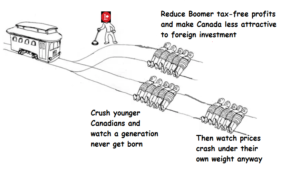
Adam Vaughan made himself the face of government callousness and inaction earlier this year[0]. It started with an appearance on TVO’s the Agenda, where when talking about what the government should do about housing, he said “We’re in a safe market for foreign investment but we’re not in a great market for Canadians looking for choices around housing.” Which wasn’t news to a lot of people, but it was news that the government knew and was choosing to do nothing rather than just being incompetent and unaware.

He then continued to say (and followed it up and in various Twitter battles) that the government would not do anything if it meant risking even a 10% decline in house prices — which in the context of the time (over 20%/yr increases, and not just in the big cities) would have been rolling prices back just a few months. But even that was too much for them.

In other words, he said the quiet part loud. And now we all know that they know, and that they don’t care.

He’s tried to make the case that housing prices falling is bad, as have others throughout this decade+ run-up in house prices. People don’t like seeing their biggest asset fall in value, and recent buyers could be underwater and financially stressed. If it gets rolling, it might lead to a recession.

And sure, it’s pretty obvious that if we have a housing crash, it would have many negative effects. The problem is, high prices also have negative effects, and there’s a chance prices will fall anyway in the future, and inaction just delays and exacerbates that.

Why Housing Bubbles are Bad

A housing crash and its associated harms is hard to miss, but the harms of a bubble are more subtle and insidious, but just as bad for society.

Bad? The wealth effect? Our cities becoming “world-class”? These are bad things? Well, those aren’t the only side effects of a housing bubble.

There are much more serious effects on people’s lives. There’s rising inequality, though that’s just part of it.

Housing is the biggest cost in most family’s budgets, and for young people that can be by a huge amount[1]. When housing gets more expensive, they feel the squeeze: literally, if they have to settle for being under-housed to make ends meet. That has real-world consequences.

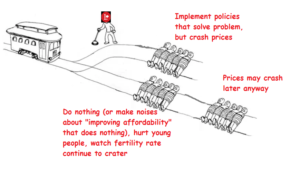
I can write about the rent-vs-buy decision and raising a kid in a rental all I want, many people out there still want to put off starting families until they can buy sufficient housing for a family. The frenzied speculation makes rentals less secure even if rents themselves have lagged price appreciation. With higher prices (and rapidly rising prices), buying is harder — much harder — and young families have to settle for less space, and delay their purchases to save up. That means they put off having kids longer, and having fewer when they do. Toronto’s fertility rate dropped 16% in the last decade[2]. If anything else had caused our fertility rate to drop that much in just a decade (in the face of millennial demographics that we might have expected an increased fertility rate from) we would be rioting in the streets for the government to do something, holding up signs about the missing 10,000 babies. We’d be banning chemicals, exterminating mosquito vectors, or adding fertility treatments to OHIP coverage. But when it’s economic: crickets. Housing insecurity and microcondos are just the way of life here in a world-class city, and a few thousand unconceived babies are acceptable collateral damage for muh price growth.

Mike Moffat has also pointed out Toronto’s troublesome population movement patterns: the largest cohort of people leaving the city are newborns (followed by other young children and those in the parents of young children age bracket) — so even when a kid is born here, there’s a good chance its family promptly leaves.

Lower interest rates (that somehow keep going lower) have helped support housing prices: mortgage payments have not increased as much as prices. But they have gone up quite a bit, and even if more and more of that payment goes toward principal, the principal still has to be paid back. 10 years ago, a $775k average detached house required that, at some point, you paid back $775k. Spread evenly over 25 years, that’s $31k/yr. A big chunk of a couple’s after-tax income, but doable if you were pulling in $100-120k combined (and a monthly payment including interest of $3.1k). At $1.7M, that’s $68k/yr to pay it off in 25 years, which doesn’t leave much else for having kids or supporting the economy (and the monthly is up to $5.4k at lower interest rates).

This is a big black hole for the velocity of money: more and more of our salaries are going to paying for our houses. That’s money that isn’t circulating back through the economy, or investing in something productive. Wouldn’t we be better off with lower house prices, and more of our disposable income going to services, innovation, transitioning to a low-carbon economy, charities, etc., instead of having housing sucking up all the cash flow?

In conclusion, while a crash can be harmful, high (and rapidly rising) house prices also have harms. So far the government has made it clear which set of harms they see and care about.

Election Time

A federal election has been called, and more and more people are saying that housing is a big issue for them. Each party has come out with an ineffectual do-nothing housing plan, and not one has acknowledged the elephant in the room: that a solution must allow at least the risk that house prices will drop. The cure to affordability is not to create more loan programs and tax breaks to help people pay higher and higher prices for housing[3] — it’s to get prices lower.

The first step is admitting that there is a problem[4]. I’m a left-leaning voter — often ABC — and while there are a lot of issues I care about (science funding, the environment, electoral reform, etc.), man, at this point I would vote PC if they actually came out with a housing plan that was willing to actually address prices and affordability.

[0] And stealing that crown from DoFo in a pandemic was quite the achievement.

[1] Though for the wealthy who haven’t read my book, investment fees may edge out housing.

[2] And that’s before the effect of the pandemic and lockdowns, which looks to have created its own “baby bust”. Also, other cities did have birth rate declines over the last decade too, though they were lagging Toronto’s — Calgary and Halifax had held steady through to 2016 (which would be about 9 months after Alberta’s oil bust started) and then a step down; London had a small decline in 2016, which was then exacerbated in 2018, while Toronto just heads down and down the whole decade.

[3] which in a tight market just gives people more money to bid which drives prices up further — many of the proposed programs are counter-productive that way.

[4] Update: Rob Carrick had a similar take here (and he got around to hitting publish first while I was dicking around in MS Paint). “Only a major price reversal can restore mass affordability and the federal parties won’t touch policies that would make this happen.”

Rent vs Buy: So How’d That Work Out for You?

August 10th, 2021 by Potato

It was 10 years ago that I finished my PhD and started looking for a new place to live. I went deep, deep down the analysis rabbit hole, eventually emerging with my rent-vs-buy spreadsheet. At the time, we decided to rent: the housing market in Toronto was already at a price-to-rent ratio of over 300X, and using a bunch of very reasonable assumptions, renting looked like the much smarter move.

Well, now it’s 10 years later. How’d that all work out?

The housing market (esp. in Toronto) performed very well over the last decade. That was unexpected: the market was already expensive on a price:rent and price:income basis in 2011, and it just simply got more expensive — incomes have not surged ahead in the city, nor have rents. Yet prices have been on an absolute tear, roughly doubling in that decade.

Back then interest rates were at “emergency” lows, and nearly everyone was warning buyers that they would have to be prepared to renew at higher rates. Reality is stranger than we can imagine though, and instead we find ourselves a decade later with rates even lower. If you predicted that, congratulations, you already have your prize. If you used the best information available at the time and decided to rent instead, then you likely have a constant stream of people looking to dunk on you. “How’d that renting thing work out for you anyway?”

While housing is the national obsession, investments had a hell of a decade, too. Remember in the rent-vs-buy analysis we assumed a 7% rate of return for investments? Well in actuality an aggressive diversified portfolio got over 9% because the stock market also blew the lights out.

So how did those two choices shake out with all things considered then? The answer comes down to leverage: if you had a big pile of money and were looking to buy a place outright, you were better off investing it. A $775k (the price of an average detached house back then) investment in a TD e-series portfolio would grow to become $1.9M, while a house of the same value grew to $1.7M. Without leverage, renting and investing was a toss-up versus buying.

If you use the more realistic scenario of starting with a smaller amount to invest and using that as a downpayment (and getting a mortgage for the rest), then buying a house came out better — thanks, leverage!

To look back we can use the same rent-vs-buy calculator and just adjust a few numbers based on how things played out — higher realized returns for both investing and house price appreciation, lower mortgage rates, lower property taxes, as well as lower rent inflation [1].

Saving the extra cashflow from renting plus investing the downpayment would leave the renter with a portfolio of $820k (remember how expensive housing was compared to rents — it took a lot of cashflow to buy!). But that house appreciation (to $1.7M!) leaves the owner with even more equity. Once you sell both (hit the renter’s portfolio with some capital gains taxes, the owner with some sales commission), the owner is better off by $367k.

That’s… not a small difference.

Findependence Proximity

Here’s the strange thing: in reality I chose to rent, so I can see how much more houses in my neighbourhood are than my portfolio. Yet I don’t feel bad about missing the boat. Part of it is not wanting to engage in resulting. I knew what information I had at the time, I know that I put a tonne of effort into my decision-making and analysis, and made the best decision I could with it at the time. Some people were indeed calling for those high growth rates to continue, and we would do the math and laugh.

“You can’t be serious. At that rate, in a decade an already-expensive bog-standard 3-bedroom detached house would be $1.7M! Who would possibly be able to buy that!” Well, here we are, the Darkest Timeline.

With the incredible stock market returns, the renters now have enough to be able to buy in cash — mortgage-free — the house they were previously renting… if it had only appreciated in-line with inflation. But it didn’t, and instead they’re priced out forever (…ever-ever-ever…).

Yet in a way, they’re better off.

I tend to try to put big numbers into context by thinking about FIRE — how much closer to retirement would $367k [2] put me? On the surface, that much money should be a very meaningful difference in outcomes — years knocked off the time in the science mines. But it’s all locked up in real estate equity in the counterfactual. That’s the funny thing: though they can’t buy a house, that stock market performance means that the renter’s investment portfolio is now roughly large enough to pay their rent indefinitely. A few more years of saving and investing to cover their other needs and they’re on track to retire in their 50’s.

The owner still has 15 years of mortgage payments to make, and then still has to save up enough to be able to pay the other costs of the property (tax, insurance, maintenance) and then find a way to pay for food and all the other necessities of life. Their net wealth is significantly higher, and yet their life goals are much further away.

Unless, of course, they’re willing to sell and realize those gains. But at what point do you do that? If you looked at the market in 2011 and decided to buy anyway, when do you switch tracks and get out? What do you do with all that housing wealth if you don’t sell?

The market has seriously warped the notion of wealth. Ten years ago I was aiming for an early retirement (not extreme FIRE, something like early-to-mid 50’s). Round numbers, $1.5M invested would have been in the ballpark for me to comfortably quit my job and either fully retire or go freelance part-time. Yet these days, that doesn’t even buy a house here.

Resulting and the Next Timestep of the Simulation

Was it a “bad decision” to rent 10 years ago? I don’t think so — based on the information available at the time, it was the right move under most expected future scenarios. The future as it turned out happened to be the darkest timeline: rather than correcting the 300X price:rent, it simply went to an even crazier 470X through massive appreciation. If in 2011 you told me the high rate of growth would continue for another decade, I’d say that seemed laughable, and do the math for you — wouldn’t the average house becoming $1.7M in 2021 seem like a ridiculous outcome? …yet here we are. So no, I don’t think it was a bad decision, just a bad outcome.

Likewise, continuing to rent from here: there is nothing in the short-term data that suggests this market is about to crash. The bulls are firmly in control and the government has explicitly said it’s not going to do anything that might bring prices down. But it doesn’t have to crash for renting to come out ahead — it just has to stop growing at such a ridiculous rate. The price:rent is even more insane, so even with lowered expectations about future stock returns, renting looks like it should come out ahead if the housing market also settles down to inflation-plus-a-bit returns. And maybe in 10 years we’ll laugh at how people thought a two-and-a-half decade bull market would continue into a third and fourth decade, and that an average house would somehow be trading at $4M by 2031. Or maybe we’ll see that become the price and the class divide will be complete.

Now, if you gave me a time machine and said what would be the best move to make in 2011, then sure, buying might be the way to go… but that would be a terrible waste of a time machine. As Ben Felix said it would be even better to use that time machine to go back and rent and then invest the difference + downpayment into Bitcoin.

1. There’s a big suburbia/downtown split here — AirBNB really threw a wrench in the rental market. If your condo approximately resembled a hotel room, the rent went up by more than the 2% assumed inflation, then crashed in 2020, while rents out here in commuterville have gone up less than 2%/yr yet held up through the pandemic.
2. Or whatever scaled but not so very different amount for my actual situation vs. the average house retrospective/counterfactual numbers here.