Supply and Demand

November 9th, 2012 by Potato

You’ve all heard about “supply and demand” even if only as a back-handed excuse given for why something costs so much. It’s pretty basic economics stuff: even a scientist can follow it. As the price of something goes up, suppliers will be willing to sell more product (and will make changes or substitutions to bring that product to market) while consumers will demand less (and find way to substitute other goods for the expensive ones). Graphically, that looks like:
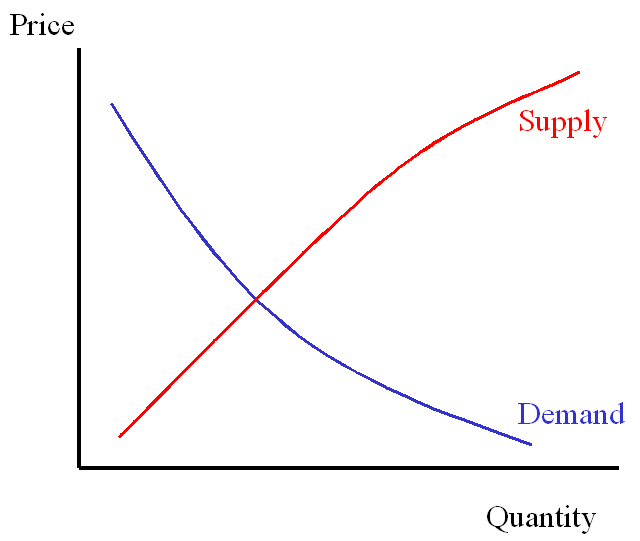
Generic supply and demand curves.

The shape of the supply and demand curves vary depending on exactly what system you’re talking about, but they have that general property of supply moving up and to the right while demand goes down as you move up in price. (Note that economists usually treat price as the independent variable, and thus have their graphs backwards, but let’s leave that alone – the relationship works either way around). Where the lines meet should be your equilibrium: the same quantity coming to market for both the supply and demand side at a certain price point.

You can then do things to those curves to find what the new equilibrium would be. For instance, if the above graph represents the market for potato chips, we could imagine what might happen in a scenario where say Nelson’s chip truck breaks down. With less supply available, the supply curve would slide to the left, and the price would go up while fewer bags of chips were sold.

For housing, the demand curve is very flat: most people go through their lives without ever really analyzing the largest purchase they’ll make (and a again, remember the backwards axes of economists — a “flat” curve is actually nearly vertical). They simply get to a point where they figure they can afford it, and they go out and pay whatever the price is to get a house because that is what one does. There are a small number of people at the fringes who can’t afford to buy as prices go up (giving the slight negative slope through the middle), and prices would have to go down a lot before anyone would consider buying a second house. But through most of the range of typical prices, the quantity of demand is pretty stable.

Supply is a little less flat, but still fairly stable compared to many other markets with more substitution options and more responsive supply sources. Above a certain point and you can keep your construction crews operating profitably so away you go. As prices start to get really high supply can start to really ramp up as people get drawn away from other professions to recover supply from the margins (fixer-uppers) or subdivide existing large single units into multiple smaller ones (as seen not only in condos going up over SFHs, but also in Vancouver row houses).
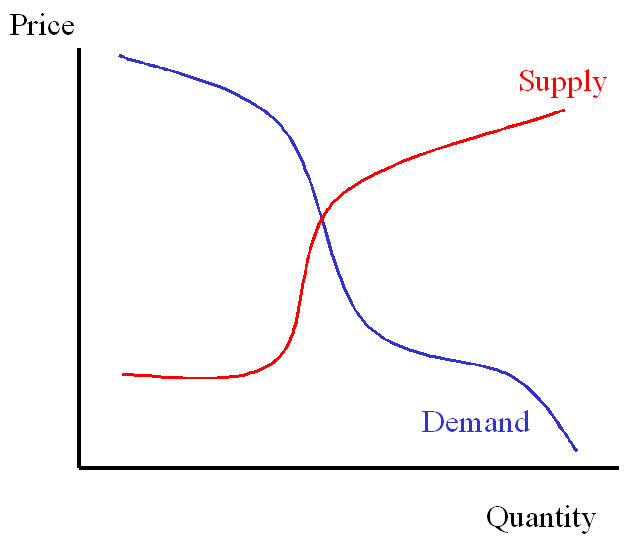
My understanding of supply and demand curves for a normal housing market.

But it’s never this simple in the real world. Supply and demand can be perverse when speculation comes into play. Then you have not just prices versus number of units sold, but also price history as a factor.

If prices were to rise too far too fast, our simple model of supply and demand suggests that more supply should come into play and demand should drop because of the influence of high prices, creating pressure to bring the market back to the equilibrium point. In a mania though, the opposite happens: the price history turns rational buyers and sellers into speculators. Buyers buy more, either borrowing demand from the future in the form of the buyer who’s afraid of being priced out if prices continue to go up, or from speculators buying multiple units with dollar signs in their eyes. Supply is a little more complicated, as it does definitely respond to the higher prices — that’s evidenced in the real-world by the plague of cranes in Toronto and Vancouver slapping together ever taller and smaller condos. But supply also shrinks a bit with strong price history in what’s referred to as “speculative holding” (at least relative to the supply dump we’d otherwise see). With prices on the up-swing, those moving (or moving in together) decide that rather than sell the old place, they’ll hold on to it, sometimes explicitly for investment purposes, but there are anecdotes of those who do it “just in case” even though they would have never considered that holding if price history was less favourable.

So we see that as prices move up, both supply and demand can increase in proximity to each other, feeding the beast ever upwards (no equilibrium restoring pressures), and the whole time it will superficially appear as though supply and demand are in balance.
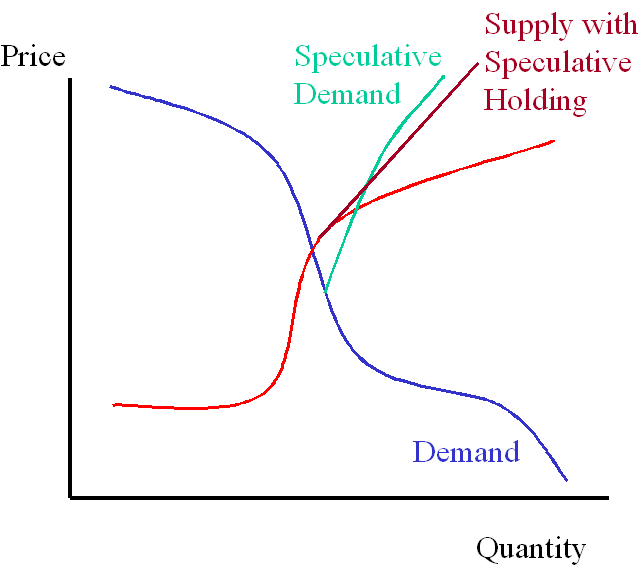
It's hard to show a second-order supply curve that depends not just on price but also on the time derivative of price, at least not without a 3-D graph that no one could read anyway... so imagine that the speculative demand curve is moving up along price and not a pure mathematical relationship.

What happens when prices stop rising at a break-neck pace? When they go down a bit – or even just stop increasing – in the so-called soft landing? In a normal market, the lower prices should bring more buyers out of the woodwork to support the new equilibrium. However if it’s not a normal market, but rather one driven by mania and attention to price history, then declining prices are not seen as cheaper but rather a shattering of the speculative world-view. Instead of finding new support for the equilibrium, the speculation in the market dries up. The demand snaps back to the inherent demand curve (which at the high prices, is a lot less quantity) while the same happens to supply (speculative holdings flood the market and listings go up). Supply and demand are “very suddenly!” far apart and there is a lot of pressure for prices to drop back to the original equilibrium.
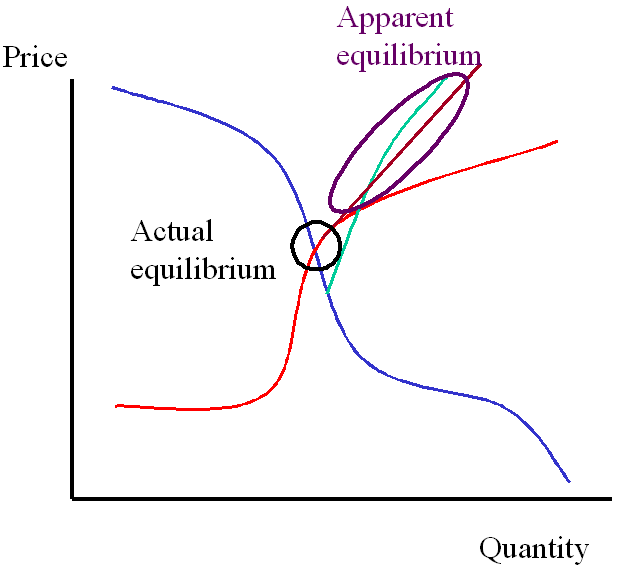
With speculation bringing in more demand as prices rise, while speculative holding reduces the increase we'd expect to see in supply, the market can appear to be in equilibrium the whole time that prices are shooting ever higher -- and ever-further away from the true equilibrium. Once the momentum is gone and the speculation with it, the market at the high prices will find supply and demand very far apart indeed, with a big drop back to a normal equilibrium.

It is my firm belief that the decline in sales volumes seen in Toronto and Vancouver this summer/fall are the first stages of that. {update from the future: this took about a decade and a half more to be realized}

Now, many are saying that sellers won’t accept lower prices, that they will pull their listings rather than sell at a lower price. This is supported by our conventional view of supply-and-demand, and indeed this is what I expect will happen in the short term. But the speculation also affects the sellers. Those with speculative holdings may no longer be quite so enamoured with the land-lording life (or worse yet, the cash-sucking vacant “just in case” condo), so they may sell a bit below the peak (though the early ones will walk away with personal profits). As price momentum turns negative, the thoughts of holding out for better days turn to fear that negative price movements will persist, and panic sets in. Meanwhile, the builders who pulled out all the stops to meet the crazy demand of last year can’t stop on a dime.

There are many pundits out there with a basic understanding of “supply and demand” and who try to change their vision of the real world to fit that – in other words, they play up evidence that demand is legitimate (whether from immigration or a secular shift in how much of their paycheque the average Canadian is willing to put towards housing expenses) in order to explain high prices. But that simple model doesn’t really leave room for bubbles, manias, and speculation. Of course, I might be wrong — I still have to stop and think about those damned backwards axes every time — but at least the mental model I’m working from has the possibility of generating a bubble. For some bulls, they don’t think there’s a bubble not because of the weight of evidence, but because an overly simplistic model of supply and demand simply doesn’t allow for the possibility.


Impact of Housing Slowdown on the Banks

October 5th, 2012 by Potato

Last week TD came out with a brief research report titled “Canadian Housing – How Bad Could This Get?” that looked at what the impact of a housing downturn would be on Canadian banks.

As a bit of background, banks are in the business of borrowing money from investors and lending that money out to borrowers (as well as other businesses like transaction facilitation and capital markets and what-not). A big component of the money lent out by a bank comes in the form of people taking out mortgages. If something happens in the housing market that affects borrowers and their mortgages, then that can affect the banks.

The two basic ways that banks can be affected is through the balance sheet or through the income statement.

If people stop repaying their mortgages entirely, as happened with many underwater borrowers in the US and Ireland (and was particularly severe in subprime pools), then the bank starts the foreclosure process to get their money back from the borrower, and will likely have a small loss due to the costs of foreclosing (particularly if the size of the mortgage is high relative to the value of the house). If the security that backs the loan (the house) is also worth less because housing prices have fallen, then even after foreclosing and auctioning off the house, a large part of the mortgage may be unrecoverable, and the bank takes a big loss on that. This is a balance sheet problem: the assets (mortgages) are worth less while the bank still has to pay the investors that lent it money. This is a crisis for a bank, and can lead to the bank having to raise more money, get a bailout, or go into bankruptcy.

The TD report says that Canadian banks are not at risk of a balance sheet crisis from a housing market slowdown, and I generally agree: even though we may see some severe price reductions and increases in mortgage defaults in certain Canadian cities, the banks here have been very good at getting rid of their exposure to that risk through insurance and securitization. The mortgages they do hold generally have low loan-to-value ratios, so that even with fairly severe price corrections they won’t have a critical imbalance between their own borrowings from investors and the value of the mortgages they’ve lent out.

The other impact can be felt in the income statement: since mortgages are a big part of a bank’s business, they also make up a large part of where the profits come from. If fewer people are buying houses, and taking out smaller mortgages to boot after prices come down, then the banks will be making less money because of the effect of writing fewer mortgages.

Jason Bilodeau says that there will be some impact of a correction there, but that it won’t be large: he estimates that for a 5% reduction in mortgage growth, the banks would report 7% lower profits. I found that rather surprising: that the impact to profits would be higher than the reduction in activity, though in hindsight it should have been expected of any business with fixed and variable costs.

Thing is, he calls this 5% reduction a “worst case”. That is not the worst case, not by a long-shot: hell, sales are already down 25% in Toronto and over 30% in Vancouver. Those two cities hold roughly 20% of Canada’s population, but the dollar-volume (i.e., the size of the mortgages for the banks) is even higher than that because house prices are also higher. With a bit of back-of-the-envelope math, it looks like the mortgage growth is already in negative territory by about 10% even if the rest of the country was perfectly stable.

One other important factor is that housing activity can change without necessarily changing the size of the banks’ books: a lot of housing activity consists of people who already have houses and mortgages selling to one another. In those cases, it’s possible that no new net mortgages will be written, so there is a case to be made for changes in first-time buyer activity being the important metric, not overall sales. But, I think it’s a reasonable to assume that first time buyers will move with the rest of the market, or if anything, to drop even more in times like these (in rising markets, there’s a sense of “buy now or be priced out forever” leading to more first time buyer activity, and larger mortgages at that as they jump in without downpayments).

So what would the worst-case-scenario look like? Well, in 1989, Toronto had about a year where housing activity was cut in half, and activity only picked up again after price declines set in. Even if the correction was limited to Vancouver and Toronto, with a sales decline of 50% (or some combination of sales declines and price correction) the overall national change in mortgage activity would be more like 17% lower.

At some point I may run through the financial statements of a bank to pull out how much of the increase in profitability over the past 10 years has been due to mortgage credit expansion, and what a correction of ~30% in prices with some decrease in volume would look like to earnings. But unfortunately dear readers, I simply don’t have the time right now. Instead, let’s just extrapolate from TD’s numbers in the report: if a 5% reduction in activity lead to a 7% decrease in EPS, a 17% decline in activity might lead to a 24% hit to EPS.

That’s not necessarily killer: I wouldn’t be shorting banks on that basis, but I wouldn’t be buying them either. Also keep in mind that this still isn’t the worst-case, since many other cities will also likely follow Toronto and Vancouver’s lead. First-time buyers might drop out of the market entirely for a few years, to correct the imbalance in the ownership rate. And people may start making downpayments if they aren’t rushing in to beat price increases.

Using this historical experience as a guide, our sensitivity analysis suggests that our 2013 estimates could be roughly 7% lower, all else the same, if the market were to experience what would be the worst housing correction on our record.

Part of where the low numbers come from is looking at the effect of past housing busts: 1989 was bad in Toronto (and indeed, many regional trusts collapsed), but the rest of the country was fairly unscathed, with Vancouver powering on for 5 more years. Nationally, the banks (and mortgage volume) came out ok. In 1994 Vancouver had a correction, but that was when Toronto was pulling out of its decline. These regional housing corrections have never lead to major problems for the banks before because they were regional and uncorrelated. This time around is going to be much worse than the historical record would suggest because there’s a lot of correlation. Alberta managed to blow off a bit of steam with a soft landing over the past 3 years, but could be sucked in for another 10% down-leg. Ottawa, Montreal, Halifax, Winterpeg and Regina are all equally affected by record-low interest rates and primed for a correction as well.

“In addition to the earnings risk, as is often the case, the cycle would likely be marked by poor sentiment and compressed multiples driving share underperformance. Typically, the group underperforms early in the decline, before recovering as the market looks through to the bottom and eventually improving conditions.”

There are enough investors worried about this, apparently, that multiple compression has already set in. Despite fairly good EPS numbers, most of the banks have gone nowhere since powering out of the 2009 crisis, more-or-less plateauing since the spring of 2010. Once earnings growth turns negative, there will likely be another round of share price decreases, at which point I may look at buying back into the sector.

As an aside, this report begins with the statement “We continue to believe that we are in the midst of a material slowdown in Canadian housing activity.” It’s a very devious statement: throwing in that “We continue” makes it seem like they forecasted this some time ago, rather than, say, just starting to say this last week. Indeed, back in the summer in a report on Genworth, they believed there would be no material slowdown.

The Mythical Soft Landing

August 10th, 2012 by Potato

I haven’t posted much on the housing bubble lately because there hasn’t been much to say: I’ve been more of a bottom-up than top-down person, so each monthly release of building starts, sales numbers, or immigration figures doesn’t affect what I’ve already said about the individual decision of whether to rent your shelter or rent the money for one from the bank. I think I may have exhausted the limits of what a spreadsheet can do.

Plus, the story is all over the news now, it’s not like you really need me to keep digging up nuggets of information for you. The correction looks like it’s started in Vancouver, with both sales volumes and prices plunging over the past few months – though I’d wait a bit longer before lighting the ceremonial bonfire and starting the dance of the bear, as the typical summer seasonality is probably distorting things. I don’t have to stick to any kind of short-term news cycle, so I’d prefer to wait at least a year before calling it.

Hey, these things move slowly.

That torpid pace and the tendency for volumes to dry up as the correction starts also means that for many, it’s too late to cross over to the bear camp. The time to consider long-term implications was over the past few years — when I was most heavily posting on the matter — when it was easy to sell for a profit if you had bought, when you had the luxury of time to locate a high-quality rental. Not now that the cracks are starting to show. For most, by the time the procrastinating and hand-wringing is done there’s little to do but watch as it unfolds, particularly if they’re paralyzed at the prospect of taking even minor losses (preferring instead, as many do, to wait for major losses).

Toronto isn’t looking as strained yet: volumes are down something like 10% while prices hold steady… but there are anecdotal signs out there of realtors talking of slow-downs, buyers holding off and refusing to enter bidding wars, and new condos that aren’t sold out within minutes of the presale doors opening. But by this time next year I expect the correction to have (finally!) begun.

Meanwhile, the talking heads speak of soft landings and single-digit corrections. Many are quoting verbatim the things the US vested-interests said before the bubble collapsed there, like “it’s not a bubble, it’s a balloon, the air will come out slowly.” Kind of ridiculous.

The bank economists keep revising their forecasts down, and this by the way is a feature of bank economist predictions — for stocks as well as real estate. First they’ll predict that prices will be flat. Then maybe a 5% correction. Then 10%. As house prices fall and approach that 10% mark, the forecast will be revised again to 15%, and so on. The expectations are “walked” down. They don’t suddenly awake to the over-valued state one day and turn bearish (or at least, their writing doesn’t) which is why I’ve never put much stock in their predictions. Plus many like Scotia’s this week will talk about modest numbers for the country as a whole, leaving unsaid what happens to the particular cities driving the action.

The same is not true of home buyers: they can and do suddenly turn bearish. When prices are rising rapidly, people build rising prices into their assumptions and plans to buy (e.g., in their mental version of my rent-vs-buy spreadsheet, they’ll put in a high value for expected appreciation, skewing the decision towards buying). They don’t see a higher house price as a bad thing – the house being more expensive and shelter costing more – they see it as something positive. The opposite happens as prices fall: buyers don’t suddenly turn into value-hunters, glad to see that the house they were lusting after the year before can now be had for 10% less. Instead they put a lower number into that mental (or actual) rent-vs-buy spreadsheet, and hold off further. Why buy now if it will be even cheaper next year?

This psychology drives bubbles and crashes. It is inherently unstable, which is why all the calls for a soft landing are so misguided. There are very few examples in history of soft landings happening.

One example is recent though: Alberta. Going into the GFS, Calgary & Edmonton real estate was arguably even more over-valued than Toronto real estate. In late 2008, the market there seized as it did in Toronto and Vancouver, falling 10-15% in just a few months. Then, interest rates cratered, credit began to flow, and Toronto and Vancouver recovered and rocketed ahead to new heights in the years since while Alberta flattened out.

Alberta then has shown that a so-called soft landing is possible: a snappy 15% nominal price decline followed by a few years of stagnation while inflation helps the fundamentals catch up.

The thing is, there’s a pretty exceptional set of circumstances that lead to that soft landing: namely an incredible drop in mortgage rates that cannot now be repeated in Toronto and Vancouver – where those same rates were insanely stimulative. Without that factor, who knows? Alberta real estate might have fallen another 15% by now.

Even with that unlikely soft-landing, it was not a good time to be invested in Alberta real estate: if you had bought in the few years before 2008 without much of a downpayment, you’d still be underwater now; those who chose to rent can be proud of that decision. The soft-landing, also known as correction by stagnation, will likely continue for a few more years yet while fundamentals creep their way upwards to meet the nominal prices.

And so it is in Toronto: though they didn’t explicitly say so, Scotia implied a forecast of 9 years of stagnation ahead by comparing the previous two corrections in the city. Plug that in to the rent vs buy calculator and you’ll almost certainly decide to rent, yet this is a report that is more positive than many out there right now.

All-In-One Mortgage Accounts

July 27th, 2012 by Potato

There are some readvancable mortgages that are sometimes billed as all-in-one accounts at a few different institutions. The way they work is to basically pull together your mortgage, line of credit, savings, and chequing accounts into one product. The stated benefit is that your emergency fund and cash float from your savings and chequing accounts will be used to pay down the mortgage, but are still available for your use as needed.

All else being equal, this would be a great idea, and indeed recently Nelson at Financial Uproar had a post covering them.

The problem though is that these products usually come with a higher interest rate than you could get on a plain vanilla mortgage, about 0.5-1% more. So does the benefit of having your whole float working on your mortgage balance outweigh the extra cost of the higher interest rate? Like many things, the answer is it depends… but mostly, no.

You can grab a spreadsheet and play along at home with the full calculations if you like, but for once I’m just going to back-of-the-envelope it. There will be some minor effects from the compounding, but not enough to really worry about.

So let’s say you’re a fairly typical recent homeowner: you bought a few years ago, and just recently crossed over into having enough equity to try out this scheme. You’ve got $10k in your emergency fund, and your chequing account balance varies through the month depending on the timing of your bills and payroll deposits, but is on average about $3k. So you could potentially put an additional $13k towards your mortgage with this plan. If you’ve got $400k left on your mortgage, then the amount of interest you’d pay in a year would be $12k at 3%. With the new plan, you’d only be paying interest on $387k, but at the higher rate of 3.5%, which would cost you $13.5k. So the higher interest rate makes it a fair bit more expensive to go with this plan (and any impact of compounding would be balanced by the interest the cash would be generating in a savings account).

If you have more in cash and less owing on your house, it may look better: with $20k in cash and only $100k owing on the mortgage, you’d be paying $3k in interest the traditional way, versus $2.8k for the all-in-one. Still, you need almost absurd amounts of cash compared to the mortgage balance for it to work out.

Plus, with just a little bit of effort on your part, you could in those situations do even better with separate accounts: you can get a regular mortgage at the lower rate, put all of that cash on the mortgage, and open a separate HELOC to get the flexibility to re-withdraw your emergency fund if and when needed. All the money goes on the mortgage at the lower rate — you can even put your chequing account float on the mortgage and use the HELOC for the revolving cash needs (which sounds scary, but is functionally exactly what is happening with the all-in-one products).

The Pain of Speculative Holding: An American Reader Writes In

March 28th, 2012 by Potato

Reader Rhea, from Seattle writes in:

We have a rental property in what was supposed to be an up-and-coming neighborhood near Downtown Seattle. We lived there for 2 years and loved it. It is on the top floor of what was a new condo (now 7 years old), and has amazing views of the water, mountains, and downtown. We paid $275,000 7 years ago. Then we moved and bought a house and rented it out for 4 years for $1500/mo. That tenant left and we tried to find another renter, but had a hard time at that price point, eventually renting it out for $1300. We pay about $2100/mo including HOD’s. We got into a bad mortgage deal, as was typical at the time. Zero down/Interest Only.

All condo sales in the building have been short sales, and estimation of condo [market value] is around 200k. Question is, do we re-finance, which would cost us 125k to get mortgage down an amount which renters would cover. Or short sell it?

Hi Rhea, thanks for the question.

I’ll start with a question of my own: why did you hold on to the condo after you bought a house? Is it because you planned on moving back in later, or because you loved the idea of becoming landlords, or was it purely an investment motivation?

The fact is, as an investment, the condo turned out to be a poor one. You’ve lost money on it, and the thing to realize is that the money is gone and you can’t get it back. You can realize the loss bit by bit as the rent falls short of the monthly costs, or you can face the loss all at once by paying down the mortgage deficiency now or doing a short sale, but no matter how you slice it, it’s not coming back.

With that realization, the most important thing to consider for your decision of what to do in the future is your motivation for holding on to this condo. If you just love being a landlord and would do it even if you had to pay for the privilege, just so you could speak with tenants and help put roofs over their heads, or if you plan on moving back in to this specific unit in the next few years, then one of the options for continuing to hold on to it would best suit you. If you don’t love being a landlord, and were just looking for an investment, then you might want to think about just taking your losses and selling it.

At a current value of $200,000 and current rent of $1300/mo, your price-to-rent is 154X, which is in the roughly break-even range. Continuing to hold it shouldn’t hurt you further (at least not much), but it’s still not a very good investment. If you can get the rent back up to $1500/mo (while still maintaining good tenant quality and low vacancy) then it might be worth holding on to, with a price-to-rent of 133X, but it’s still not a stellar investment, especially if you find being a landlord to be a time-sucking chore (and the time commitment will only get worse as your unit approaches 10 years of age and starts to need more maintenance and appliance replacements).

So ask yourself whether you have a good non-investment reason for holding on to the condo, and if you don’t, then speak to a real estate broker about selling it. If you do still want to hold on to it even if it isn’t a good investment, and if you have the cash available to pay down the mortgage and refinance, then speak to a mortgage broker or your bank about your refinancing options.

For my Canadian readers (which I thought was all of you — no idea where Rhea came from!) this is an example of “speculative holding.” Rhea didn’t buy her condo with the intention of being a real estate speculator, nor the house that followed… but instead of selling the condo to buy the house, she held on to rent it out. Thankfully no one I know in person has become a speculative holder, but I’ve seen them around the various personal finance fora, choosing to borrow against the starter home to buy the second and then rent it out, rather than sell to move up… becoming real estate speculators in the process. This is a kind of phantom speculative demand: you don’t see them lining up in the cold, clamouring to buy pre-construction, and they’re not at any point applying for an investment mortgage, but the speculative holding has the same effect on the market… and on the speculators themselves.

Not to pick on Rhea, but in this particular case it was egregious speculation: with an interest-only mortgage if it’s cash flow negative you should know immediately something is going wrong. With an amortized mortgage if you’re not very good at math, it’s easy to fool yourself that you’re at least “building equity” while being “a little” cash-flow negative.