Renting: Explaining it Again For You

December 19th, 2011 by Potato

MOA: “I can’t see renting being better than owning long-term. I really can’t.”

I can understand that there is a lot of room for debate as to when exactly it’s better to rent than buy: there are a lot of factors to consider, and a lot of forecasting future rates or guesstimating costs. But it’s quite another when people don’t seem to understand that there is some point where that happens, as with MOA’s comment above. To try to explain it again I will say first remember that price matters.

If someone is willing to rent you a house for $1/mo, and that house costs $1,000,000 to buy, then it is overwhelmingly better to take the rental option: you can invest your million bucks in a savings account and make more than that in interest, and if you don’t have a million bucks, then even better: you don’t have to convince a bank to lend that to you, and incur the even higher interest costs. Conversely, if rent was $1000/mo, and the house was $36,000 to buy, then it would make sense to buy the house instead: you’d have it paid off in just a few years.

So the important concept is that there is going to be some cross-over point between those two extremes where rents and prices are such that it’s a break-even proposition for either choice. And beyond that point, there will be a set of prices so high and rents so low where it just doesn’t make sense to buy any more, long-term or not. Exactly where that cross-over point is depends on a lot of factors, like interest rates, how long you’ll stay, taxes, appreciation, maintenance, insurance, risk tolerance, etc., but there is that break-even point (and a regime where renting is better) somewhere.

For most of our history, we haven’t been on the other side of that line, so it seems hard to imagine: all our heuristics are geared towards a life where landlords make money and buying a house is a smart financial move. So yes, in most markets most of the time it’s better to be an owner if you’re in it for the long-term. But in Vancouver and Toronto, it’s not most of the time: we’ve crossed the line.

It’s tough to get people to grasp that concept sometimes when it’s just not in their everyday experience, even if it is at its core a simple concept. It’s like saying to people that somewhere above our heads, there’s no air to breathe. “That’s nuts,” they say “I can dig a hole and there’s air below here to breathe, and I can go up an elevator to the top of a building and there’s air to breathe. Now excuse me while I climb into my open-air rocket-ship.”

Tater’s Takes – Chewing Gum

December 16th, 2011 by Potato

I just identified a major flaw with my job search strategy: I’m taking waaaay too long on my cover letters. I’ve been doing a big round-up of job postings towards the beginning of the month, then spending a few days each on my top few postings to get a submission in, only sometimes to find the competition closed before I could submit! “Drat,” said I, “what terrible luck.” Well, no, now I see that there were a bunch of postings that were only open for a few days by design, so I’ve got to retool my strategy to one of constant searching, constant applying, and to not fret so much about perfecting my cover letters.

Oh, and if you’re in the Toronto area and hiring, hey, here I am. I’m awesome at lots of stuff, not just science.

Anyway, it’s been a pretty slow couple of weeks. I’ve had a nasty cold that I just can’t seem to get over, going on almost two weeks now. The upside is that with the lack of appetite I’ve lost about 5 lbs — I just hope that wasn’t all muscle mass from lazing around.

Looks like chewing gum may help with concentration. I do like to eat snacks or chew gum while studying/writing… I should really focus more on the sugar-free gum for that.

A bunch of warnings from the Bank of Canada this week.

Even the banks are calling for mortgages to be further tightened, not that they actually expect the government to do anything. “I think the government will pause here and not do any tweaks, because they’re hoping that the housing market is slowing down on its own but not collapsing and they don’t want to push it over and make it go down rapidly,” Mr. Clark said.

Not a very in-depth report, but one of the first I’ve seen on Toronto news that was so bearish. In fact, I think the first I’ve ever seen on Toronto news where they didn’t cut from the latest bearish housing report to spend 5 minutes with a pumper. This is a naturally slow period for the housing market anyway, must be a good time to get out all the bad news.

There was some speculation around the net-o-sphere that this year would see the TFSA limit bumped with inflation; the CRA has just announced that it will remain at $5000 for 2012.

I’ve seen people get mad at really bizarre things, but here’s a weird one: an investor that didn’t buy a stock until 2009 is upset about the long-term returns, even though their returns from 2009-now have been fantastic. Also, a rather poor article for comparing returns without taking into account distributions. Consumer’s/enercare would have still under-performed the TSX, but it was at least a positive return including distributions.

Amazon makes a dick move against bricks-and-mortar stores by encouraging customers to go in, scan an item with their smartphone, then buy from Amazon (with a coupon). [HT: John Scalzi, worth reading his take too] I know that comparison shopping has long been the norm, and that many people will check out an item in a bricks & mortar store only to go home and order it online if the price is better. And I’m certainly not one to disparage being price-sensitive — it’s nice to support your local businesses, but you’ve gotta eat too [though for books in particular, I get a lot from the library]. So it was perhaps inevitable that comparison-shopping would evolve from trying to store things in memory or take notes to taking cell phone pictures and even shopping with your phone on one site while being in another business’ store. By creating a barcode reader sales app, Amazon was being three parts ingenious, business-savvy, and ahead of the curve, and just one small pinch of a dick. But then going out and encouraging people to do exactly that, with coupons? That’s evil genius territory.

Michael James looks at the volatility drag effect of owning a small subset of stocks (i.e.: a dividend portfolio) vs the whole index. Check out the comments section for a good (but long) discussion of sampling and where that volatility drag comes from. I was particularly interested in this one as I was starting to draft a post about whether you could sample the index and “make your own ETF” with even lower fees at a discount brokerage. I might still publish it, though now of course I’ll have to point out that it’s wrong…

Also check out some articles on a new fund facts disclosure for mutual funds. The big question is, how do we get everyday investors to appreciate the importance of fees? Percentages don’t seem to be doing it, and as Jonathan Chevreau pointed out in his article, converting a percentage to a cost per $1000 isn’t helping much. Michael James suggests another method with percentages, and in the comments there, I suggest using dollars, but not as “per $1000”, but per some kind of large-dollar-value standard portfolio over some reasonable life-time: e.g., “this fund will cost you $90,000 more over a standard investment period than a lower-cost equivalent.”

Happy last-minute shopping, everyone! (PS: for the person on your list who’s not much of an investor, did you know I have a book? ;)

What Counts As A New Appliance

October 19th, 2011 by Potato

Wayfare saw an interesting ad for a house recently, claiming among other things, that there were 5 new appliances.

Now, this listing was very familiar: it was the house we’re renting now (and leaving soon). The thing is, we can’t figure out what the 5 new appliances could possibly be. What counts as an appliance? I guess we’ve got the dishwasher, stove, fridge, washer, dryer, and maybe the mini bar fridge in the basement. So 6 potential appliances that could make up the advertised 5. Except, only 2 of those are actually less than 3 years old (what I might consider “new” without stretching the truth too much): the dishwasher and the mini bar fridge. Maybe the fridge and stove are new-ish: they’re still in decent shape, but even though I haven’t searched too hard for a date of manufacture, I’d guess with a fair bit of confidence that they’re at least 5 years old, and likely more than 10. Not exactly new.

Even then, that only brings us to 4 (mini-fridge, fridge, stove, dishwasher). Neither the washer or dryer can count by any rational use of the word “new” — they’re possibly older than I am.

So what’s the 5th appliance? We’re trying to figure it out. There are some straightforward answers: perhaps the landlord is planning on replacing some of those appliances so they will be new for the next tenants. Maybe he’s counting the air conditioner, or the new doors we installed. Perhaps the medicine cabinet? More troubling answers might be if he just recently counted appliances when visiting, and is including our stuff like the microwave, storage freezer, or toaster oven that we bought for ourselves (and will be taking with us). Perhaps he’s confusing “new” with “working” and is counting the ancient washer and dryer.

Or maybe it’s just an honest error, which reinforces the need to take ads with a grain of salt.

Toronto Housing Search Redux: Mould Edition

October 11th, 2011 by Potato

We’re back at it: looking to move again, just two short years after the last go-round. A strange smell has been coming out of the A/C the last few months, which has driven Wayfare into an allergic/asthmatic reaction (my nose also gets runny when the A/C is blowing, but I don’t mind it if I get cool air in exchange). Unlike our previous house, there’s no visible mould, and no visible water getting in, either. It might not be mould — it could be some other allergen like mouse dander, or asbestos, but mould’s the working hypothesis*.

Our best guess as to the source involved the clogged/mis-levelled gutters, which created an uncontrolled waterfall right on the side of the house where the A/C is every time it rained. But after getting that fixed the problem has only gotten worse. While we’re pretty sure our landlord would fix it if we asked (like he fixed the gutter and the water leak on the other side of the house last year) — which is a trait very much unlike our last landlord — we just don’t have any idea what the problem might be, and if we can’t keep him focused on specifics, nothing will get done.

I’m loathe to move: the location is perfect, and we (or more properly, Wayfare and her parents) have put a tonne of work into the house fixing all the minor things that were wrong with it. But if you can’t breathe the air, well, that’s no good. The final straw though was when sewage backed up into our washing machine. I don’t think that any blame can be ascribed to the house or the landlord for that one, but it was just enough to make us throw our hands up in the air and decide that yes, we should move.

Once again, we dove into the housing search. We found a lot of houses were listed with realtors this time around, though we had a bit better luck with getting them to return calls and set up appointments. Still, some disappointments: a few that never called back, one that called back and didn’t seem to know how paging and calling back worked (“Who is this?!” “Umm… you just called me.”). Overall communications were quite poor, which I still find surprising since a realtor’s job is basically to communicate with people. There was one townhouse complex I was curious to see: it’s a small complex, I’d guess no more than 10 units total, and 3 of them were on the market at the same time — made me think we’d have a good chance of low-balling a bit. Yet we couldn’t get in to see any of them: one realtor just didn’t return our calls and emails, another returned my email but then took a few messages to get the concept of wanting to set up an appointment to see the place, by which time a few days had passed and my visit to Toronto was at an end… and he wouldn’t set up an appointment with less than 24 hours notice. At least 3 places went off the market before we could get in to see them.

For the houses that we did see, we were pretty disappointed: one with obvious black mould, another that wasn’t in very good shape (carpet in the basement that could not have been more recent than the mid-70’s, a really bad paint job, and what looked like booby-trapping: toothpaste on the handle of the bathroom drawer, a sanitary napkin in the storage area of one of the bedrooms… ick), and one that we think maybe someone died in (reeked of mothballs and possibly mould as well; tiny kitchen, smaller than many apartments; 6 bedrooms, but each was tiny, and no living room; and the new wood/laminate flooring in the basement had been laid down incorrectly, so it dipped and sagged with every step).

Then we came across what was basically the perfect house: a bit bigger than what we had now, and newly renovated so we wouldn’t have to do any of the crazy work we did on the current house to get it livable. The main issues were the location (further from the subway than we’d like, but nothing can be done about that) and the price (quite pricey for the size and location, and at the absolute top-end of our “we’ll just never eat out again” rent budget). For the price we could attempt negotiations, which I did. In the end, we only got 2% off the price, but that’s still better than nothing. What was interesting though is that we also offered for a November 1 possession — we hadn’t yet given our 60 days notice to the old landlord, so even then we’re going to have a month of overlap. The new landlord though fired back initially at the negotiation attempt, saying that she was already “giving” us the equivalent of 2 months rent by letting us wait until November to take possession. That point didn’t fly with me though: first off, it was already mid-September, so there was zero chance she was going to get someone to take it for Sept 1 (maybe a mid-month possession of Sept 15). And even then, for a detached house the renter pool tends to be like us: looking for more time before moving in (though on the flip side, perhaps to stay for longer), so I don’t think she can even count “giving” us October as a loss — it was very unlikely (but not impossible) that she’d ever find someone for an October 1 possession.

For the obligatory rent-vs-buy analysis, this house last sold at $X, and then was significantly improved by the landlord (new kitchen, a few new windows, upgraded electrical, new washer/dryer, new A/C). So if we were to buy it in the current condition, it would likely cost $1.2*X. Yet the price-to-rent is 225 times X (270 times the estimated current “value”!). If we assume that we took a fixed-rate mortgage at 3.5% and never had rates increase on us, that rent increases 3% every year, that we stay there for 10 years (for calculating transaction costs), no CMHC req’d, and that zero maintenance needs to be done over that 10 years (since almost everything is new now) — in other words, assumptions that are about as favourable to the owning case as I can make them without having to rely on boom-times price appreciation — it would still cost about as much to rent as if we managed to buy it for $X — it’s like getting the renos for free. And of course, the actual cash flow impact is less (the mortgage payment alone would be more than rent; even though some is principal repayment, there’s less flexibility there). If I assume what is, IMHO, a more realistic scenario (rent only increases 2%, and the mortgage rate averages 4.5%), then opting to rent is like getting this house for 30% less than what we’d have to pay to buy it now.

So yeah, we’re happy to take the rental option and not have to deal with owning in this market.

And one other source of savings for the renter we haven’t discussed before: life insurance. Since we don’t have a mortgage or dependants, we don’t really need life insurance at the moment, but would if we borrowed. Oh, and: lawn care is included. That’s like another $700/year benefit.

Here are the before/after pictures of the kitchen, to give you an idea of how thoroughly renovated the house is:
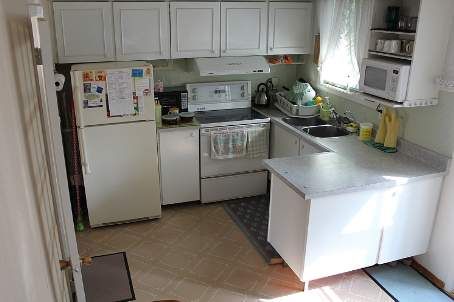

The original kitchen from when this house was last sold at price $X.
The newly renovated kitchen. By renting, it's like we got these upgrades for free (and then some!)

* – Yep, it’s mould. The work guys just had the wall boards off, and I’m told it’s back there.

Ratesupermarket First Time Buyer Guide

September 22nd, 2011 by Potato

As soon as I heard that the mortgage brokers behind ratesupermarket were pushing a first time house buyer’s guide, I thought “I’m gonna hate that. Tearing it apart should make for a fun blog post.”

A novel idea was that you’d sign up for a 2-week guide that would send you one part of the lesson by email each day. Kind of gimmicky, why spread out 14 already-short pages over a full two weeks? Anyway, it’s short, there are cartoony graphics, and there are quizzes so it’s apparently aimed at getting the school-age crowd to buy homes.

Much to its credit, it does start the series off with the question of whether one should rent or buy. But of course, I have to take issue with the nonsense in the rent vs. buy comparison. They create a simple pro/con list for buying and renting. Unsurprisingly, they dig up the tired old half-truth “Money paid towards rent disappears forever” and stick it under the con column for renting. Yet under the pro column for buying is the flip side of that half-truth “Mortgage payments go towards your home’s equity” with no mention that interest also disappears forever.

“Restricting rules regarding guests, noise, pets, yard space, etc.” also appears as a con for renting, though most of that is not true (or applies equally to owners in condos or other situations with rules regarding noise, pets, etc.).

Even more strange though is this one: “Cosmetic renovations typically come out of your own pocket” as a con for renting. Huh? Whose pocket do they come out of for owners? For that matter, aside from Wayfare and I, who does renovations as a renter?

Considering the site is owned by mortgage brokers, who only make money when someone buys and takes out a mortgage, I was expecting it to be much more strongly biased towards rushing in to buy (e.g., to not even have a section on rent, and to focus more on stretching to get the maximum mortgage possible). The budgeting section didn’t stress that their calculations would give the upper end of affordability, but that was to be expected.

Interestingly, they have another rent vs buy table on their site. I’m not sure how I stumbled on it, but it’s not part of the cartoony first time buyer’s guide. It also looks to perhaps be a rough draft, since they get away with saying things like “Affordable: in some cities renting is the only option for people because of high housing prices; Low Risk: If house prices start to drop (as some people are predicting), you’ll be glad you didn’t buy” under renting pros, it’s not as nicely formatted, and has the common loose/lose mistake.