REITs vs Direct Real Estate

April 8th, 2011 by Potato

Macquarie research put out a comparison of REITs vs direct (condo) ownership in Toronto and Calgary. The story was picked up by the Globe and others. It’s an interesting comparison, especially the part about leverage, when another article this week warned of the dangers in leverage.


“Unbeknownst to most of these families, their theory of home ownership as a safe, low volatility investment is based on the often-mistaken premise of no or little debt. This is a crucial blind spot because the moment that a large amount of debt is used to buy a home, that safe investment theory goes completely out the window. […] What happens when that family buys that house with just 10 per cent cash down and a 90 per cent mortgage that promises an interest rate of 3 per cent to the bank over the long term? Amazingly, the equity in the house has now become dramatically more risky than before. The equity is now three times as risky as the overall market rather than 30 per cent as risky. This is more risky than an investment in nickel mining stocks or Internet start-ups.”

I was asked after these reports about REITs, and specifically if they’re as risky as the housing market, given my views there. Briefly, a REIT is a real estate investment trust, a type of investment that owns real estate that it rents out. The majority of the cash flow is paid out as a distribution to the investors. I tend to view them as a step up from fixed income: essentially all of the anticipated return will come from the distribution (rather than capital gains), and though that can be cut or expanded depending on circumstances, it should for the most part be stable.

I do invest in REITs (until late last year they were a huge part of my portfolio, but now are down to ~3% as I was selling as the prices appreciated), and don’t think that they’re in for the pain that residential housing is, due to several key reasons.


The first is diversification: both personally and for the REIT. Even if I wasn’t hugely negative on housing, I’d be somewhat uncomfortable having my house be the entirety of my net worth for the better part of a decade. With a REIT, I can get some exposure to real estate without risking it all. Also, the REITs themselves are diversified, holding many buildings all across the country. Even if I think Vancouver and Toronto are bubbles, Canada on the whole is not quite as bad.

The second is the sector: most REITs I invest in lease retail and commercial buildings (plus some industrial and government properties). Even the REITs that invest in residential apartments are not buying individual houses or condos. The housing market has been blown up by speculation and cheap-as-free CMHC financing, but those factors haven’t applied to multifamily residential (i.e.: apartment buildings of 5+ units) or industrial/commercial/retail buildings.

The third is return: REITs are investment vehicles for professionals, run by professionals. Before investing money, a building is evaluated for its investment return, and only its investment return (not how nice the school district is or how grown up you’ll feel buying it or how only scumbags rent or how pretty the countertops are). A common measure of investment return is the cap rate: the rent less the expenses divided by the price. The lowest cap rate I’ve seen on a REIT purchase in the statements I’ve read for the last few years was 5%, but 6-8% is more typical. For residential housing, buyers don’t evaluate it for its investment return (often at all, but certainly not as a top priority) — some people don’t even investigate what their housing alternatives are, and I kid you not, more than one person (on the internet, granted, so trolling is a possibility) didn’t even know that you could rent detached houses/townhouses/anything but apartments — and if they try, don’t typically do a very good job of it (innumeracy at work). In Toronto, a typical residential condo cap rate is something like 2% right now, with gross yields at 5%.

And the fourth is liquidity: if I buy a house and I’m wrong, I’m sunk: up to 10% just in transaction fees, and in a down market it can take a long time to sell (or a big discount). Even if I could recognize a downturn early on (say after only a 5% drop in prices), I’d probably lose 20% by the time I got out, not even accounting for the risk-layering of leverage. For a REIT, transaction fees are the same as for other stocks: small (for the position sizes I take, I try to keep fees to less than 1%). If I’m wrong, I can sell as soon as I decide to — again, if I could recognize a downturn after only a 5% drop in prices, I could get out losing only 5-7% (depending on transaction fees).

The third point in particular explains why I don’t think REITs are as prone to a real estate crash as residential housing: the over-valuation simply isn’t there in the first place. Plus, unlike residential housing speculators, they don’t rely on flipping property to make money: even if property valuations slide, as long as it’s not so far as to threaten the ratios on their loans, the income should continue to flow.

That said, REITs have had a big run up from the financial crisis lows, and since they are leveraged, they are somewhat interest-rate sensitive. They’re not without their own set of risks. For residential REITs, if rents come down due to competition from accidental landlords, they could take a hit. Even if there was zero spill-over from the coming condocalypse to commercial/retail values, REIT pricing could suffer if crowd psychology caused people to jump ship from anything with “real estate” in the name. A downturn in the economy that causes businesses and shops to close means they have higher vacancies, and thus less income.

There’s been some discussion over whether to hold individual REITs or the iShares REIT ETF XRE. XRE has a 0.58% MER, and not a great amount of diversification, with only a few names making up three-quarters of the fund (Riocan alone is a quarter!). For zero MER, one could buy the top one (or two or three) holdings and get the same basic exposure, it’s argued. Though the MER is a touch high for an ETF, it’s still nice to get the diversification… but I personally wouldn’t/didn’t go the XRE route for a different reason entirely: I just don’t like RioCan (REI.UN). It only yields 5.5% (as of today), and that’s with over-distributions (paying out more than cash flow as they hope that future income growth will close the gap). I know yield-chasing for the sake of yield-chasing isn’t a good thing to do, but there are other (smaller, ‘natch) REITs paying substantially more with, IMHO, the same riskiness as RioCan. Either way though, not a bad way to go for a part of your portfolio, especially as a renter without other real estate exposure.


Tater’s Takes – Sad Panda

March 6th, 2011 by Potato

Thesis progress was once again abysmal this week. In fact, yesterday featured negative progress as I got into a discussion with my supervisor about some previous prose that I may now have to rewrite… Can’t wait to be finished this thing. Weight was down: only one pound, so it could just be measurement error, but at least it wasn’t up again!


Patrick of A Loonie Saved has finally put a post up, discussing the P/E-10, which right now is suggesting that the market is over-valued, in contrast to my earlier ambivalence. In the comments, Patrick links to another blog by Saj Karsan that suggests the P/E-10 may be skewed a bit by a large number of share buybacks over the years, and by the effect of two recessions (the -10 part of P/E-10 is supposed to give an idea of P/E over a full business cycle, but the last 10 years catches two bottoms instead of just one).

Harper once again shows he’s a class act.

Now even Paul Krugman is very worried about a Canadian housing bubble. The Economist has an article titled “Bricks and Slaughter”. “An even bigger reason to beware of property is the amount of debt it involves. Most people do not borrow to buy shares and bonds, and if they do, the degree of leverage usually hovers around half the value of the investment. Moreover, when stock prices fall, borrowers can usually get their loan-to-value ratios back into balance by selling some of the shares. By contrast, in many pre-crisis housing markets buyers routinely took on loans worth 90% or more of the value of the property. Most had no way of bringing down their debt short of selling the whole house.”

Michael James has some very sensible advice on looking beyond the next 5 years in the eternal fixed vs variable debate.

There have been a couple good reports on the fox domestication program in Siberia (watching that Nova episode was the source of the current tagline in the masthead: “50 years ago, Soviet scientists set out to…” “That’s how all the best stories start.”), but I haven’t tracked them down on the web to link to them. Here’s National Geographic, Nova Science Now, and Nova: Dogs Decoded.

Wired has a nice article up on why trivial decisions can sometimes seem hard when there’s an abundance of choice. I seem to recall another article from a few years ago on choice paralysis in investing, and that company pension plans were much better utilized when fewer options were presented.

I was feeling a bit down as my thesis progress has been so slow, and what has progressed has seemed to be won at such a high cost. So I took the Sad Panda meme image and made it my avatar on various social networking sites, but then realized it wasn’t sad enough for the PhD thesis woes. So I made it even sadder by turning it greyscale and adding a watercolour painting effect:

The original sad panda image, currently a popular internet meme.
Greyscale and watercolours are both sad on their own. Combined with Sad Panda, and it's now super sad!
Since I don’t know who to credit for the original image, I can’t presume to claim any rights on the derivative, so have at it.

Tater’s Takes – Space Wall

February 28th, 2011 by Potato

Went grocery shopping, with largely two things on my list: real food, and candy. At the intersection of the two: cocoa krispies, but they look to have discontinued them! Which is dastardly, because they were on sale this week!

Wired had a good article on magnetic navigation in sea turtles. Neat, because I was just talking about this in my lecture last week! Hope the undergrads find this. I love this quote: “A skeptic could reasonably believe that the latitudinal cue is magnetic, but that determining east-west position depends on magic,” Another recent article also discusses the radical-pair mechanism. I’ve long lamented the poor quality of journalism, especially science reporting, in these times of ours, but I have to say that I’ve been reasonably impressed with a few articles from Wired recently, in particular because they actually include the citations to the papers they’re talking about, so I’ve subscribed to their RSS feed.

The Berkshire Hathaway annual results are out, including Warren Buffet’s famous annual letter to shareholders. Worth a read even if you’re not a shareholder. Of course, many blog posts out there to help you digest the wisdom, including Larry MacDonald, Canadian Capitalist, and Michael James.

Barry Rithotlz points out that banks are writing credit default swaps on debt that doesn’t exist… if you figure out how to view the full story on the WSJ, let me know, I only got the first few lines as a preview, and there wasn’t even a link with the option to buy the article, so to me it just looks like a broken website (way to go, newspapers, you show the internet how conveying information is done!).

I got a response from my MP after my UBB letters: basically just a form response that the Liberals oppose UBB, and that they’ve received a lot of letters on the topic! Other than that, I haven’t noticed any news on the matter, so now I think we just wait and see what comes out of the CRTC.

A bunch of other bloggers got copies of various tax programs to give away (come on Intuit, it’s not a personal finance blog, but I do taxes too!). Oddly enough many of them only opened their contest up to their email subscribers. I guess people who use RSS to follow every. single. post. just aren’t worthy.

With even the permabulls like the real estate boards calling for the housing market to at the very least flatten out, it’s important to market your home’s selling features. A snazzy virtual tour may help, but might I suggest a space wall?

Space wall. A whole wall for a space scene. In your basement. What more do you need from a house?

Toronto Realty Blog considers moving up. The post highlights a few things that I see as being horribly sick and wrong with the current Toronto market (well, it doesn’t intentionally highlight them, but they stand out to me):

  • Five years is far above the average time that a condo-owner will spend in one unit in downtown Toronto…” Transaction costs are high: so far, price appreciation has dwarfed them, but in a flat market, moving very often means more people should lean towards renting rather than buying. If people are feeling squeezed out (or bored, or whatever other reason they have for moving so frequently), then they do need to start to consider the risks of buying at the top, as they can’t just wait out a downturn in the unlikely event that it happens (even if that’s what they tell me). Five years sounds like a very short amount of time to buy a place for to me, so for that to be above the average sounds crazy.
  • As I look around the living room, I see a bookshelf with so many books stacked on top of the unit itself that I’ve begun a small pile on the floor […] and I can’t tell you how many things (skiis, snowboard, golf clubs, hockey equipment, baseball gear, winter tires) I keep in seasonal storage in my mother’s basement. Not only have I outgrown my space, but I can afford far more now as well.” The condos that are going up (even in Markham) are freaking tiny. I have trouble seeing how a single person fits in some of them, let alone a couple. That is partly due to amenities: no need to set aside room for a treadmill if your building has a gym, and space for more than two guests can be taken care of by the party room and movie theatre. But I have to wonder how much of the demand for these tiny units is driven by people buying from plans, and when the buyers will finally stop trying to get a place, any place, and start demanding livable space.
  • Let’s assume that I own my condo in cash, and I have no mortgage.[…] For whatever reason, I would rather keep my money in my condo th[a]n throw darts at the board known as the stock market […] so my all-in cost of living is only $545 per month.” Once again, the fallacy that owning your shelter somehow makes it free, or nearly so, without taking into account the opportunity cost, that is, the return one could get by investing that money elsewhere. Even a GIC-like rate added to the other costs listed would put that monthly total north of $1600 — more than what a 1-bedroom rents for. And along with it, the notion that somehow the stock market is risky but Toronto condos are not. Eventually, fundamentals will matter.

Mortgage Amortizations

January 18th, 2011 by Potato

First up, the 5th edition of the Canadian Real Estate Blog Carnival is up on Landlord Rescue.

In the news today, the government tweaked mortgage lending rules slightly, reducing the maximum insured amortization to 30 years, maximum refinance LTV to 85%, and removed government insurance for HELOCs.

The various financial forums are still discussing the HELOC issue — I’m not sure myself how many HELOCs were actually insured, so it’s probably a minor issue. Refinances should likewise be a small piece of the pie. So that leaves the reduction in amortization. On the one hand, this is something that will influence almost every first-time buyer, as huge swaths of that section of the population have been opting for the maximum amortization to grab as much RE as they could. I myself would have preferred an increase to the minimum down-payment at the same time, but we’ll take what we can get. What’s the impact? Very briefly, if someone had a maximum mortgage budget of $1000, then:

At 35 years, they could get a $260k mortgage at 3%, or $198k at 5%. With the new 30 year maximum amortization, that same $1000 monthly budget gets $237k at 3%, and $187k at 5%. The effect is interest-rate dependent, but it means that for someone at the very edge of affordability, their maximum house price just went down something like 5-9%. Not a huge effect, but hopefully something to get the ball rolling.

The Idea of Risk and the Housing Bubble

January 8th, 2011 by Potato

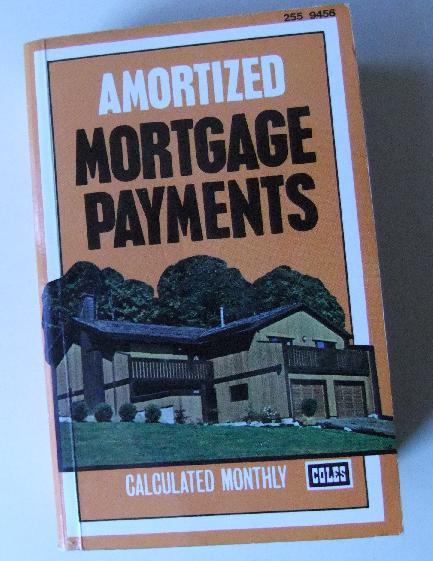
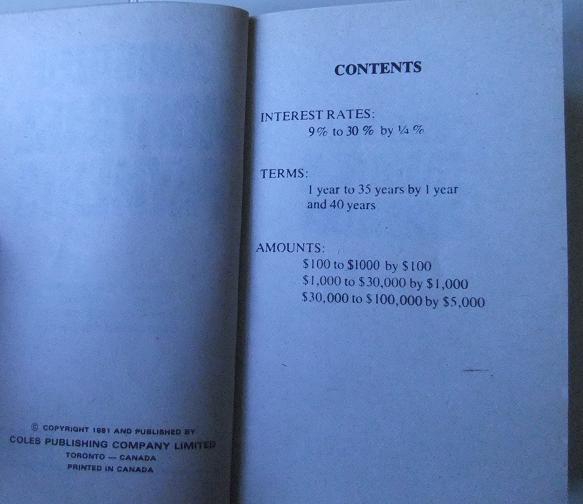
Partly for the laugh, Wayfare gave me a book of mortgage payment tables for Potatomas. For those of you not familiar with these tables, they date from a time before spreadsheets and online java calculators, when if you wanted to know what the monthly payment on a mortgage of a certain amortization at a certain interest rate would come out to, you had to run the calculation by hand. To help, tables were drawn up with the figures pre-calculated so one could just look up the value rather than calculating it. It was published in 1981, and has tables for 9% interest through 30% interest, in 25 bp increments. Interest rates below 9% were so unfathomable that they didn’t bother to print them in the book.

I’m not sure what the lesson there is: whether these current low interest rates are indeed so far below the historical norm that people should be prepared for higher rates in years to come, or the opposite: that times change, and now 9% is unfathomably high, and I shouldn’t keep trying to warn people about rates that aren’t likely to be seen again.

Anyhow, I wanted to explore a little bit the idea of risk and the housing bubble. This is based a bit upon some percolation of recurring themes here, and a bit upon some things people are saying on the internet (because no one in real life wants to talk to me about housing anymore).

First we really have to try to understand risk. Everyone has at least a little bit of gut feel for what risk is, and how some things are riskier than others. But everything has some form of risk to it: even GICs risk not keeping up with inflation, or in large concentrations, outliving your money. Volatility is sometimes used as a proxy for risk, in part because it’s easier to measure. But volatility doesn’t tell the whole story of risk, not by a long shot. If I’m talking about risk being the potential for permanent loss, for turning your life inside-out and just ruining your whole day, then volatility isn’t really a good measure of that at all.

If you look at a graph of the Toronto housing market over a number of years, it’s this incredibly smooth line moving up from the late 90’s to the late 00’s, and even beyond that there’s this smoothed bump in the 80’s and a little wiggle at the end in ’08/’09. So in terms of volatility, housing doesn’t look risky at all. Yet to my mind, it really is. One part of that is how the lack of volatility works against it when there is a crash. Go back to the last crash in ’89. If you were unlucky enough to buy at the top there, you’d see the value of your home decline some 30%, and stay down for years. It would take well over a decade to get back to break-even.

“But,” the people say, “why would I sell then?” And that’s a very strange question, because those same people often don’t have the same pragmatic zen attitude towards stock market corrections. With housing, you can be forced to sell when you’re underwater, for the usual reasons: job loss, move, family circumstances change, etc. When the stock market crashes though, you don’t have to sell your stocks (except for margin calls), unless you’re already retired. Heck, you can even rebalance and buy more.

The stock market by comparison is far more volatile, on any timescale. There have been 3 separate crashes in the Toronto stock market since the 1989 Toronto housing market crash. And the severity can also be frighteningly worse, about 50% top-to-bottom in the last crash. But, the recoveries are far snappier: not even counting dividends, someone unlucky enough to invest at the very peak of the market in 1989 was made whole by what looks* to be 1993; someone concerned with getting back to the 2000 peak found it in 5 years. Though we haven’t quite gotten back to the peak of mid-2008, in just 2.5 years we’re down less than 10%, and I’m pretty sure another 2.5 will find us back up there (and that’s not including dividends). Yeah, stocks are more volatile, but that works both ways, which means those crashes are both more frequent but also transitory. And you don’t have to buy in one chunk and get unlucky and find yourself at the peak (like with a house) — you can buy in year after year, so the real-life situation isn’t even this dire (as one would hope, since your investments are supposed to make you money). With diversification and rebalancing, you can do even better than the straight index.

But there’s still the fairly legitimate idea that stocks are risky: they can go to zero. Nortel went to zero, and that event seems to be burned into the Canadian mindset. “Can you point me to the house that went to zero?” Well, individual stocks are risky, but portfolios much less so. Even in one of the worst stock market declines in recent memory, a diversified portfolio was only down by about half, and much less if you had bonds too, and even then only for a short period of time. Think not so much of the house that went to zero, but the roof, or waterheater, or deck that became worthless. They’re just components of the overall investment, which as a whole is not as risky as the sum of its parts.

Leverage and familiarity of course play into the real and perceived risks: because of the high leverage employed these days (5% down baby), I’m deathly afraid of the potential for real estate to ruin your whole life. Because it’s strange and foreign, people in general are afraid of equities: the concept of distributed ownership in hundreds of companies is alien, and not in the daily experience of most people (or even in their educational readings), but everyone knows about houses (in fact, I’m writing this rant while sitting in one). However, the lack of volatility, and the last crash taking place when my cohort was still in elementary school can lead to some false complacency on the matter.

I’ve mentioned before that if real estate is overvalued by 30%, and if the typical family spends about 30% of their income on housing, then if they buy in too close to that peak, that leads to about 10% less money in the budget — about what people save for retirement. Even though it’s not so expensive that you can’t afford to put a roof over your head (that would probably bring an end to the bubble), it’s pricey enough to impact your financial health for essentially the rest of your life, which is why I waste so many electrons on this. It’s legitimately important, and it can be controlled.

I don’t know how to get people comfortable with stocks though, because it’s a fair point that if you don’t save and invest the difference when renting, the benefit isn’t really there (though even just saving in a savings account may be attractive if housing is overpriced enough relative to rent). On the one hand, equities are the riskiest, most volatile class of investments. Indeed, Mandelbrot suggests they may be even riskier than we first imagine. On the other hand, they’re not all that risky when diversified and held for very long periods of time (and as youngish folks, we have very long periods of time on our hands). Combined with the fact that it’s cheaper to rent right now, renting and investing the difference really looks to be the less risky path. Though the English language has the expression “safe as houses”, it’s not true all the time, and blind faith in real estate is in my mind, one of the most risky notions facing young Torontonians and Vancouverites.

* – Sorry, I just have a (not particularly great) graph for data that old.