Housing Advice Silly Season

July 3rd, 2010 by Potato

It’s been a rough few years to be a young adult in Canada and not own real estate. The media keeps firing off article after article about how it’s different here, how real estate always goes up, and how the systems and perverse incentives that lead to the bubble blowing up in the US totally don’t apply here.

Here’s a few recent ones to pick apart.

First up, CNBC asked around after the G20 in Toronto why our housing market didn’t crash. Amongst the silly answers given:

there are just six big Canadian banks that own the bulk of the mortgage market, and they don’t securitize and sell off loans at nearly the rate U.S. lenders do. They hold nearly three quarters of their loans on the books, and 80 percent of Canadian loans carry mortgage insurance.

In the same sentence they undermine their point. It doesn’t matter if the loans are securitized and sold to someone else, or insured, the effect is the same: for 80% of the loans made by Canadian banks, the risk has been offloaded (in our case, to the taxpayer, rather than AIG). The effect on behaviour is the same: sell sell sell full steam ahead, and damn the torpedoes. How many times have we heard of banks “helping” people find ways to borrow way more than they should qualify for, looking the other way on “creative” downpayments (that aren’t downpayments at all, but often other loans, sometimes even credit card cash advances). When they don’t bear the risk for making a bad loan, they make more bad loans.

Or this gem of misinformation and lawyering up the definitions:

Canadian banks also had and have no such thing as the Alt-A, or low-doc, no doc loans that fueled bad borrowing and consequent defaults. At the height of the Canadian housing boom barely 5 percent of loans were considered “subprime,” while a full third of U.S. loans were either subprime or Alt-A.

The CMHC will insure a person with a credit score of somewhere down in the 610-620 range, which is below Alt-A and into subprime in the states, but here AFAIK it doesn’t get a different name. It’s all good, baby. Not only that, but high loan-to-value mortgages (i.e.: CMHC insured) are rampant here. According to GT, the average downpayment on a new mortgage is now 6% (and since the minimum is 5%, that means a lot of people are not putting much equity in their homes). Small downpayments are almost as big a predictor of default as bad credit; combine the two risk factors and defaults rise exponentially. The difference in US and Canadian lending is not a difference of kind, just of degree (plus, our taxpayer bailout is built-in). Yes, there were fewer subprime mortgages issued, and the very worst dreck (negative amortization/interest only) was avoided, but just barely (40-year 0-down is not all that different).

Then this especially terrible article from the Toronto Sun was forwarded to me. In it, the author (a condo marketer and saleslady) recommends first-time buyers buy preconstruction condos because the builders aren’t as strict as the banks, and will let you create a payment plan for your downpayment, so you don’t need anything saved up. Spoiler alert: I’m going to recommend that people don’t buy condos (or pledge to buy condos at some unknown future date) when they don’t have any savings!

Recent statistics from BILD report that the typical high-rise condo suite price was up $25,108 in April, or 6.3% compared with April 2009. Where else can you get that kind of return-on-investment in this day and age?

Ouch, bad choice of timeframe. The TSX was up 28% in that period, not including dividends. And, it won’t cost you 10% in transaction fees to realize your profit. Of course, there is a logical reason for pre-construction to go up: your capital is locked up for 3+ years while your unit is built. And through all that despite real estate being an “investment you can touch/live in”, you can’t touch or live in or preview your pre-construction unit. How (and when!) it actually turns out can be a nasty deviation from what you were lead to believe in the sales pitch, and this is another risk pre-construction speculators are rewarded for. That this premium has now dropped to only ~5% is a statement on just how distorted the market has become.

Even if we weren’t tipping over the edge of our own housing crash, I’d almost always advise a first-time buyer to avoid pre-construction. A Tarion warranty is next to worthless, and as a first time buyer you’re probably keen to get out of whatever situation you’re in now (rental, parents’ basement) and don’t want to wait several years before your purchase is completed. Not to mention that you may not have the stability to effectively plan that far in advance plus a few years to know for sure that the imagined condo is where you’ll want to be living 10 years from now. No, leave pre-construction to the speculators and retirees, even if you do have to scrounge up a bit more for something you can inspect right now.

Then, on the same day in the Sun, “No bubble trouble to report here“:

We experienced a true bubble in the late 1980s and early 1990s, when mortgage rates skyrocketed and speculators flooded the market. Despite the fact that conditions are very different today, people continue to compare our current success in home sales to that time. I don’t understand why.

Look, no. Rates did not skyrocket in the late 80’s. Rates do not have to go up to pop a housing bubble — you just have to run out of buyers. In the early 80’s, there was a brewing bubble that was smashed by high rates (the 20% rates your parents still wake up in the middle of the night in a cold sweat thinking about). But the bubble that popped in ’89 was not fuelled by low rates or killed by high ones. Look them up yourself. Rates spiked all of maybe 2% (starting from ~12%, the equivalent of going up about 0.6% today) over the course of about 8 months in 1990, after the housing boom had already started to die. The late 80’s housing bubble can’t be laid at the feet of interest rates. Plus, we’re at rock-bottom interest rates now, so if conditions are different, it’s in a way that makes the current times look even more bubbly!

Speculation though, that’s a good measure of when things are getting bubbly. How much speculation was going on back then? Unfortunately, I don’t know of any good measures of that, but there is a heck of a lot going on now.

Then, after acknowledging that bubbles happen, this guy goes on to say:

Prices are only going to go up…

Unless, as they’ve done many times before, they go down. The Toronto Life article said that up to 40% of new condos are held by speculators. That’s a lot of future demand pulled forward, so we can easily keep putting roofs over the heads of families even as prices crash…

And again, in what must be the Sun’s G20 silly real estate report section:

Pricing is affordable, while construction-related job creation is averaging around 170,000 per year over the last five years in the GTA alone.

Do the math on that one. Average of 170k per year over 5 years. 850k. There is no way, absolutely no way that 850,000 new construction-related jobs were created in the GTA alone. That would mean that, of the ~5.6 million residents of the GTA, roughly 1 in 6 works in construction, and just started doing so in the last 5 years. If it is true, it’s terrifying, as a city of nothing but people building homes to sell to each other sounds like a frightening ponzi scheme to me, and will mean that when a downturn does come, there will be incredible positive feedback loops (where here, “positive” means “bad”).

And it’s not just the Sun, widely recognized as the paper with let’s say the least amount of journalistic prestige of the big 4 papers in Toronto. Even the Globe is making these goofs, such as “the little matter of affordability” which actually recognized that condos sold today can’t be rented for a profit. Rather than coming to the logical conclusion that a bubble exists and prices would come down, the author instead warns that rents are due to jump ~40-60% in the next few years. (And repeats the figure that up to half of all new condos are bought by speculators). Rents, of course, are constrained by wages to a much larger degree than owned housing prices, and can’t be leveraged up by low rates; we simply will not see rents jump ~50% just because that’s what’s needed to make the speculators’ numbers work. Not with an already healthy vacancy rate.

Kids, time to tune this shit out. The denials will continue to get stronger and more frequent as the wheels come off the market, and it won’t be until well after the decline has finally started before the majority of the stories turn into tales of woe and despair and talk of bubbles bursting.

Anyway, nobody listens to me these days because — despite the fact that I do research and am right — I’m not a “journalist” at a “respectable” paper. They can’t print this out and plunk it down in front of their parents to explain why they aren’t “building equity” like other kids their age.

Except for Julia, who is therefore awesome.
CREA Revises Forecast

June 2nd, 2010 by Potato

Just a week after putting out a release saying that the bank economists were wrong and that Canada won’t have price declines, CREA has come out with another release revising their earlier statement. They now predict prices to decline nationally through 2011, driven by (unstated) declines in BC and Ontario. For those in Ontario and BC (which is pretty much all of my readers AFAIK) this means it really isn’t time to buy a house now — even the CREA thinks it’ll be a terrible idea!

All provinces are forecast to post modest average price gains in 2011, except British Columbia and Ontario. The forecast decline in activity is sharpest in these two provinces… The national average price is forecast to decline by 2.2 per cent in 2011 as a result.

So even though they’re calling for the rest of the country to go up, the declines in Ontario and BC will be enough for the overall national average to be pulled into negative territory (and remember that CREA is generally one of the most bullish sources of predictions!).

Tater’s Takes

May 28th, 2010 by Potato

I haven’t done one of these for a while. There was some bad weather for a few weeks there, and I didn’t get on the bike at all for a fortnight. Not owning up to my downfalls in the exercise routine kind of defeats the point of the public update/shaming, but I also reasoned that I didn’t have any links I wanted to share, either.

The last two weeks have been much better though: I broke the 20 km barrier, and rather easily at that, returning home feeling like I still could have done more, and wasn’t much sore the next day. Now the problem is going to be that to keep pushing myself to be able to bike further (e.g., to train for the Rona/MS bike tour), I need to start committing serious time. I did a (fairly hilly) 18 km on holiday Monday, and that took me about an hour and a half — I just don’t have the time right now to push it any further than that.

Diet: aaaah, you don’t even want to know. So far the multivitamin seems to be keeping away the scurvy.

Random thoughts:

Realtors to Canadians: Chill Out

“There will be no drastic drop in Canadian housing prices, the Canadian Real Estate Association said Thursday, because house prices will stabilize and climbing household income will make owning a home more affordable.”

Wow, I barely included tautology in my list of logical fallacies because I couldn’t think of any examples where it really came up, and circular reasoning is usually fairly easy to spot. But, here it is: there will be no drastic drop in house prices because house prices will not drop drastically.

Then that last tack-on about incomes doesn’t mention a timeframe. Incomes rise at about the rate of inflation, say 2%/year. If houses are 10% overvalued on average (and 30-50% in Toronto and Vancouver), that could be a very long period of flat-lining. If even the CREA is saying that the best case is a flat-lining of house prices for years, then why be in any hurry to buy, especially with uncertainty about where rates will go?

And if everyone’s in no hurry to buy, then won’t sellers have to lower their prices to attract buyers back? I just can’t see a stagnation as a likely scenario. Yes, house prices have stagnated for long periods of time before, but not usually so far from equilibrium, and not following such epic volatility (down ~10% in ’08, and then bouncing back ~20% in ’09!).

Plus there’s the issue that Canada is not homogeneous… a nation-wide decline of just a few percent could very well mean that Toronto and Vancouver got smashed while the rest of the country stagnated…

Michael James has a good set of links in his roundup this week, including a couple on your financial advisor, and whether small investors have no choice but to become DIYers.

My Bell bill arrived for the month, and I was greeted with a $30 over-usage charge. Bell’s cap of 25 GB is way more restrictive than Rogers’ 60 GB one (and even that is getting tight as more and more uses for the internet come out but the cap hasn’t changed in years). So even though I had a fairly moderate month (~40 GB in usage, well under what my cap was when I was with Rogers), that qualified me for the full $30 overage fee. What really ticked me off is that even though they have my email address (and phone number) they never notified me that I was getting close to (or exceeding) my cap. I thought I was being good. You can bet I’ll be switching to Teksavvy (with a 200 GB cap!) when my contract’s up…

Stephen Novella has another interesting post up on science and public perceptions. “[P]eople find stories much more compelling than data.”

Spoilers ahead!

Borderlands: I finally finished this thing. I had no idea I was that close to the end… it just simply ended. I must say, it was very unsatisfying. The beginning of the game had so much promise (and with multiplayer it would probably still be fun), but it felt like they rushed through it and did a little too much cut ‘n paste, as the charm and humour from the first little bit seemed gone completely by the end. It was a grind-fest basically. The reward for beating the final boss? The ability to run through the game all over again on a higher difficulty to unlock “achievements”. Whoopee. The last boss didn’t even drop any epic loot! Oh, and there is no treasure vault: the vault is a prison for some kind of Eridian demon thing, that is unlocked every 200 years by the alignment of the moons, which gives our hero the chance to finish the demon off once and for all. To quote the PA guys: “It is at this point that people begin to question the wisdom behind moon-powered demon prisons.”

Immigrants Are Not Stupid

May 25th, 2010 by Potato

Though you wouldn’t think it from the message some housing bulls have. “It’s different here, housing will never go down, the immigrants are coming in waves and buying everything in sight.”

No matter how overpriced the market gets, somehow the magical immigrants will ride down on their rainbow with their pots of gold and buy an investment property or three. Unfortunately, immigrants aren’t going to magically sustain a housing bubble indefinitely. Immigrants are not stupid, and won’t continue buying houses at prices that no one else would touch. Even if they would, there comes a time when there just aren’t enough people with money to keep the whole thing climbing to the moon and it all falls apart.


First off, the “rich overseas investor” is a fairy tale. Ok, yes, there are a few people who come from overseas and buy a house with cash (or “really cheap” unserviced vacant land) and don’t care what interest rates do, but not enough to keep inflating a bubble when all the other buyers face rising rates. Not by a long shot. I don’t have good statistics on the matter, but I wouldn’t be surprised if the wealth and incomes of immigrants is no different than the average Canadian — and if anything, may be lower. Just because a place in Vancouver is still cheaper than one in Hong Kong or London (the Other London) or New York doesn’t mean that people coming from those places will happily cough up Hong Kong prices for Canadian real estate without thinking about it (at least, not forever, and not all of them). Indeed, they’ll probably have Canadian jobs and so the price-to-income measures are every bit as relevant to them.

Secondly, immigrants have never before saved any city from a real estate bubble and collapse. What, you think immigration was invented in 2002? The US has immigration to all its big cities too, and look what happened there. Heck, one of the biggest periods of immigration to Toronto was in the lead-up to the Hong Kong handover in 1997, and real estate crashed big time from the peak in ’89 through the 90’s.

Thirdly, immigrants are not all that different than other Canadians in their desire for housing. So it doesn’t matter whether a person is an immigrant or not — it’s population growth and household formation that drives demand. I’ve actually had people argue that immigration drives housing prices because “immigrants stop at nothing to get a house of their own; they’ll pay any price and live 3 or 4 families/generations to a house until it’s paid off and then buy the next one.” Well, multiple families/generations living under the same roof actually decreases demand (households) for the same number of people, so that argument doesn’t hold a lot of water, it’s just trying to reach for an explanation as to why anyone would pay any price for a house.

For the country as a whole, population growth has been rather steady for a long time now: any increases (real or perceived) in immigration rates are really just offsetting our natural declining birthrate. Now, I don’t have any data on growth rates by city, so it is possible that recently the immigrants have decided to concentrate more on moving to Toronto and Vancouver, though I doubt that it’s actually out of line with any longer-term trends.

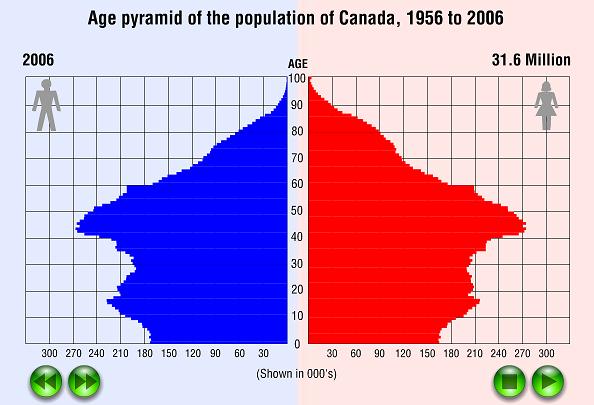
Speaking of household formations though, the one fly in my bear soup comes from this graph (via stats can) of the population pyramid:

Canada's population distribution by age -- how many of you tried to click the play/forward/back buttons? :)

The tail-end of the baby boom would have been passing through age 25 right about 1989, which may in part explain the housing boom and crash that happened then. The echo only just started working their way through their homebuying years a few years ago, and won’t be finished for another 5-10 years. I’ve long maintained that the unsustainably high housing prices were due to lax lending, low interest rates, and the madness of crowds. If, however, demographics also play a starring role, then this may take longer to unwind than I thought.

It’s interesting to see how sharp the baby boom was though — the start in ’46 is very sudden, for obvious reasons, but even the tail end sees a 20% decrease in just 3-4 years. The echo isn’t as sudden on either end (though oddly enough, is more pronounced in men than women).

Now, all this isn’t to say that immigration can’t have an effect on a housing market, especially in the short term and when immigration is not smooth — there’s a fundamental limit* to how sharp a baby boom can be, but an influx of new people to an area can happen quite sharply, which can distort a market badly in the short term. Ft. McMurray is a good example of this. As the tar sands projects ramped up there was a huge influx of people to Northern Alberta to work the oil patch. Housing simply couldn’t be built fast enough for the people coming in, and combined with the high wages, the cost of shelter shot up there, to the point where a house in Ft. McMurray was in many cases more expensive than a house in Toronto. But that’s all short-term: as the rate of house construction has a chance to catch up to the demand, then it’s reasonable to expect prices to settle back down to whatever the incomes can support (though in Ft. McMurray those are fairly high), and then down to the cost of building a new house when the builders overshoot the demand.

* – octomoms and bunny rabbits excepted.

Tater’s Takes

April 26th, 2010 by Potato

So as you can imagine from the end of my last update, I took off most of the week from working out to let my back heal up. I got a good bike ride in on Thursday, and then was too busy on Friday, and then the weather was poor on Saturday and Sunday. So, not so good. Feel free to ridicule.

Links!

Tony Wong reports on a bearish forecast for housing. Is that a sign of the apocalypse?

For the third time in less than a month, the banks are raising fixed-rate mortgages again. Their “special” 5-year closed rate has gone up 0.9% in 28 days…