Wonky Buy vs Rent Calculator

December 11th, 2013 by Potato

One of my shining triumphs here has been to create (with generous help from Matthew Gordon) the ultimate buy-vs-rent calculator tool (direct link to the spreadsheet).

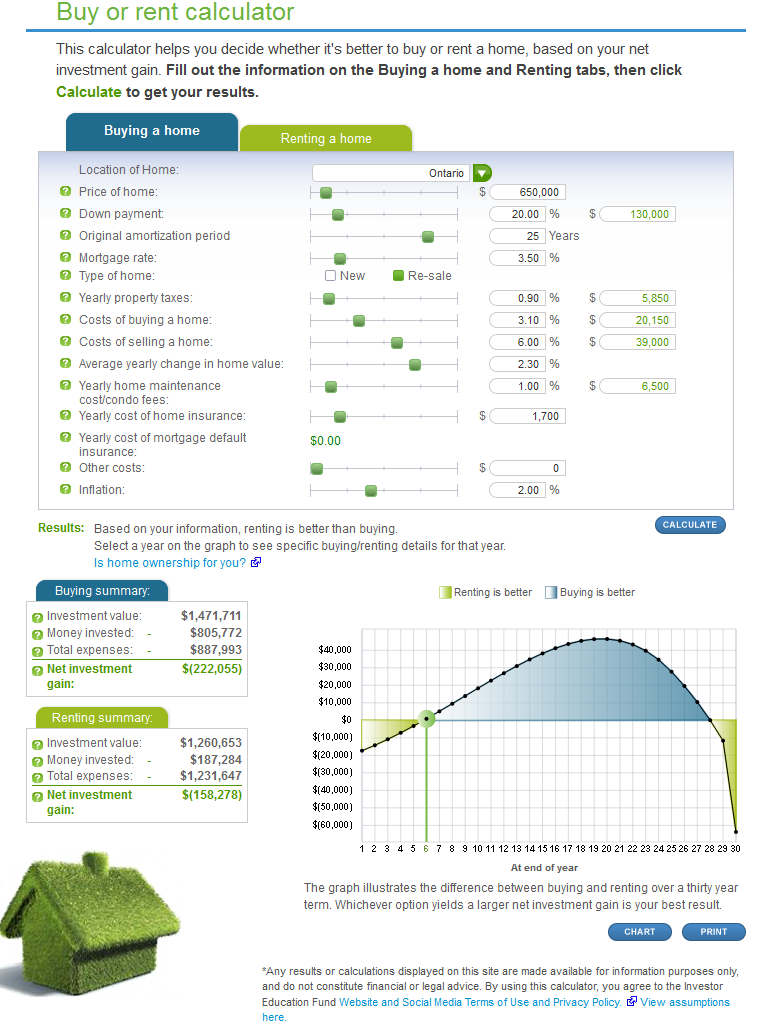
The beautiful thing about a spreadsheet-based calculator like that is that you can follow the calculation, item-by-item, and check it for bugs if you get unexpected results. Earlier this week, B&E posted a list of calculators out on the net, and rather than linking to my supremely excellent calculator and associated post, Robb linked to a Get Smarter About Money calculator. Ok, it’s web-based and a little more user-friendly than a spreadsheet, and has graphs and sliders (though why you need house price to go up to $10M is a question left unanswered)… but was it accurate? I’ve seen many, many terrible buy-vs-rent calculators (even some seemingly excellent ones like the famous New York Times ones that just doesn’t work for Canadians due to tax differences). So I played around with it. And I quickly saw wonky results like this:

Weird behaviour from a buy-vs-rent calculator: the curve simply should not be shaped like that, there's nothing to drive the differences in the last few years. Click to enbiggen.

In the comparison I have there, the price-to-rent multiple is 260X ($2500 monthly rent on a $650,000 house); as we’ve learned from previous posts in realistic scenarios it should be better to rent with prices so detached from rents. Yet here the calculator is showing a rather large benefit to buying if you can only wait 7 years or more. Then, strangely and inexplicably, renting rapidly takes the lead in the final few years of the comparison, with some sort of apparent discontinuity at year 30. If you look at their “chart” you can see more errors immediately: I had entered $2500/mo in rent, which is $30,000 per year, yet the “total renting expenses” came to just $12,360 in their chart, a factor of three too low. The buying expenses were only about $31k in their chart, whereas the mortgage alone is that much, with a total cash outlay of nearly $45k each year.

Now if you instead do the same comparison in my calculator, you’ll find that renting beats buying right from the start (due to the high transaction costs), and is fairly flat in terms of net benefit for about 10 years, at which point the investment portfolio starts to get large enough that investment returns become comparable to rent and the exponential growth becomes truly noticeable. There is no big “buying is better” hump in the middle. Moreover, the magnitude of the difference is notable: in my calculator renting beats buying in such a scenario by over $600,000 in year 30, versus the nearly break-even result from this scenario in the flashy online tool, with the same assumptions regarding investment returns, inflation, mortgage interest, and other sundry costs.

It’s a bit distressing, as other online calculators have recently been found to have serious errors as well. For instance, Michael James uncovered one on the Globe & Mail’s site, and just today news broke on retirehappy about the government’s CPP calculator over-estimating your future CPP benefits and not at all handling early retirement scenarios correctly.

Footnote: let’s say you’re not convinced that my spreadsheet is the gold standard to which all other rent-vs-buy calculators should be held. To then check the accuracy of the online calculator, let’s run the first year’s numbers manually:
Buying: mortgage $31k, property tax $6k, insurance $1.7k, maintenance $6.5k; total cash cost: $45.2k. Principal paid down: $16.5k. Net cost of owning: $28.7k.
Renting: rent $30k, insurance $0.4k; total cash cost: $30.4k. Investment portfolio gains: $10.5k. Net cost of renting: $19.9k. Cost to sell house: $39k. Gain on house: $15k. After year 1, renting ahead by: $49.3k. Online tool says: $16k.
If you notice any errors let me know.

The Veritas-Urbanation Showdown

December 3rd, 2013 by Potato

Fact: an “investor” buying a condo in Toronto today quite likely faces negative cashflow and poor projected investment returns based on current rents. The three reasons for buying in such a situation are that rents will increase — and increase fast enough to matter/before interest rates rise; that there will be price appreciation; or that the investor is making a mistake. Well there certainly was price appreciation in the past, and appreciation can beget appreciation until a bubble pops. Current and future buyers may not be counting on appreciation as much though, as expectations temper and we see flat or negative price growth (year-over-year price changes were negative for 416 condos in 5 of the last 12 months, and under 2% in all but 4).

That leaves rent increases. Urbanation puts out a quarterly report claiming staggering amounts of rent increases (figures that look even higher as they report price per square foot in a market with ever-smaller units). I mean, they don’t come close to keeping up with the kind of price appreciation seen over the past decade, but staggering compared to our expectation of rent increases from CPI inflation and the Ontario rent control increases. This news often gets picked up by the Star (with breathless headlines) and these high inflation figures get stuck in the minds of some. Personally, I’ve doubted these figures, as they don’t jive with my anecdotal experience or other data sources on rent inflation.

A new report from Veritas has ignited a bit of a spat, as they report a small amount of rent deflation. They also explicitly track and project the negative cash flow for an investor buying a condo in Toronto today. Urbanation took to their blog to try to debunk the new report and reinforce why we should listen to them instead.

What I found particularly shocking in Urbanation’s post is that they themselves don’t have a good handle on what proportion of the market their data is sampling. As far as I can tell, nobody does. They claim to capture 2/3 of the [condo] rental market. I back-of-the-envelope it and get more like a quarter of it (and a non-randomly selected quarter at that). And I think that says just how bad the data is: the biggest, splashiest report on the matter uses a non-random subset of data with several potential selection and reporting biases, and no one can even say what proportion of the population their sample represents or how representative it is. Smaller spot-check “mystery shopping” samples are potentially not as accurate, but nevertheless the fact that they disagree should call into question how much weight we give either figure. Nobody can even say whether the average rental tenancy lasts 3 years, 5, 7, or something in-between. Urbanation just takes an unsupported stab at 5 years below (20% turnover), and assumes that’s the same for owner-occupied and rental units:

Who’s [sic] research should be taken with a “grain of salt”?
We recognize that transactions through the MLS system don’t represent all activity in the condo rental market, but we do believe it represents the strong majority. […] The ‘true’ annual turnover rate of all condos is likely closer to 20%

[Emphasis mine]

Yes, whatever slice Urbanation gets from MLS will be bigger than the slice Veritas sampled on Craigslist and their mystery shopping adventure, but that’s not the point*. The take-home message is that they are both imperfect samples saying very different things about the market. We need to view the whole thing as a lot fuzzier than we have been: both reports likely have large margins error, and it looks like all we can say about rents on condos is that they’re basically flat, plus or minus 5%. Heck, the Ontario rent control rate may be the best estimate of rent inflation out there.

* – Even though bigger is usually better in sampling and stats, a bigger biased sample is still a biased sample.

Of Course You Invest It

September 18th, 2013 by Potato

In almost all of my rent-vs-buy comparisons I have the renters invest their capital and ongoing savings, including in my most recent one about the three year condo holding (Toronto Condos: Best Case Scenario). Note that the renters didn’t have to in that scenario: the buyers lost so much to frictional costs1 and higher ongoing costs2 in their short foray into condo life that the renters could have left their cash in a chequing account and still come out ahead. But I had them invest it anyway because that is what you’re supposed to do. It didn’t hurt that doing so helped hammer the point home, making the spread in outcomes so large that you could be especially generous to the buying case (e.g. assume they were prescient about their mortgage needs rather than acting like a typical buyer) and still conclude that renting for 3 years is hardly throwing your money away — it’s the opposite. But that’s not why I chose to: it’s my default recommendation and assumption.


On Twitter, @barrychoi questioned the assumption that the renters would invest their capital. I wondered why you wouldn’t, to which he replied: “for time purposes. Is it worth risking your money if you might need that cash soon?”

Here is the thing, “need” and “soon” mean different things when you’re talking about housing. There are a lot of rules of thumb out there, but the general idea is that equities are volatile, while providing high return expectations. So you should invest money for the long term in equities, but not money you might need in the short term because you could be hit with a market down-turn just as you’re about to take your money out and spend it. The rules of thumb say money you need in about 5 years, or 10 if you’re really conservative, should be in something safer.

This is trying to take a heuristic shortcut to risk tolerance, but risk tolerance is made up of many components. The ability to recover is a big part of it, and it’s closely related to the time you have on your hands, which is where these rules of thumb are derived from. They’re also influenced by the history of the stock market and how long it may take to recover from a typical crash. If your timeline is too short, you could get unlucky and be caught in a crash just as you need your money, and have to eat the loss.

But when you’re talking about buying a house your timeline is not generally short: in the example David Fleming provided that inspired the previous blog post, the couple had been in a condo for ~3 years, and was looking to rent a slightly larger condo for another year or two before buying. Close enough to the 5-year rule of thumb to go investing the capital. In general, at the very least you’ll be signing a lease for a year, with a likelihood of renewing and maybe even having another rental stage before ending in your “forever house.”

Even if you’re not a housing bear3 and are just renting for a few years to avoid the ruinous transaction fees or until your career settles down enough that you have some certainty you won’t be packing your bags for the other side of the continent, you’re going to have a few years to play with. Just because the rule-of-thumb is 5 years doesn’t mean you’re insane to invest with a planned 3 ahead of you. Because if you are unlucky, you don’t need to buy a house on August 15th, 2016 like your plan says — you won’t vanish into a cloud of pixie dust and parental disappointment if you still have a lease on Tuesday — you can chill and rent for a few more years if you need to. Plans can be fluid that way, and that kind of flexibility is what gives you the risk tolerance to invest in equities.

Your plans are not set in stone, and the ability to defer your purchase date adds to your risk tolerance.

Aside from not needing to buy on a certain date, you don’t need a specific, immutable downpayment. If you invest a $100k nest egg, you expect that, with a 6% return, you’ll have $126k after 4 years when it might be time to buy. It could be better than that4, or it could be worse; uncertainty is something to deal with rather than fear. If you are unlucky and in four year’s time there is a terrible correction and you’re down 25%, well, you just lost $25k and it stings, but it’s not going to ruin your life. You take the reasoned gamble that you’re more likely to be up money by investing in equities for the next few years — and that, in advance, you’re not sure whether “next few years” will turn out to be 3 or 10. In many scenarios you will be proven right and be better off. But even if you do lose that bet, it’s not like you can’t buy a house at all, you just have to settle for less house or more leverage. Your original $100k (plus accumulated savings) might be enough for 20% down on a $500k place, but if you come to the table with only $75k you can still buy a house — with CMHC you can even still buy the $500k one from your twentysomething dreams. The risk to your life plans is not that large: it’s not a life-altering risk you’re taking, but a manageable financial one.

If you’re a housing bear like me and have recognized that with crazy price-to-rent metrics it just makes more sense to rent, then you’ll be doing so for as long as it takes. Housing corrections take years to play out. And a housing bust is almost never a “V-shaped” event, where you only have a few weeks or months to swoop in on cheap prices: once the excess comes out (which itself will be a multi-year correction event even in a crash with numerous accelerating factors like in the US), the market will very likely stay in “fair value” range for a few years. As a bear you may be living in a rental house that would sell for5 $500k in today’s bubbly climate. One day, if prices make sense, you might like to own a similar house, but it’s 30% over-valued. So you rent, invest, and get on with your life. But if the conditions have changed so that it’s time to buy then that house has likely come down over $100k in price — you’d still be way ahead even if you were unlucky in equities and lost $25k of your downpayment. And, if you want, you can keep renting for another few years to see if equities recover, knowing the house likely won’t. And conditions might not change: in which case your “downpayment” fund is really your “retirement fund” in a soft-landing world for renters.

Of course you invest it if you’re a housing bear.

So when you’re talking housing, you generally have some long timescales to play with. Maybe not the 10+ years needed for the chance of a negative outcome to go to nearly zero, but enough that investing in equities is not some wild, undisciplined gamble. Even a 3-year holding period has something like an 80% chance of beating cash. I think too many people are too afraid of uncertainty, particularly young people who have a lot of ways to recover from loss at their disposal6. Risk tolerance comes from many sources: you can be flexible with your timelines if needed, or adjust your expectations/budget. And you need a downpayment, not the downpayment you started with — ending up unlucky and losing a portion of your downpayment is generally a survivable event.

My dad taught me at a young age that you only put in the stock market what you can afford to lose. But the market doesn’t go to zero even in a bad crash, and the amount you can afford to lose is generally not zero even when you’re house-horny. So with that in mind I take acceptable risks to try to invest my money in a way that maximizes my expected value.

Plus I know that the risk I’m taking as a renter with equity investments is way smaller than the risk a buyer in today’s market is taking (both financially as well as to my future lifestyle and mobility options).

1: Realtor commissions, CMHC premiums, mortgage break fees, and possibly land transfer taxes (or the burning the opportunity to use the first-time buyer exemption later on a more expensive property), legal fees, inspections, and the inevitable over-spend on customizing (or as is often the case for new condos, finishing the job the developer botched).
2: The higher monthly costs to own (condo fees, interest, property tax, etc) that add up to more than rent, a renter can save in this market.
3: Why are you not a housing bear? Have you seen my spreadsheets? You must live in Hamilton… or non-waterfront Gravenhurst.
4: Indeed, I was more confident being fully invested in 2009/2010 coming out of a huge crash — with the valuations and recovery it seemed unlikely that a second major crash would take us yet lower. If, as in the previous example, someone had listened to me then but with $100k they’d have hit the $125k mark in just three years. Also, I’ll add down here in the footnotes that if you’re close to the CMHC threshold then the potential gain of going over the 20% mark might provide an added incentive — though the downside is there as well.
5: I refuse to say “worth”.
6: Again those are dodge, dive, duck, dip, and dodge… er… Wait, it’s: defer, earn, save, change expectations, leverage, and run crying to mommy.

Mortgage Helpers: Not Magic

September 16th, 2013 by Potato

Rob Carrick posted about a Toronto family frustrated by the high cost of housing and wondering what to do. There were over 100 responses from the community: some suggested renting, some moving away to more affordable cities, others accused them of being spoiled and entitled for thinking that a house in Toronto should be anything other than a crushing financial burden. About 10% of responses said that they should buy a house with a basement suite (“mortgage helper”), and that renting it out would solve all their affordability concerns.

Some quick math for all those who think “just get a place with a mortgage helper” is somehow a magic solution.

Assume they can rent out the basement for about $1000/mo inclusive. There are some added insurance and utilities costs, so say the real gross is $800/mo. Apply some reasonable rate of return — say an 8% gross yield, which might work out to a 4-5% cap rate — and that $800/mo income basically means that they can buy $120,000 more house than they would otherwise. So the $700,000 house they were looking at would effectively “only” cost them $580,000 — yet they’d have to deal with tenants in the basement, lose out on a 2nd or 3rd washroom, all the storage space, a ready play room for the kids, and quite likely share their parking and back yard. In other words, they lose a good portion of the benefits of paying up to get a detached house in the first place, without the lower cost of a true attached property.

Plus, the prevalence of this analysis-free HGTV presents Income Property-type thinking means that the house with a basement apartment roughed in usually costs more than the comparable true SFH in the first place! All those risks and drawbacks, in the end to only be a few hundred dollars per month ahead, if any at all. I don’t know how “mortgage helper is axiomatically good” became such a prevalent meme*, but playing amateur landlord to the basement-dwelling crowd** is not the solution to a young family pressured by high house prices.

* – though we can guess: most people probably think that the suites build and maintain themselves, with no additional cost, that the full $1000 cheque comes every month without default or vacancy, and that it is entirely profit because accounting is hard.
** – no offense intended towards basement-dwellers, who are 96% of my readership.

Toronto Condos: Best Case Scenario

September 14th, 2013 by Potato

David Fleming says that (gasp!) renting is not throwing your money away in a recent blog post. I’m always amazed at how close he can come in his arguments to seeing the bearish light and yet not quite cross over. As usual he has his realtor I-work-in-today’s-market blinders on: “That was then, and this story takes place now.”

Though renting may not be throwing money away, he concludes near the end: “Is it worth living in a rental for three years? I don’t think so.” Now conveniently, he provides a backwards-looking example of a couple that bought for just about three years rather than rent. These past three years — two of which represented some of the strongest, hottest Toronto real estate markets they could ever wish for. This was as close to the best case scenario as you can come as a condo owner for three years. Let’s even go back and revisit that choice — was it worth buying for those three years?


One criticism people like to make of bears like myself is that the analysis for rent-vs-buy says how distorted the market is, yet it irrationally keeps going up anyway. The timing is hard — irrational prices are irrational — so it’s all too easy to say “if you had listened to Potato back in 2010 you would have missed out on an incredible market!” My thinking is that you have to make the best decision with the information you have available at the time. Taking a bad bet and having it pay off does not mean it was a wise, justified move, it just means you got lucky despite the math. Considering and accounting for risk moving forward is how I have to live my life, and when I take extra steps to avoid a calamity that does not occur I don’t consider the steps “wrong” any more than I consider paying for car insurance wrong even though I’ve never been in an accident. But let’s say that you are swayed by backwards-looking logic, and run the numbers for David’s clients and see just how worth it it was to buy a condo for just 3 years in one of the best possible appreciation scenarios.

So far he hasn’t provided the full details so we’ll have to make a few extrapolations/work from an average couple over the same timeframe.

Buying scenario: The couple bought in mid-2010. The average 416 condo price was $340k in May 2010. David says that their mortgage is $1500/mo. Most likely they took a discounted 5-year rate, which at the time would have been 4.1%, suggesting a 30-year $310k mortgage. On purchasing they would have had to pay $6700 in land transfer tax (or burned their first time buyer credits), and with just $30k down would have had to pay $6820 to CMHC/Genworth. Pretty typical scenario for a young couple. Assume they also paid about $1000 for legal and inspection, and another $3k either up front or over the course of their time there in maintenance/remodelling. So their starting capital would have been $47.5k — money they could have invested as renters.

Their annual cash flow would break down as: $18k for mortgage, $5.4k condo fees, $2k property tax; total of $76.2k paid out over the three years (some of which went to principal which will come out below). They would have some additional costs over renting as well in terms of insurance, but we’ll let that slide.

Upon selling they are delighted to see that the “bears were wrong” and they can now sell their condo for $357.5k in August of 2013. They pay Dave his 5% commission ($17.9k), the bank it’s mortgage break fee (IRD of $7.5k), and they are free and clear, ready to move up to something bigger. At the end, they have had a condo to live in for 3 years and, after paying the remaining $293k on the mortgage, are walking away with $39.1k in their pocket.

Renting scenario: The couple, after reading my blog and doing the math themselves (this is back in 2010 before the spreadsheet calculator was out), find that the Toronto condo market is kinda, well, insane. So they take their $47.5k and stick it in an ING Direct Streetwise account and decide to rent the very same condo and get on with their lives. A comparable unit runs them about $1525 in 2010 (a price-to-rent multiple of 222X). The landlord hits them with a 3% rent increase in 2011, and in 2012 after reading a ridiculous Condonation report summary in the Star, hits them with a shocking 10% increase. Over three years, the renters pay $57.9k in rent.

After the end of the three years, their initial capital has grown at 7.83% per year net of fees in the ING Streetwise growth account, giving them a nest egg of $59.5k. They saved an additional $18.3k, which let’s face it, I don’t even have to pull out the spreadsheet to trickle into an investment account because renting knocked it out of the park. Their total capital is north of $77.8k.

The renters are $39k further ahead — after just three years, in what has been a relatively good real estate market (keeping pace with inflation, no signs of a crash anywhere, naysayers defied… at least according to the news). Even if you’re more generous to the owning case (or as I would call it, less realistic) and ascribed no value to burning up the first-time exemption to the land transfer taxes, started with more capital to avoid mortgage insurance, assumed that the buyers were prescient enough to go with a variable-rate or 3-year mortgage, or that the investments wouldn’t have done quite as well: it’s not a good outcome. And it could have been so much worse if a correction did occur in those years and they ended up underwater — as could still yet happen.


At these price-to-rent multiples it really doesn’t make sense to buy. Even at more normal price-to-rent multiples it wouldn’t make sense to buy for only three years: the transaction fees are killer. When you’re 24 and just slogged through a two-year MSc, or are barely into your career after a four-year undergrad, three years seems like forever; how are you to supposed to be able to plan what your space needs will be that far out? It really makes more sense for people in that situation to rent: both projecting forward as well as looking at the past few years. Add in the current extreme prices and there is basically no scenario where it makes more sense to buy — this is the era of the renter.

Note some important real estate mantras shattered by the short timescale:

  1. Renting was not throwing money away, it was the wiser move here. Even if they were poor budgeters with little savings discipline — people who “should” buy for “forced savings” — and spent the ongoing savings from renting on enjoying life more, just the growth in their nest egg and not blowing tens of thousands of dollars on transaction fees still put them ahead (though just barely in that case). And though I would not recommend that scenario, such a couple would have been able to go on more trips or eat out more or whatever it was that they spent the money on not being house poor.
  2. Buying did not build equity. With such a short holding time and such steep transaction costs, they walked away with less capital than they started with. And that’s with decent growth in average prices over those three years and low mortgage rates.
  3. There is no such thing as a “property ladder” and if there is, they were not climbing it. With the reduction in their capital base they ended up further away from being able to afford a detached house in 2013 than if they had rented and built up a downpayment through savings and investing. This was exacerbated by the different growth rates in the property types: while Toronto condos were up about 5% over the time period, the average detached house was up more than 13%.

2010-2013 were a couple of pretty decent years for the economy and real estate, and yet for this pair renting was still the better move.