Drinking in Pregnancy

August 20th, 2012 by Potato

A friend linked to an article on drinking while pregnant, which sparked a spirited discussion on Facebook. I thought I’d go off on a bit of a tangent here, where the discussion is a bit more open (and where I can add in graphs).

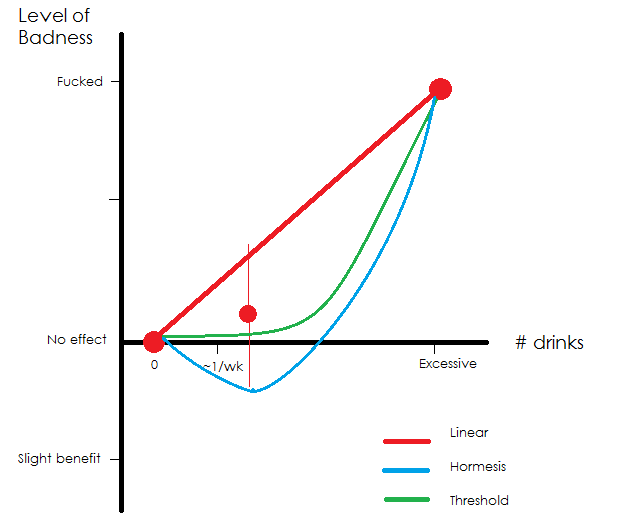
I don’t have the free time these days to dig around in the literature to get fully up-to-speed, but basically here’s the science as I know it on drinking in pregnancy: it’s bad. We know that completely abstaining is our baseline: most moms-to-be are cautious and do this. And, we know that drinking a lot is bad. In-between, there isn’t a lot of good data: it may be a little bit bad to drink a little bit, or it may have no effect until some threshold has been hit, or it may even be slightly beneficial (as this recent article suggested). So there are some big error bars in the middle there.
To pick on this study in particular, it was a retrospective study that asked women what they drank during pregnancy many months after they had given birth. Though this kind of study can be insightful and guide further research, I wouldn’t be overturning a cautious, conservative hypothesis on that kind of data. I would caution moms-to-be out there to not go out and have a drink or two on the basis of a study like this.

This is how science works, generally: you get a weak-ass study that nonetheless is cheap to do and suggests something interesting, so you get some funding and ethics approval, and do a better study, and change your ideas of how the world works as the data comes in. But real-world considerations do get in the way sometimes.

A stronger study would be one with randomization, controlled variables, etc. The thing is, it’s unethical to run that kind of study, and I don’t know if there are good animal models for the more subtle forms of alcohol-related damage, due to the unique nature of frontal cortex development in humans. Plus, there isn’t really a demand for such a study: it’s not hard to abstain from drinking for 9 months. No serious scientist wants to spend time trying to find out what the safe limit is for alcohol in pregnancy when there are so many more pressing problems to address. Nobody would want to fund it: even the brewing companies wouldn’t touch it since even if you did show beyond a doubt that drinking some amount was safe (nay, beneficial), there would be a negligible effect on alcohol sales (if it found 1 drink/week was safe, that’s not even two cases of beer for the whole 9-month pregnancy). And it could be an expensive study if you were to follow a cohort of several thousand kids to age 10 or something in order to detect potentially subtle changes in IQ and social development.

So we’re stuck with imperfect information. We know the two ends of the curve fairly well, but have imperfect information for what lies in the middle. Our simple linear assumption may not be correct, but guessing wrong has consequences. In that case, the conservative thing to do is to assume that there is no safe level, and abstain completely. Which is what the current recommendations are.

An analogy would be radioactive materials: we know that a large amount of ionizing radiation is bad: it causes cancer, radiation sickness, necrosis, and death. We’ve seen it in accident victims and those near the WWII-era bombings and tests. But even with good animal models it’s hard to study the in-between doses. Once again we have a case with really good data at the extremes of the chart, but gaps and poor data in the middle leaving open the question of what the response looks like at intermediate doses. There is a hypothesis (called radiation hormesis) that small amounts of radiation are actually good for you, and there are some people testing that out… but there isn’t really a market for that study, either. So the principle of keeping the dose As Low As Reasonable Achievable (ALARA) is employed for those working with radioisotopes. For drinking, ALARA is zero: there is no “background level” of alcohol exposure; being pregnant is very unlike being a nuclear medicine technologist. It is very easy/achievable to just not drink while pregnant. I have no sympathies for someone who can’t abstain when presented with a good reason to do so (e.g.: someone who needs to drive somewhere, is pregnant, or is on call for some demanding job).

Now the point was raised in that long Facebook back-and-forth that women suffer a lot of second-guessing and judgment by people for what they put in or do with their bodies while pregnant. It can be harsh and unfair. For many things, yes, yes I think it is, especially since there are so many little things you’re supposed to do these days, and no one can ever be perfect (not even a pregnant woman).

One person suggested it was a double-standard to criticize a woman for drinking but not for a midnight ice cream pig-out. To that I say: there isn’t fetal mochaccino syndrome, or infant chocolate disorder (indeed, chocolate consumption seems to be beneficial), while there is fetal alcohol syndrome (and just as importantly, widespread knowledge thereof). So it’s a totally different thing to look down on someone drinking, smoking, or shooting heroin than it is to judge someone for pigging out, drinking caffeine, using a cell phone, or skipping the seafood portion — I wouldn’t consider it a double-standard at all.

As much time as I spend here turning over conventional wisdom with evidence, in this case I think the evidence is not definitive and the best course of action is to continue to abstain from drinking while pregnant.


Reflections on Midwifery

April 15th, 2012 by Potato

Wayfare (and, I suppose, myself) chose to go with a midwife as the care provider for her pregnancy. As it turns out, the delivery was handled by an OB (and 2 other doctors and like 7 nurses), but that’s the way things go sometimes. In fact, I think that our case shows that the system in place in Ontario is a good one: had things progressed as planned, it would have been the midwife attending the delivery. Yet when preeclampsia lead to an induction and a complicated birth, the hospital on-call medical team was there and ready to help. Just because you choose a midwife doesn’t mean you give up the resources of the hospital in the worst-case scenario.

There are a tonne of resources out there about midwifery and how to make your decision, including several books (I know, Wayfare read many of them). In short, a midwife is someone who is a specialist in helping women in pregnancy and through to early post-natal care (such as breastfeeding), with a focus on natural delivery. It is a regulated profession, and in Ontario their use is covered by OHIP. There are many points in the debate about using a traditional physician or OB for pregnancy or a midwife, but the main ones are the potentially unnecessary interventions in physician-assisted births, and that midwives try to put the patient’s wishes first. In particular, the high Caesarean rates. A C-section is an invasive surgery, and while it’s very much needed in the delivery tool-kit, there’s a charge that it’s vastly over-used because it makes the doctor’s life easier at the expense of the patient’s wishes. The advocates of midwifery say that the majority of pregnancies and deliveries are very natural processes, and don’t require interventions or the specialized training of a surgeon. Instead, they need the support and guidance of a patient midwife.

So a midwife will work towards a natural birth, helping with positions and what-not, and can also provide some measure of interventions if needed. They’re very attentive to their mothers-to-be, with a typical midwife visit being an un-rushed affair with lots of opportunity to ask questions and get coaching along the way. There’s also a very good chance that the midwife who provides your prenatal care will be the one to help you through the delivery, whereas with a physician you may just get whoever is on call at the hospital that night. Plus she comes by a few times after birth to check on the baby and answer our many, many questions, which helps a lot since it takes a while to get around to getting a family doctor or pediatrician.

After all the research Wayfare did, and our own experience with the process, I think a midwife was a really good way to go, and I’d recommend it to other pregnant couples. If we haven’t high-risked ourselves out of the option, we’ll go with our midwife again. I make that recommendation with just a few minor caveats though:

The first is the big one for me: though midwives do hospital deliveries, many people associate the idea of a midwife with a home delivery, and many of the books and articles on midwives are intertwined with those on home births. They push not only a midwife for your natural (or mostly-natural) delivery, but also a home birth as being the best option. I was uncomfortable with the home birth idea before-hand (our plan was a midwife-assisted hospital delivery), and after our experience I think you’d have to be half-crazy to try a home-birth. Yes, a midwife has first aid training and certain supplies, but if something goes seriously wrong there’s just no way she could handle it. If you tear something (or in engineering speak, blow out an O-ring) and decide that yes, you would very much like the epidural after all, you’re out of luck. So if you start reading up on midwives and come across this information on the magical wonder of a home birth, I’d say to skip over that option. Indeed, I wouldn’t even necessarily pick a regular hospital delivery: I had “NICU on-site” as one of my criteria for picking a hospital, and in hindsight was really glad it was.

The second is that midwives are something of an “alternative medicine” practice, and tend to associate with other such practitioners. So you can quickly run down the line from your midwife with her care and sets of evidence-based practices and standardized blood workups to a referral to a naturopath, herbal preparations, or further down the line to acupuncture or out-right quackery like homeopathy. Yet they do also provide the good care of checking the fetal heart rate, prenatal screening, regular monitoring of the mother’s blood pressure and urine glucose/protein, etc.

The third is a bit of give-and-take: a pro for using a midwife is the patient-centred care, helping you to shape the way your own pregnancy and delivery will go. Whether you want it to be at home or in the hospital, with drugs or without, they will help work with you and develop that plan. But they make a lot of things that are standard-of-care sound optional: for example, a quick vitamin K injection is standard after birth as newborns can sometimes be a little deficient, and it will help them clot. I found that with some of the midwives instead of “we normally do this, but if you really object we can avoid it for you” it was “well, if you want, we can give vitamin K. Totally up to you.” Just the way it was put made me a little afraid they were just a touch too flexible sometimes, and wouldn’t default to the standard-of-care if the new moms were even a little bit apprehensive about interventions.

But those are all very manageable caveats. In the pro column you have a great pregnancy resource who is very unrushed and patient with your endless lists of questions (well, maybe we’re a bit abnormal in the number of questions we can come up with), patient-centred care, totally open to trying to meet your wishes for the birth experience, with a good chance of your primary or secondary midwife actually being the person who will attend the birth. You can page her any time if you have a concern, and usually hear back promptly.

IMHO a midwife-assisted hospital birth is a great way to go, giving you the best of both worlds: good patient-centred care for a calm, natural delivery your way in the majority of cases where that’s possible, while still being able to summon 3 doctors and 7 nurses in an instant for the minority of cases where it’s needed.

Flag Football

January 9th, 2012 by Potato

Wow, nothing rubs in the cruel realities of old age (or, more precisely, a lifetime of sedentary computer work and the cruel realities of carrying around 40 lbs more than is healthy) like playing flag football against a bunch of 20-year-olds.

I don’t quite know how I got roped into it, but a few friends convinced me to join them in the TSSC flag football league. We didn’t have nearly enough players to form a team on our own, so we signed up as individuals to get randomly put together with some other folks to field a team. The other two guys who showed up to play were good, but unfortunately they were the only ones who showed up — we had to forfeit due to lack of players (though the other team had to forfeit from lack of equipment, so we called it even and played anyway).

There were a few incidents that made me question the whole concept of flag football. The idea is to have a little velcroed-on flag on your body that the other team can rip off to show that you are down, to avoid the brain-damaging tackling of “real” football. The thing is, sometimes you can’t grab the flag, but can grab the player. So at one point one of our guys (one of the younger, fitter ones — obviously not me ;) had two of the opposing players hanging off him, but because they couldn’t manage to grab his flag, he just dragged them across the touch-down line. I had to wonder if that was a kosher goal: on the one hand, they didn’t get his flag, but on the other, they clearly had caught the player. I don’t know, I think if I were faced with the same situation, I’d be sportsmanlike/defeatist and give the other team the benefit of catching me once they started to pull my pants down: yes, you’ve caught me. It’s ok, I won’t get all rules-lawyery about ripping the flag off being the only way to stop the play. The point of the flags is to avoid tackling and the ambiguity of two-hand-touch, and I don’t want to encourage people to tackle someone just to get the flag off at their leisure on the ground.

Speaking of which, I unintentionally knocked someone down, just pushed them the right way below their centre of gravity in the process of grabbing the flag, and down they went. I went down on the next play myself and learned just how deceiving the fake indoor turf is: it feels soft enough under-foot (actually pretty good for running on), but it’s like steel wool to the touch. I’ve got some real nasty turf burn down my leg now, not to mention some sprains and bruises that I’m really feeling today. So I feel pretty bad about (accidentally!) knocking someone down.

In the end, I wasn’t much help to our team: I made a few good plays, but also dropped a catch that was right to me twice, and one time as QB just threw it right into the arms of an opposing player (hey, he was open!). And while I did learn that I suck at football and am out-of-shape, I also found it fun. As much as I hate leaving the house and meeting new people, and as much as I suck at football, in the end I had a good time last night. No one cared that I sucked or gave the other team the ball almost as much as my own, and everyone was friendly and sportsmanlike. I think I’m going to try to sign up for more of these sports things in the spring, since team sports always seem to be a better motivator to go and exercise than just working out is for me.

CPSO Statment on “Non-Allopathic Medicine”

September 13th, 2011 by Potato

The College of Physicians and Surgeons of Ontario is creating a new policy to guide physicians in dealing with CAM. There’s a bit of an uproar over the document, even down in the states. There’s a fair bit of good commentary around the web so I won’t get too far into it here, especially since there’s only a few days left on the consultation period. I did agree with the bit about using “their” word, allopathic, right in the title of the document. It framed the discussion all wrong right from the beginning.

My somewhat rhetorical questions for the College on the policy:

  • If the College is willing to allow physicians to recommend CAM therapies on weak evidence of a chance of improvement then they should equally allow placebos. If the College currently has an ethical objection to physicians prescribing placebos, it should examine why the same rationale does not apply to CAM.
  • The current regulations are quite rigorous for prescribing medications that have good evidence of safety and efficacy but which have not yet received Health Canada approval for use in Canada. Why is it much harder to prescribe a drug that does have some evidence than a CAM therapy that has none?
  • The College permits in the policy draft physicians to associate with for-profit CAM clinics, even to offer such services themselves. Why is that not a considered a conflict of interest?

Note that I wasn’t able to quickly dig up the College’s current policy regarding prescribing of placebos, but I doubt it’s looked upon favourably.

Also note that in general I’m not all that hard-line on CAM, but though there may be a place for it, it’s not in the CPSO.

It’s Over!

August 30th, 2011 by Potato

Thank you all for the messages of congratulations. The long slog is over, the thesis is revised and accepted by the faculty, and in the morning I’ll be dropping off the printed copies to be bound into book form (I tried to get it done today but just barely made it up to campus graphic services just as they were locking up).

Some quick notes before I get back on track with the regular blogging:

Yes, it is a PhD (Doctor of Philosophy) degree, so I’m “not that kind of doctor”.

No, I didn’t end up meeting my weight goals (which were initially to lose a certain amount of weight, then to simply not gain weight during the final stretch), I ended up gaining about 8 lbs over the last few months. I’ve been really bad on both the exercise and diet fronts: though I started out the spring ok for exercise, when the oppressive heat hit in July I pretty much stopped biking and haven’t really gotten back in the saddle. There have been three times now that I went on road trips with my bike packed in the car, and didn’t even end up taking it out (though to be fair, on one of those the water pump at the cottage broke just as I was on my way out for my ride, and I didn’t much fancy the notion of going for a 20 km ride with no working shower at the end).

For student finances, it worked out almost according to plan. I’m pretty good at being frugal and sticking to a budget, and though it did end up taking longer than I thought (and after my MSc, I really thought I wouldn’t be overly optimistic for my PhD timeline… yeesh) I managed to cope. As you may recall, I had a scholarship for a number of years and was actively saving a portion of that since I expected I wouldn’t finish by the time the scholarship ran out. Most of that savings I invested, and most of that into dividend payers, so in this later phase I was using the dividend income to help make ends meet when departmental minimum funding wasn’t enough to pay the bills (well, it was enough to pay the rent and food bill, but not the internet, phone, insurance, or tuition bills). I did get surprised by a few mis-calculations, the most recent being figuring when my last stipend would be paid out: I knew June was the last month I was getting paid for, but I thought my pay was arriving the following month, so that I could count on money arriving in July — it turns out I had my pay cycle wrong and the money I got in June [which I thought was for May, etc.] was the last I got. So that lead to an even tighter belt than I thought, but I suppose that’s what emergency funds, lines of credit, and investments are for. I picked up a bit of contract work in July, and I didn’t realistically expect to be paid for it until August, but here we are at the end of August and I still have no idea when I’ll be paid. Wayfare’s in much the same situation, I think she just got her paycheque for work done in May.

So right now I’m into full-on defer everything mode. I know that I’ll eventually get paid again, but until then I’m trying to defer as many expenses as possible, and tapping my non-traditional emergency funds like reward points to pay for things like groceries and gas where possible. I normally keep a large stockpile of food on hand (I suppose I have my mom to thank for that), and aside from seeking some variety and fresh foods, I could probably go 3 weeks without having to go grocery shopping. So I’m going to eat through some of that cache. I wore a suit for my lecture and defence (yes, I own a suit now, crazy!), but I think it can wait a few more weeks to be dry-cleaned. My shoes have holes in them (not serious ones, I’ve just worn through the lining near the heel so the plastic heel cup is showing on the inside), but they still work and soon enough I can switch to my winter boots which are in good shape.

I’m really good at procrastination.

As to where I’ve been for the last week: well, I didn’t have that many revisions to make, but there were a few, and I only had a week or so to make them. Otherwise I’ve largely been catching up on half a lifetime of sleep deprivation and spending time away from the internet. I got a kobo reader as a graduation gift (which I’ll review shortly) and picked up the next few books in the George RR Martin Song of Ice and Fire series, and they are not short books. I’ve already finished the second one and have moved on to Storm of Swords. It’s still technically summer, so I can make some progress on that summer reading list!

Now that I’m done my PhD what comes next for Dr. Potato? The clever-boots answer I came up with was “Dieting. Definitely dieting.” Short-term, I’m going to be doing some more research work for the next few months. After that, I don’t know yet. I’m looking for jobs, but seem to have more of a geographic limitation than an occupational one: I’m open to private sector R&D, academia, or may even try a turn at finance or pure teaching/lecturing. I’ll just have to see what opportunities present themselves.