China-Based Stock Frauds

January 14th, 2011 by Potato

Note: I am not actually alleging fraud myself in any of these cases. I have for the most part not looked into the stories one way or the other except for personal interest. Despite the fact that I love reading the stories of the investigations of short sellers, I am not myself a short seller, and hold no position in any companies mentioned.

John Hempton brought to light the case of a Chinese internet-based travel agent with a non-functional website, over the course of several posts. Though I found the reporting to be a great read, UTA is up ~40% since JH published his research. An even better time to short, or was the thesis wrong? Unfortunately I’m not going to invest the time to look into it for you, so you’ll have to figure it out yourself, or wait for the fullness of time (like me).

Kerrisdale Capital (registration may be required to view post) goes into great detail outlining another case of a Chinese private education company with again, a non-functioning website, and a teaching facility with no desks for students. It’s actually rather amazing the amount of work they went into their investigation, and to me at least, their report reads like a financial detective thriller. They also outline the mechanism of profiting from the fraud, as well as another way of spotting one: they issue more shares when the share price is high, with no concrete need or plan for the cash. The cash just sits there, despite the ostensibly high earnings growth rate.

One of the interesting parts of the Bronte Capital post was that the amount of interest income they were reporting on their income statement didn’t jive with the amount of cash they had on hand. There’s a post at Seeking Alpha on that topic.

Financial Uproar had a post recently looking at a Chinese small-cap that had my magic words “trading for less than the cash on the balance sheet.” Unfortunately, the company is mired in an accounting scandal, with class-action lawsuits mounting, and the filing of their latest quarterly results weeks late now. Using the quick John Hempton test, I looked at the most recent available data I could find: they have something like $90M in cash, and are trading at a market cap of $80M. However, that big cash stockpile made something like 25 bp of interest income in the last quarter, which is suspiciously low. Moreover, they didn’t pay down at all a revolving line of credit — why keep a LoC open with cash on hand doing nothing? Something smells funny here. If this were a local Canadian small-cap, trading this cheaply, I’d be tempted to investigate further, maybe try to figure out who was right in the accounting dispute and whether there was any business activity to back up the statements. But it’s not Canadian, it’s Chinese, so there’s really nothing more I can do but examine the financial statements, and those are now definitely suspect. Like I said at the beginning, I’m not a short seller, but I am very good at staying the hell away from stuff, and that’s exactly what I intend on doing here.

There are enough of these stories out there that I’m even worried about investing in China in general. I was going to look into some BRIC ETFs (not necessarily because I wanted to invest myself, but Netbug was asking me about emerging markets), and I have to say the lax regulation/fraud risk issue is enough for me to not bother. Besides, the Canadian market is plenty levered to the Chinese growth story anyway.

Accidental Weather Witchcraft

January 12th, 2011 by Potato

You may recall reading (and if you don’t live in London, laughing) about our woes with record snowfalls here in London this year. The snow squalls were bizarre in their specificity, these narrow finger-like bands of cloud streaming off Lake Huron, arrows shooting straight for London. Towns just 30 minutes away to either side still had green lawns in some cases. I just realized now that I may have caused this series of supernatural storms via the application of accidental weather witchcraft.

You see, just before this all started, I was starting to decorate the office for winter (read: procrastinating on my thesis) by cutting out paper snowflakes from scrap paper (and I have a lot of scrap paper on my desk). I then hung them around the office at important power nodes, including a large tissue-paper snowflake guarding my filing cabinet. Perhaps summoning the most power weather magick was a string of snowflakes, of all different sizes, with at least one cut out by other members of the office, that was then itself hung from snowflake garland. This multiplicative effect of snowflake on snowflake, combined with suspension from the ceiling in the psychic centre of the room may ultimately have been too much for the physical realm to bear, and snow squall after snow squall was summoned up and directed directly at London until finally well over a meter of snow blanketed the supernatural signal and it’s dread message could no longer be received in the humid airs above Lake Huron.

To all the residents of London, I’m deeply sorry for this irresponsible — though accidental — use of the dark arts, and I promise it will never happen again.

This oversized snowflake drew power from the filing cabinet and its Dark Contents. The filing cabinet already served as an altar, receiving daily offerings of Coke Zero tainted aluminum.

The combination of snowflakes crafted by different hands and a shiny, sparkly snowflake garland lead to an unstoppable multiplying chain-reaction of weather magicks.

ISP Regulation?

January 12th, 2011 by Potato

I was having an interesting discussion with Netbug earlier about net neutrality and bandwidth caps and the like. He also recently sent me to a standup bit by Joe Rogan:

“If I left you alone in the forest with a hatchet, how long before you can send me an email?”

It’s a funny, poignant point that much of what we use in our everyday lives is basically magic to us. Infrastructure is very important, we basically can’t do anything without the network of tools and facilities around us. But infrastructure covers a lot of things, certainly more than roads and sewers and electricity which may be what first comes to mind with the word.

At some point in the future, perhaps the ability to download large files will be seen as an important infrastructure for a country to have. Without that in place, innovation can get stifled. Maybe soon the government may wake up to the anti-competitive behaviour of the ISPs and the data caps, how it’s crippling the infrastructure, and start to regulate them like the duopoly utility they are. Maybe split the companies up so that the infrastructure company is separate from the content distribution/media company.

An interesting idea to be sure. I don’t think it’ll happen in the near future: the current government seems to have no stomach for smacking down the ISPs or touching net neutrality, but if it’s recognized that these policies are holding back whole sectors of the economy, it may be an issue in the future…

The Idea of Risk and the Housing Bubble

January 8th, 2011 by Potato

Partly for the laugh, Wayfare gave me a book of mortgage payment tables for Potatomas. For those of you not familiar with these tables, they date from a time before spreadsheets and online java calculators, when if you wanted to know what the monthly payment on a mortgage of a certain amortization at a certain interest rate would come out to, you had to run the calculation by hand. To help, tables were drawn up with the figures pre-calculated so one could just look up the value rather than calculating it. It was published in 1981, and has tables for 9% interest through 30% interest, in 25 bp increments. Interest rates below 9% were so unfathomable that they didn’t bother to print them in the book.

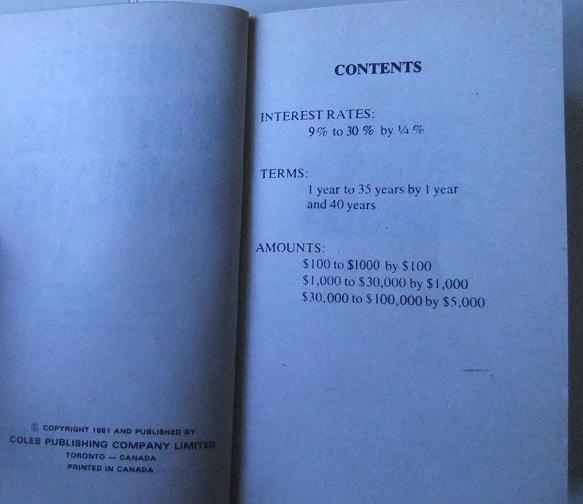
I’m not sure what the lesson there is: whether these current low interest rates are indeed so far below the historical norm that people should be prepared for higher rates in years to come, or the opposite: that times change, and now 9% is unfathomably high, and I shouldn’t keep trying to warn people about rates that aren’t likely to be seen again.

Anyhow, I wanted to explore a little bit the idea of risk and the housing bubble. This is based a bit upon some percolation of recurring themes here, and a bit upon some things people are saying on the internet (because no one in real life wants to talk to me about housing anymore).

First we really have to try to understand risk. Everyone has at least a little bit of gut feel for what risk is, and how some things are riskier than others. But everything has some form of risk to it: even GICs risk not keeping up with inflation, or in large concentrations, outliving your money. Volatility is sometimes used as a proxy for risk, in part because it’s easier to measure. But volatility doesn’t tell the whole story of risk, not by a long shot. If I’m talking about risk being the potential for permanent loss, for turning your life inside-out and just ruining your whole day, then volatility isn’t really a good measure of that at all.

If you look at a graph of the Toronto housing market over a number of years, it’s this incredibly smooth line moving up from the late 90’s to the late 00’s, and even beyond that there’s this smoothed bump in the 80’s and a little wiggle at the end in ’08/’09. So in terms of volatility, housing doesn’t look risky at all. Yet to my mind, it really is. One part of that is how the lack of volatility works against it when there is a crash. Go back to the last crash in ’89. If you were unlucky enough to buy at the top there, you’d see the value of your home decline some 30%, and stay down for years. It would take well over a decade to get back to break-even.

“But,” the people say, “why would I sell then?” And that’s a very strange question, because those same people often don’t have the same pragmatic zen attitude towards stock market corrections. With housing, you can be forced to sell when you’re underwater, for the usual reasons: job loss, move, family circumstances change, etc. When the stock market crashes though, you don’t have to sell your stocks (except for margin calls), unless you’re already retired. Heck, you can even rebalance and buy more.

The stock market by comparison is far more volatile, on any timescale. There have been 3 separate crashes in the Toronto stock market since the 1989 Toronto housing market crash. And the severity can also be frighteningly worse, about 50% top-to-bottom in the last crash. But, the recoveries are far snappier: not even counting dividends, someone unlucky enough to invest at the very peak of the market in 1989 was made whole by what looks* to be 1993; someone concerned with getting back to the 2000 peak found it in 5 years. Though we haven’t quite gotten back to the peak of mid-2008, in just 2.5 years we’re down less than 10%, and I’m pretty sure another 2.5 will find us back up there (and that’s not including dividends). Yeah, stocks are more volatile, but that works both ways, which means those crashes are both more frequent but also transitory. And you don’t have to buy in one chunk and get unlucky and find yourself at the peak (like with a house) — you can buy in year after year, so the real-life situation isn’t even this dire (as one would hope, since your investments are supposed to make you money). With diversification and rebalancing, you can do even better than the straight index.

But there’s still the fairly legitimate idea that stocks are risky: they can go to zero. Nortel went to zero, and that event seems to be burned into the Canadian mindset. “Can you point me to the house that went to zero?” Well, individual stocks are risky, but portfolios much less so. Even in one of the worst stock market declines in recent memory, a diversified portfolio was only down by about half, and much less if you had bonds too, and even then only for a short period of time. Think not so much of the house that went to zero, but the roof, or waterheater, or deck that became worthless. They’re just components of the overall investment, which as a whole is not as risky as the sum of its parts.

Leverage and familiarity of course play into the real and perceived risks: because of the high leverage employed these days (5% down baby), I’m deathly afraid of the potential for real estate to ruin your whole life. Because it’s strange and foreign, people in general are afraid of equities: the concept of distributed ownership in hundreds of companies is alien, and not in the daily experience of most people (or even in their educational readings), but everyone knows about houses (in fact, I’m writing this rant while sitting in one). However, the lack of volatility, and the last crash taking place when my cohort was still in elementary school can lead to some false complacency on the matter.

I’ve mentioned before that if real estate is overvalued by 30%, and if the typical family spends about 30% of their income on housing, then if they buy in too close to that peak, that leads to about 10% less money in the budget — about what people save for retirement. Even though it’s not so expensive that you can’t afford to put a roof over your head (that would probably bring an end to the bubble), it’s pricey enough to impact your financial health for essentially the rest of your life, which is why I waste so many electrons on this. It’s legitimately important, and it can be controlled.

I don’t know how to get people comfortable with stocks though, because it’s a fair point that if you don’t save and invest the difference when renting, the benefit isn’t really there (though even just saving in a savings account may be attractive if housing is overpriced enough relative to rent). On the one hand, equities are the riskiest, most volatile class of investments. Indeed, Mandelbrot suggests they may be even riskier than we first imagine. On the other hand, they’re not all that risky when diversified and held for very long periods of time (and as youngish folks, we have very long periods of time on our hands). Combined with the fact that it’s cheaper to rent right now, renting and investing the difference really looks to be the less risky path. Though the English language has the expression “safe as houses”, it’s not true all the time, and blind faith in real estate is in my mind, one of the most risky notions facing young Torontonians and Vancouverites.

* – Sorry, I just have a (not particularly great) graph for data that old.

The New Thunderbird

January 7th, 2011 by Potato

The look of Thunderbird has changed a bit in the latest version. One thing I didn’t like too much was the moving of the “reply” buttons to the top of the email reader pane instead of the toolbar at the top of the overall program window, where it lived forever. However, there are two neat new features that I really like: there’s now an “archive” button to quickly move your mail into an archive folder (email takes up so little space compared to today’s harddrives that there’s little sense in ever deleting anything that you might want to get back to), allowing you to get something out of your main inbox without deleting it or doing the ever-so-slightly longer “move to…” process. I find I’m more likely to hit “archive” than I ever was to hit “move to…”.

The other major advancement is a quick key-word checker that looks for words like “attached” in your email. If it sees that and you try to send your message without an attachment, it’ll give you a quick “did you forget to add an attachment?” reminder before final send-off. This is the biggest, epicest, most important advancement to the email client interface since the invention of searching. I can’t believe it’s taken nearly 17 years since the invention of email attachments for someone to come up with this simple, handy checker. Yet, I didn’t come up with it, either, so there we have it.

Whoever developed this deserves an award of some sort, perhaps the Nobel Peace Prize.

“The Peace prize, seriously?”

Yes, imagine all the suffering and wars that could have been averted if people just remembered to include attachments on their emails! Picture it: the North Koreans plan an artillery test, and to set the South Koreans’ minds at ease, they send out a quick email to note the event, with an attached schedule and an invitation pass for an observer… except the attachment isn’t included! The SKs think it’s a deliberate ploy to keep it a secret and launch an attack, so they increase patrols to keep an eye out for suspicious activity. The NKs in their paranoia meanwhile, think that the increased activity to the south is really a prelude to invasion while their artillery is loaded with practice shells, so instead load live ammo into the guns… and it all quickly goes to hell in a hand-basket.

This won’t happen now thanks to the attachment checker in Thunderbird.





