MW has been popping up in the comments sections of a lot of blogs recently touting an options collar strategy. Larry MacDonald recently briefly touched on the issue. This is an advanced method for reducing risk in your portfolio: you buy an option, essentially insurance, that limits your maximum loss. You then sell the right to buy your shares at a higher price to someone else — that limits your maximum profit, since if the stock goes above that, the person who bought your option will call your shares away. You trade off some of your potential upside to limit your downside. After stomach-wrenching losses in the market over the last year, it sounds pretty attractive.
However, the costs are usually (slightly) stacked against you. Let’s take the example of XIU, an exchange-traded fund tracking the TSX 60.
Today, you could have bought XIU for $16.40. Let’s say you wanted to limit your losses to ~10%, so you want to buy a put at $15 — the ask on that is $0.30 for a put that expires in December. To cover that cost you sell a call for $18 at $0.30 that also expires in December. This collar limits your downside to 8.5% and your upside to 9.8%. Doesn’t sound too bad so far: at almost no cash cost to yourself (there will be commissions as well) you manged to limit your risk while still allowing yourself to reap a decent profit. However, there are a few wrinkles in the collar:
First of all, the commissions are going to be somewhat draining. If we’re dealing with someone somewhat early on in their investing career, then they might have $20k to invest in any one ETF. If the commission is $20 for both halves of the collar, and it has to be reapplied twice a year, you’re looking at only 20 basis points of drag, 0.2%, about what the MER on an ETF is to begin with. Naturally, if you’ve got more money invested the commissions become less oppressive in a percentage basis, but you might run into liquidity problems with the options and pay more in the spread. See comment by MW below, I over-estimated the typical commission for options.
Secondly, there’s the small matter of positive expectation: generally, you expect your stocks to go up, so it’s not like this collar is quite as balanced as it looks: if you expect a 3% average return over the time period of the options (6% over the whole year), then you’re protecting against a return that’s 11.5% below what you expect, but giving up anything that’s more than 6.8% above average. Of course, that ties in to the idea of the risk premium: this strategy reduces risk, so you can’t expect a premium in expected returns. More safety comes at a higher price, and Michael James has a good post on this with a nice graph showing that your expected return actually goes down as you try to draw a tighter collar, to the point where you could have a negative expected return if you want to have a very low risk tolerance.
The next wrinkle is what happens if one of your options is executed? If the market goes down then at least you’re protected — the collar worked for you in this case. But then what do you do? Do you buy back in at a lower price? Do you try to time the market lower? It can add some confusion, and will require some degree of hands-on monitoring (which, IMHO, does not go along with the investor personality that needs this protection). But the bigger issue is what happens if your stocks get called? If the market goes up say 15% in a short time period and you miss out on 5% of that, do you wait to see if it goes back down, or just buy back in right away? If you don’t believe in market timing, and buy back in right away after your options are triggered, then why get the options in the first place? If you do believe in market timing, then why not just do that?
Option collars can be a useful tool to reduce the risk in your portfolio, but IMHO they are too complicated for the benefit they provide. A large portion of fixed income (bonds, GICs) can provide stability and predictably low returns without the hassle. For example, if you wanted to keep your losses at less than 10%, and you figured the largest likely stock market loss was 30% (yes, we did have a larger decline than that recently, but it was also fairly short-lived at that depth), then with 1/3 of your portfolio in stocks and 2/3 in bonds, you’d be set for safety.
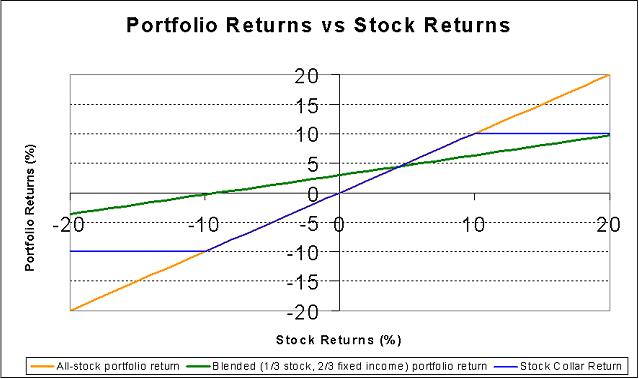
The options collar will outperform the largely fixed income portfolio in the cases where stocks to better than bonds, since it’s 100% stocks, even past the point where the stocks get called. It will underperform when stocks do poorly relative to bonds, despite the insurance. Past the point where the call is made, things get tricky because of the issue of market timing and how long it takes you to get back into stocks with a new collar in place, and what gains you miss out on in the meantime. So what we need is a more robust model that includes iterations, cycling through potential market returns and seeing what happens. The best way to do that would probably be with a Monte Carlo simulation, but unfortunately I’m not the person to do that (maybe Michael James will give it a whirl if we ask him nicely?). Here’s one quick shot in the dark though: assuming we have a collar of roughly +/- 10%/yr, fixed income gives 4.4%/year*, and stock returns are along the X-axis, we get the returns in figure 1 (inspired by MJ’s figures).
* – I originally had 3% here for the fixed income part, but in the graphs forgot to multiply that by 2/3 since only that portion of the portfolio earns the interest. It’s easier to change the text to 4.4%, which is still not unreasonable for fixed income, than to go back and redo the graphs :)
Figure 1: the options collar outperforms the fixed income method to safety when stock returns are between 5 and 20%, and again when losses are more than 30%.
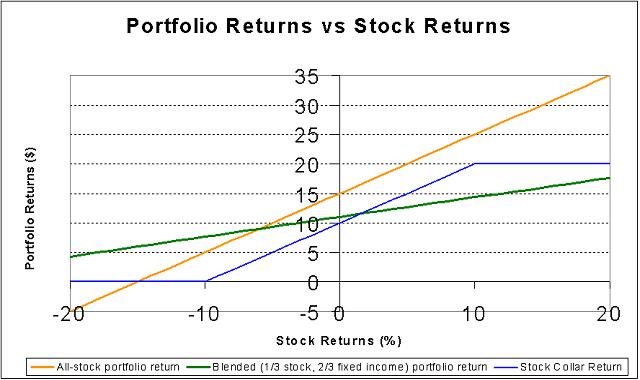
Now if we had a good year, say up 15% (and for reference, the market is up over 50% from the bottom last March) and the upper bound of the option collar was exceeded, and we missed out on 5% of the growth before buying back in to the market, we’d start the next iteration down 5% relative to the buy-and-hold portfolios (though the blended portfolio would also be down relative to the all-stock portfolio), and for the next year we’d be looking at the potential returns of figure 2, iteration after a 15% increase in the market.
Figure 2: After the market goes up 15%, if the portfolio with the options collar insurance lags by 5% before it is reestablished, then for the following year it will be behind the all-stock portfolio for all points except >15% loss for stocks, but thanks to the large (but not huge) return of stocks, it is fairing better relative to the blended fixed income. Note that this figure isn’t exact because I haven’t properly accounted for compound returns (if you go up 15% one year, and down 15% the next, you don’t end up back at 0).
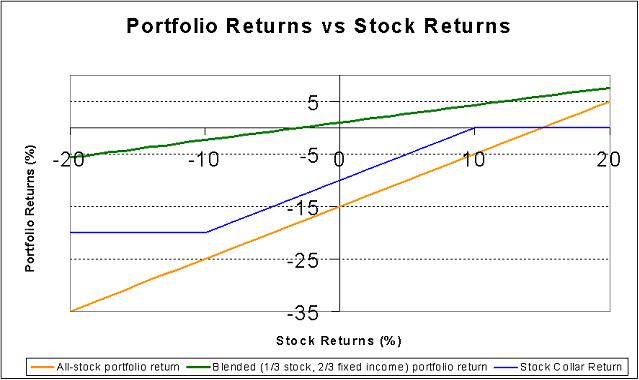
If there was a bad year, where the insurance aspect of the collar paid off, and the market dropped 15% (with the collar making you only suffer 10% of that), then we’d be in the situation of figure 3 for the second iteration. Again, I made the mistake of not properly accounting for the compounding, so the numbers aren’t quite right. Nonetheless, you see that even when the collar paid off — when the market was down substantially, the following year the blended fixed income portfolio, which is more hands-off to manage, still outperformed. You’d need to suffer a loss of something like 30% before the options collar starts to outperform the blended portfolio, though in good times (as long as they’re not too good), as mentioned above, the higher stock exposure with the options collar portfolio will beat out the blended one.
Figure 3:
Just from these cases and the complexity, I’m tempted to ignore the possibility of using options collars to manage volatility for me, and I especially won’t be recommending it to more novice investors, who in my experience are the ones who are more averse to stock market losses. Depending on the outcomes, it might outperform a hands-off portfolio with both fixed income and equities, but I’m not convinced there’s enough merit here to make it worth my time to figure out how to run the Monte Carlo simulation that would be needed to see how worthwhile it is as a strategy. This could also be coloured by the fact that I’m looking into this in 2009, as the recent market turmoil may be making the options more expensive than they would be in more normal markets (that is, zero net cost collars might normally be more bullish).
And now, since I don’t like having mistakes up here for long, the corrections to figures 2 and 3. Here I’ve converted things into dollar figures, assuming a $1000 initial portfolio in the first year, and then starting with the proper value in the second year/iteration for corrected figure 2 and 3. I’ve also added a portfolio with 1/3 fixed income (since with the smallish numbers we’re talking here, the protection is equivalent to the options collar — you’d need a >30% loss for the options collar to beat the 2/3 fixed income in that respect). The fixed income portfolios have been rebalanced to maintain the weighting.
Corrected figure 2 (portfolio value instead of percentages, after year 1 15% increase in stocks, collar misses 5% of gain):
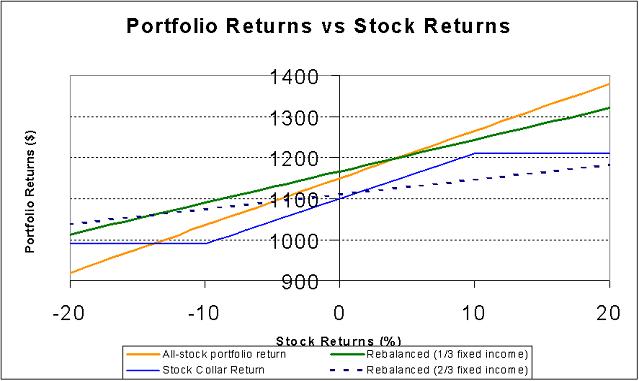
Corrected figure 3 (portfolio value instead of percentages, after year 1 15% drop in stocks, collar avoids 5% of loss):
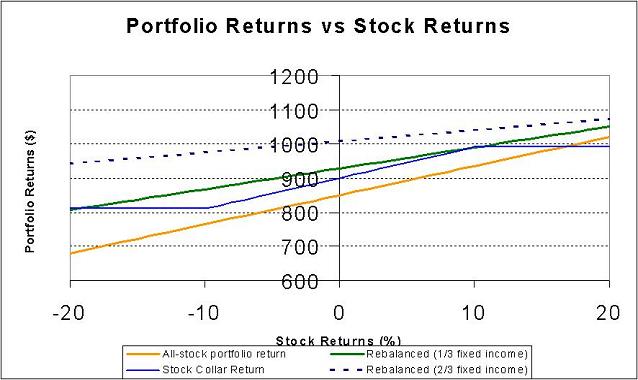
So except for very large losses in the market, a modest amount of fixed income exposure will give better returns with almost as much protection, and a lot less hands-on factors to get in the way! One could argue that the collar is meant exactly for those times when “very large losses in the market” do take place, but those are quite rare, especially if you can have a bit of patience: this year’s market meltdown was one of the worst ever, having gone down over 50% at the bottom; but after just a few months of rallying now, we’re “only” at about a 35% loss from the peak.
By now I know most of you are “TLDRing” this post with all the graphs, but what can I say, I’m a geek.
Permalink.
 as well.




 Passiv is a tool that can connect to your Questrade account and make it easier to track and rebalance your portfolio, including sending you an email reminder when new cash arrives and is ready to be invested.

