How to Discuss Uncertainty: Cancer Edition

September 9th, 2018 by Potato

My dad has read Atul Gawande’s Being Mortal, which discusses the suffering that people can experience near the end of their lives — particularly the suffering of medical treatments to extend those lives. There was no question about having surgery to remove his tumour — the cost-benefit there was huge (esp. as it had sent him to emerg). But he explicitly did not want to go through adjuvant chemotherapy, because chemo sucks and he knows that first hand, and he didn’t think it would have much in the way of benefits.

Then we met with the oncologist and found out that the regimen he’d have now would be much less severe than the kind of chemo he had a decade ago, and that the benefits were very real.

But exactly how to convey those benefits is a tricky matter. She told us, roughly speaking, that 50% of people with his kind of cancer would still be alive and cancer-free 5 years out — the surgery alone totally cured them, and taking chemo would be a pain in the rear but not actually help them because they were cured already. 20% of people would have had their disease come back, but not with chemo, while 30% would see their disease come back regardless of chemo. So, a 20 percentage point increase in chances, chemo sounded pretty good.

But it’s hard to frame that in a way that sticks. After hitting the first wall in chemo side effects, “20%” didn’t sound that great any more. So my dad wanted me to explain it to him plainly: he was giving up 6 months of his life (or at least quality of life) to chemo. What was he giving it up for? “How much longer will I live?” And I get it: he wants the benefit expressed in the same units as the cost, which would make decision-making so much easier. But the cancer stats just don’t seem to be expressed that way.

And it’s complicated: it’s not as simple as giving up 6 months, as there are probabilities and uncertainties there, like permanent adverse events, versus the probability of having a recurrence and dying (or having a much harsher round of treatment), or the probability of being cured of cancer for the rest of his life but then having a heart attack or stroke. Even if he was cancer free in 5 or 10 or 15 years, how much longer would he live otherwise? And giving up a year at 69 when he could go golf or enjoy the cottage is perhaps not worth gaining a year at 79 where he might not be having as much fun. These are all hard things to say.

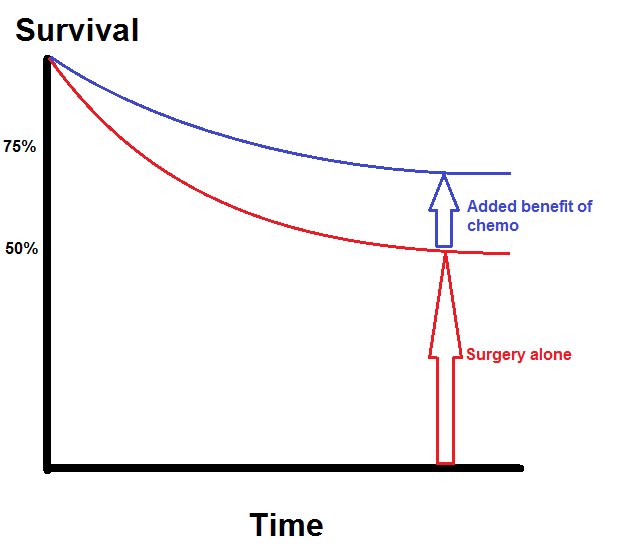
Later, I found a chart that looked basically like this that helped show the survival benefit:

A rough sketch of a survival curve for colorectal cancer patients with and without surgery, where the benefit of adjuvant chemotherapy is about a 20% increase in 5-year disease-free survival.

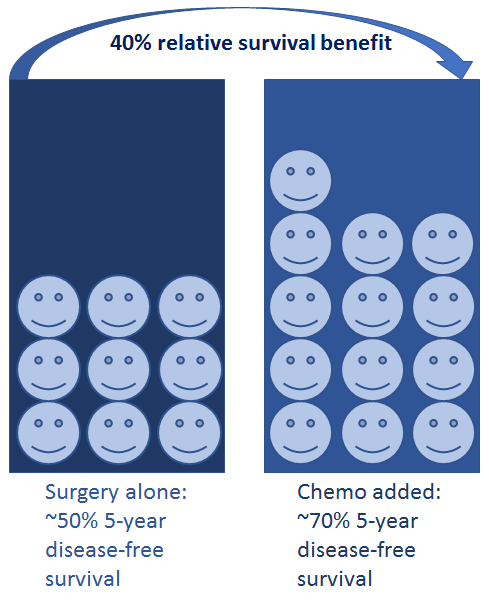
But even that is lacking, as when choosing whether or not to take chemo the percentage point increase may not be as important as the percentage increase. That is, if you’ve already got a 50% chance of survival, bumping that up to 70% is a 40% improvement in your situation — taking the chemo is better than the “20 percent” figure makes it sound.

So I made a pictograph, which I think may be a better framing for showing the benefit of chemo. The MSKCC nomogram has a similar display.

An infographic with happy faces to visualize the relative survival benefit of adjuvant chemotherapy vs surgery alone.

None of this really helps answer the question in the way my dad wants, with the benefit in the same units as the cost. I started to go down the road of maybe integrating under those survival curves, to try to quantify what the expected increase in lifespan was. I even went into some of the quality-adjusted life years research and found a set of results that I could use as a weighting function — after all, an extra month of good health at 69 is not quite the same as an extra month at 79 or 89. But I stopped because that’s guaranteed to be an exercise in false precision, and I’m not sure giving him what he wants there is the best way (and I’m also doubting myself because no one that I’ve seen in health science presents results in this way to patients — at most such things are used in health economics to talk about big picture costs and programs).

Decisions in Bad Times

September 8th, 2018 by Potato

Following my dad’s surgery for the big C, the standard of care is to give 12 cycles of chemotherapy to kill any cancerous cells that may be out there and help prevent the cancer from spreading or coming back. He had chemo just over a decade ago, and it is not a fun time, so he was a bit apprehensive at the notion before meeting the medical oncologist. But the oncologist laid out the plan and the stats and he said that it made sense and agreed to do it.

About a week after his first cycle the worst of the effects were hitting him hard, and he was done. No more chemo, no thank you. Making life miserable now for a chance at some extra years when you’re like, 80, is a bad deal and why would he have ever agreed to do it?

I went over the next day, made some soup, he started to feel better, and we went through some literature together. He agreed that a declaration that chemo was over may have been hasty, and went back for his second cycle yesterday.

That chemo causes nausea surprises no one. This was a known trade-off going in, but once he was actually experiencing these highly unpleasant side effects he was ready to quit.

You don’t want to be rewriting your plan while your head is in the toilet. On top of just feeling awful, there may be some chemo brain that makes it extra hard to make a good long-term decision.

But even beyond chemo, that’s a generalizable lesson. We’ve seen it often enough in investing: the midst of a market crash is not the time to re-evaluate your risk tolerance — you were aware that there were risks to investing and accepted those risks when deciding on your asset allocation in the first place.

The story also underscores the need to write things down. And not just the result of the plan: we didn’t need to write down that he’d be going to chemo every other week for 12 weeks, we needed to write down how he came to that decision. That there would be nausea, and that it would be temporary, and it would be worth it because the survival stats said so. Because it’s while he’s feeling that moment of doubt and urge to quit that he needs to be reminded of why he’s putting himself through this.

Cargo Cult Adulting

August 14th, 2018 by Potato

In case you’re not familiar with the commencement speech/excerpt from Surely You’re Joking, Mr. Feynman!, Richard Feynman describes South Sea Cargo Cults following WWII: “During the war they saw airplanes land with lots of good materials, and they want the same thing to happen now. So they’ve arranged to make things like runways, to put fires along the sides of the runways, to make a wooden hut for a man to sit in, with two wooden pieces on his head like headphones and bars of bamboo sticking out like antennas—he’s the controller—and they wait for the airplanes to land. They’re doing everything right. The form is perfect. It looks exactly the way it looked before. But it doesn’t work. No airplanes land.” So it has the superficial form, but of course the form is not what’s important, and without the core functions, it doesn’t work.

A recent post on doing laundry got me thinking about cargo cult adulting.

After I graduated and got a real job, my dad bought me a bunch of nice grown-up work shirts. They’re the kind of thing you have to take to the dry cleaners, or be very fiddly with about washing at home. And of course, they had to be ironed.

So, there I am*, sleep-deprived and busy as hell, watching my baby girl play in the playpen while I futz about with this scorching-hot hunk of metal. And she starts to fuss and wants out to crawl around on the floor and play with her daddy and eat all the dirt, but it’s not safe. This unstable burn hazard and relic of Victorian values is not even really safe for me to be handling in my current state. And even then, I ended up missing part of my shirt, going into work with a wrinkly arm the next day**.

I did not enjoy ironing. I had better things to do with my time, but what could I do, it was part of being grown-up and having stable employment. Then the epiphany: screw that noise. Ironing shirts didn’t make me an adult, being a good dad to my kid was my biggest ticket to adulthood, and she didn’t want me to be ironing my shirts. Wearing shirts that needed ironing (and actually ironing them) was just a symptom of someone else’s adulthood. Besides, it was 2012 (or 2013) and wrinkle-free fabrics existed in the world. Once Wayfare bought me a few wrinkle-free shirts, that was it for ironing.

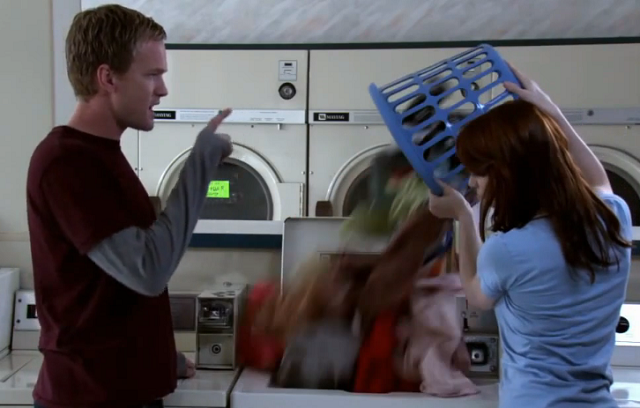
Now I have a very simple laundry procedure: everything goes in together in one bunch.

Still from Dr. Horrible -- all the laundry dumped in in one bunch.

If it can’t handle cold/normal followed by tumble dry low, I don’t want it. There’s no room for primadonna fabrics in my world, so if someone gives me a gift of clothes and it can’t deal with how I manage laundry, it just goes in the donate pile. I’ve ruined a few pairs of really superficially nice wool pants, and I have zero regrets. It wasn’t meant to be, anyway***. For the ones with sufficient warning labels (or only slightly scarred by my treatment), maybe Diabetes Canada can find someone who has that kind of time.

Of course there’s an even bigger source of cargo-cult adulting: buying real estate. Just today Rob Carrick has an anecdote in the Globe of one young adult living at home, hoping to save enough to buy a house at the expense of renting, being independent, and “[getting] on with the next phase of [her] life.”

And this isn’t some article assignment he had to go terribly far to find: it’s a story I’ve heard dozens of times in recent years. Real estate’s too expensive and out of reach, but people can’t [won’t] move out/have kids/really become adults without a house they can mortgage.

Now there’s a bit of a political brou-ha-ha in Ontario over the sex ed curriculum. Apparently we’re still using the 1998 one. Well, I graduated in 1998, so I don’t know what exactly is in that iteration — I was subjected to the one even older than that — but from listening to some millennials whine about how they have to buy before they can have kids, but the market’s too expensive to buy, so therefore they can’t have kids… well, I can only conclude that there’s something deeply misleading about how you use property deeds in there. As someone who has taken a university-level biology class and is a father, let me reassure you that there’s eggs and sperm and sleep deprivation and inordinate amounts of patience, but at no point does the legal ownership of land or structures factor into reproduction.

Anyway, there will be lots of adjustments from previous generations. Maybe you won’t have a single job that you use interchangeably with the word career — the gig economy is a monster and it’s coming for us all. Maybe you won’t own the roof over you head, or a car. Maybe you will have more monthly bills as Netflix and cell phones weren’t a thing for your parents. Maybe you won’t spend half your weekend on lawncare (or maybe you’ll spend more as you turn your little patch of dirt into an apocalypse-ready source of calories and essential fatty acids).

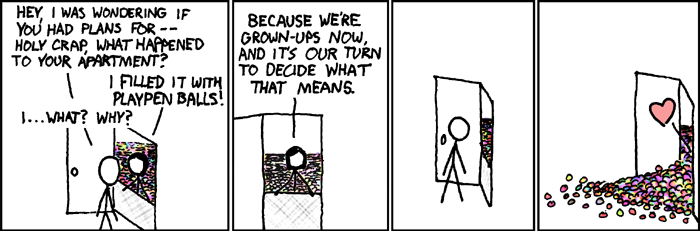
Comic from XKCD: an apartment filled with playpen balls. Why? Because we're grown-ups now, and it's our turn to decide what that means.

You are**** an adult and you get to decide what that means. You don’t necessarily need the same trappings and signifiers of adulthood that your parents had. And they won’t make you an adult any more than coconut headphones could call down a C-47. Don’t make yourself feel like you’ve put your life on hold for something that doesn’t even matter in the end.

In conclusion, screw ironing. Long live the wrinkle-free workshirt!

* – This is like 6 years ago, so it is safe to assume that this anecdote has been heavily embellished by time if not my story-telling.

** – This because wrinkles are beneath my notice, so of course I actually* wore it instead of just re-ironing it.

*** – This is a great part to put in a gif of Dr. Horrible looking in the washing machine and saying “I don’t love these!” but I can’t find one pre-made and I don’t want to invest that kind of time. Just imagine that I did. Also, it helps to play “A man’s gotta do” while reading this post. Actually, if it’s not too late, just skip reading the rest of this post and go re-watch Dr. Horrible’s Sing-Along Blog.

**** – Unless you’re not. It’s the internet, after all.

You Don’t Have to Have an Opinion

August 12th, 2018 by Potato

There are a lot of things in the world to potentially research. Even just restricting the conversation to investing, there are a lot of potential avenues to put your money to work. However, you don’t have to have an opinion on everything.

I was on Tom’s podcast recently, and he threw me some questions on bitcoin and peer-to-peer lending. Things like this pop up from time to time, and I usually do have something to say. But just because I have an opinion and want to talk about it doesn’t mean it’s a strong opinion, or that you should go off and waste some time doing a bunch of research.

There’s a difference between having an opinion for the purposes of a discussion or entertainment, and an opinion for guiding your investment decisions. I’m not trying to talk you out of ranting about bitcoin or whatever individual stock is in the news or whatever you like to talk about at parties. But just because some new option is there doesn’t mean you have to give it full due diligence and a careful pro/con decision process to determine if it belongs in your portfolio.

Sure, bitcoin went up however many gagillion percent through to the end of 2017, but it just as easily could have gone another way — that doesn’t mean you have to start researching bitcoin or every potential growth story in the future now. If you missed out on the crypto craze, you’re probably still doing just fine on your trajectory to retirement (and if you jumped in late last year you probably regret it at this point).

And almost all the stuff on TV and in the paper on investing, all the different styles and strategies and specific companies — most of that is just discussion and entertainment. It’s very hard not to talk about something when someone else wants to talk about it. That goes double when there’s a camera on you. Engaging in a discussion on some potential investment is not a pointer that you should be researching this stuff or taking the opinion seriously. Often guests on BNN have opinions on stocks they do not own, to reinforce that point.

Buffett had this concept of the “too hard pile” — he didn’t have to come to a buy or sell decision on every stock, if it turned out it was too complex or outside his circle of competence he could just shelve it and move on to the next opportunity. Sometimes in a conversation someone may give you a forced choice “which one would you pick? OK, but if you could only take one with you when you’re stranded on a desert island…” but real life rarely does in the same way. And it’s ok to say that you don’t know and don’t care to waste the time trying to decide.

Focusing on the essential building blocks — your savings rate, fees, risk tolerance — is what will help you meet your goals. Debating the blockchain flowchart can make for good conversation, learning about new things can be fun, but that doesn’t mean you have to seriously consider how much of your portfolio to put in whatever the obsession of the week is.

Worry-Free Money Review

July 31st, 2018 by Potato

Worry-Free Money by Shannon Lee Simmons describes how you can set up your finances to make sure your major goals are met and your money is working to help make you happy. Once the big things are taken care of, the method she describes lets you spend the rest worry-free. It’s a fantastic message, lots of people (including me, despite nitpicks) love the book for this, and it’s easy to recommend.

The chapter on dinner out with friends was great. To steal a quick summary: everyone felt pressured to attend an $80/plate dinner and didn’t want to miss out, but the price tag didn’t really fit anyone’s budget. By talking openly about it, the group was able to figure out the trap they were in and find a way to still hang out and have fun without breaking the collective bank.

“Is it safe, is it happy?” This isn’t a quote from Gandalf, but a framework for deciding when spending is good spending. And it’s a framework that I think is driving a lot of the positive reviews — it’s a good, simple way to frame your spending problems.

The “F*ck it moment” was a good way of framing that moment of weakness when we overspend, but I hated the orthography. Yes, the asterisk is in the book. The book for grown-ups that she wrote herself. I know it’s nitpicky, even for me, but for fuck’s sake if you want to swear then just swear — the asterisk isn’t fooling anyone. Those who are prickly about such things will still be prickly (I can tell you from experience — three obscured letters appears to be the prudish sweet spot), and it’s not like you had a network or regulator censoring your book. And if you don’t want to swear, then just call it something else in the first place: a screw-it moment, whatever moment, cowabunga moment, a Scarborough subway moment — there are lots of euphemisms.

Nitpicks

I got an advanced review copy, so I’m not sure how many of the errors were caught before final publication, but there were some funny ones, such as including costs in multiple categories in the highly detailed budget examples (am I the only one not spending hundreds of dollars a month at the gym as both a fixed and variable cost?). One appeared to be an issue of incomplete adjusting of a real case to an anonymized example, where a family with a 5-year-old has been struggling with daycare payments for 8 years (that or it’s a case of an unspeakable — and unspoken — tragedy).

One that I’m pretty sure is not an error is the description of how to figure out how much to save for an emergency fund. While I agree with a lot about the need for emergency funds and how she describes it in general, I have a hard disagree with this:

“The only way to set a savings target for an emergency account is to work out an average based on your spending history.”

Not only are there other ways, that’s a pretty bad one — if I had used that method, I would have $0 in my car repair emergency fund, and been left completely unprepared for the $1700 in damage a mouse did last winter. Similarly, she suggests reducing your emergency fund by anticipated EI payments. I can say from multiple experiences that EI is not a replacement for an emergency fund: it will eventually come through to help backfill your emergency fund, but delays in getting your EI are fairly common and you can’t rely on it in lieu of emergency savings.

That last point may be because she puts a lot of focus on accepting that people are people and to not stress people out with unrealistic goals, that it’s better to aim for something small and achievable than for where you really want them to be — though in that case I would have helped provide a method to better estimate emergency fund needs, and then tell readers to start with a month and work up to 3-6 months’ of expenses saved later.

The Problem with Dylan

I loved the “opting out of life’s checklist” part. You can’t compare yourself to other people, you don’t know how they maintain the tiny sliver of their lifestyle that you can see, and sometimes your life’s checklist (buy a detached house at age X, for example) don’t work for your life as it is and you have to change those plans.

We can’t all be robots (yet… the assimilation technologies are advancing though), so I suppose it’s good that she tackles head-on the difference between what you can do and what you will do. That mixing and balancing between the emotional/irrational part of personal finance with the finance part is always a bit difficult for my spreadsheet-based operating system. I mean brain. That organ above my neck that is totally made of wet gooey gross stuff just like yours. Anyway, it’s great that so much of this book goes right into that terrain and a big reason for all the love it’s getting.

But I didn’t get a good sense of when financial exigencies led to a “lemonade” awakening, where someone should adjust their life checklist, or when the rules of thumb could go out the window in the name of mental health. The story of Dylan was the biggest thing that stuck out here, and I think there were many problems with the case study.

To recap: Dylan’s just barely out of the lowest tax bracket, trying to live in one of the most expensive cities in the world. He was living with a SO who made more than twice as much as him, so it’s not a surprise that he’s in for a big lifestyle adjustment when the relationship falls apart and he’s out on his own.

But he wants a 1-bedroom above-ground apartment in a good location — no basements, no commuting — which will be something north of 70% of his income on housing and fixed costs. That violates the earlier rule to not commit more than 55% of after-tax income to fixed expenses. Oh, and he has a bunch of credit card debt. Shannon does a good job talking about how to make it work temporarily, the value of saving even $100/mo in fixed costs, and finding even a small amount of extra income… but this is a major violation of “the rules”.

Usually, you break the rules in an example to prove a point, and I do not see why Dylan breaks all the rules here — because he doesn’t want to live in a basement apartment or leave a city he can’t afford where his higher-earning ex just threw him out? The only justification was that it was “Not good for my emotional well-being.” So do none of the rules apply if it’s for emotional well-being? Or, given a similar thing happens in Burn Your Mortgage, is the general principle simply that financial rules of thumb don’t apply to Toronto and Vancouver?

“No matter which way we sliced it, the breakup meant that Dylan would be forced to live beyond his means for the next five years. Welcome to real life.”

That “welcome to real life” could just as well have been said to Dylan and his preference for a 1-bedroom apartment in an expensive area — instead of being forced to live beyond his means, he could just as easily been forced to live in a smaller space or (gasp!) with roommates. Now, he’s young (though that point is not reinforced), so letting his goals slip for a few years was something he could (and did) recover from, but I think there’s a danger the average reader takes another message entirely away from the case.

There’s another big problem with Dylan: that credit card debt. While he’s paying interest at 19% for nearly 4 years, Dylan is sitting on more than enough assets in his RRSP to wipe it out in a stroke. Shannon says not to tap them for a completely screwy reason — as Michael James puts it:

“…Taking money from his retirement account didn’t make sense because much of it would be taxed at a higher rate than the interest he was paying on his credit card.” There are good reasons not to touch retirement savings, but comparing a tax percentage to a credit card interest percentage makes no sense at all. You might as well decide to buy a car instead of a house because the car has more tires than the house has bedrooms.

This could likely be a blog post in its own right. But briefly, she’s comparing an annual rate of interest to a one-time tax, and furthermore, that tax is something that will apply at some point no matter what — indeed, he’ll likely never get that money out at a lower rate than he could right now (and then he should prioritize his TFSA once he starts saving again). While there are behavioural issues associated with tapping retirement savings to pay off a credit card (which she does get around to later, such as “putting him into scarcity mode by emptying all his accounts” and making long-term savings short-term ones), that only comes later, and is in reference to his emergency fund rather than his retirement savings. In terms of money sense he absolutely should have pulled the money out of his RRSP to attack the credit card debt. Moreover, that would have freed up $300/mo in his budget (when the rest of the story was about a song & dance to eek out $200/mo).

The Dylan story has a happy ending, but only because he ended up getting more income than the plan called for, and didn’t face a big increase (indeed, any increase) in his rent and other fixed costs. It could have just as easily ended as the next story does, where he builds his plan around being tight for a few years, but banking on raises/more income in the future to offset it… which never come or get eaten up by increases in lifestyle spending. Then instead of facing a big lifestyle adjustment once, he’d be in for two rounds.

Conclusion

Worry-Free Money is a great book, particularly for beginners. It goes into a lot of detail on managing cashflow, with a spend-the-rest/hard limit method that may work better than traditional budgeting for many people who are made of meat and feelings. It acknowledges that emotions exist, and those emotions may compete with financial goals, and takes a holistic view where finances are part of that.

I loved the encouragement to talk honestly about finances, and how many people may be feeling the same financial pressures as you. There are nitpicks (and again, if you’re new here, that’s just how I read and likely why I work as an editor), and it’s left kind of fuzzy when preferences have to give way to the harsh truths of the real world, but I liked it enough that it’s in the reading guide in the back of the 2nd edition of the Value of Simple, and whenever I get around to updating my graphical reading guide I’ll probably include it there, too.