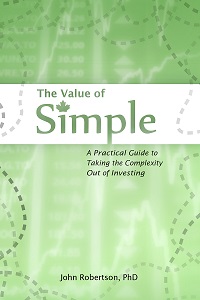
Book Update: Not a Failure

December 15th, 2014 by Potato

Before I launched the book I tried to envision how it would do. I did the Fermi math: there are millions of Canadians who need a book like The Value of Simple: people who are not DIY investors, but want to be (I even found stats on the number of discount brokerage accounts that are opened yet not used for DIY*); or who are paying outrageous mutual fund fees and don’t even know it, and would want to look at a low-cost investing method if they only knew. But I knew that despite the size of the target market, very few of those people would buy it. If I hit 10% of them it would be a huge, smashing success, but fractions of a percent were more likely. Sales measured in ppm were possible.

Like a good scientist I defined three levels of success for myself in advance.

I’m happy to say that at the end of the 2nd week of release, I have hit the first level of success — which perhaps I should instead define as not-failure. I have now sold enough books that I have broken even! When I put up my posts on the publishing process I’ll talk more about all the out-of-pocket expenses involved, from paying the artist for the cover, to the set-up fees at the printer, to printing and shipping review copies, to various office and mailing supplies. But those have now been covered by the sales so far. I was pretty sure I would hit this first level going in: I only needed to do a bit better in sales than Potato’s Short Guide to DIY Investing did to break-even, and The Value of Simple is a much better book than that first guide was.

The next level of success I defined as the point where I would get something close to minimum wage back on all the time I invested in writing and publishing the book — easily 1,000 hours that I’ve tabulated (and I’m sure I missed some in that estimate). That’s the point where I would feel really justified in the effort of putting out the book and would call it successful enough to actually consider doing something like that again in the future. That would be “success.” Beyond that would be a “smashing success” — selling over 5,000 copies, which is the approximate rule-of-thumb for being a Canadian bestseller (though whether the book would actually appear on any such list is another question).

The sales pattern for the first two weeks is kind of interesting: a peak at release, then another one after some favourable reviews and giveaways were posted, followed by an exponential decay — though I’m hoping that there will be an even larger peak to come with a lag from the first two as people read it, love it, and go tell ten or twenty friends about it.

* – A third of Canadians would like to invest for themselves, but don’t have the confidence to start. Half of those who have opened a self-directed account continue to pay an advisor.


Poloz Got My Memo

December 14th, 2014 by Potato

In a shocking change from vague mumbles about concern over debt levels, the Bank of Canada broke out The Potato Gambit this week, explicitly saying that houses are over-valued and by how much.

I’ve said several times over the past few years* that the housing bubble is held up by a number of factors: belief that there isn’t a bubble being the main one. There are many possible ways for that belief to be tested and for the bubble to end. Having someone credible coming out clearly on the news stating that there is over-valuation could help end it overnight, as the veil is lifted from the eyes of the masses in one move. In other words, that it would be possible to talk the market down by pointing out that the emperor has no clothes, absent any other catalyst (despite the “need” for rates to rise, or unemployment to rise, or for the yield curve to invert, or CMHC to be reformed, or whatever other supposed necessary condition people come up with).

Stating how much housing was over-valued by was a key component of the gambit — the end of bubbles is always a nasty, drawn-out affair as the market gropes to find solid ground. Many houses will go unsold, their owners trapped as the market goes “no-bid” with people waiting to see where the bottom is, unsure if 10% off the last traded price is a good deal, or just the start of a more substantial correction. So, the theory went, if someone like the finance minister (or as it turned out, the BoC) stood up and said “the market is over-valued, and by this much” then people could bid 30% less, and sellers would know that indeed, that was not just some totally flaky buyer taking the piss but a legitimate post-correction offer that they should take. And the sellers won’t list just to see what they can get — if they’d rather hold than sell at those prices, then they can do that without all the listing and rejecting offers business, keeping inventory at normal levels. Boom, the correction could be over in a day.

All that has to happen is for all the buyers and some of the sellers to get with the program.

I know we’re only a few days into the new enlightened age, but it’s not looking good so far. The government is not presenting a united front, with Joe Oliver sticking to the old party line that there is no bubble. The media is not following-through on the gambit with the “so there, correct your bidding strategy now!” message, and headlines of “what a 30% correction means for your local town.” There are a few stories taking it seriously, but no real call to action. This article in the Globe has the headline “Why Canadians should consider Poloz’s overvalued housing warning “, which kind of starts to make the case that this is a real issue, but then it ends with “You can, of course, brush off such threats…” And I’m not seeing a massive shift in sentiment on the various forums or at a party this weekend — as credible as the Bank of Canada is, the message isn’t taking hold.

So maybe it will work if it can stay in the news cycle a little longer, but given that this is already the nadir of the market for housing activity, and the story may be forgotten come spring, it’s not looking good for the Potato gambit’s effectiveness. It was worth a shot.

* – Apparently mostly on forums, as I can’t find a post in my archives to link to, other than an unpublished draft.

TFSAs: GIS and Business Income

December 12th, 2014 by Potato

First, a quick boring set of personal notes:

    1. I got sick shortly after the book launch. Not a whole mess of symptoms, just a bad cough — but it’s lingered and if anything has been getting more violent. I’ve lost my voice from coughing, and now sound like a squeaky, sickly 12-year-old. Would you like fries with that? [yes/YES]
    2. I only had a few things left on my post-book-launch to-do list, unfortunately two of those items were spreadsheets to finish fine-tuning and I just can’t brain right now. Thank you for your continued patience. I also haven’t been very good at responding to emails and pushing the book because of all that — please send me a poke if you’re waiting for me to respond to something.
    3. I have been keeping up with shipping books out at least. Remember that you should order by Monday if you want to be sure that your purchase will arrive before Christmas! Note that right now with the sale at Amazon and Indigo that retailers may be the best place to buy The Value of Simple rather than directly (depending mostly on whether or not you’re buying anything else to get free shipping).
    4. Don’t forget to please put a review up on Amazon and/or Indigo if you’ve finished the book!

Two somewhat hysterical issues around the TFSA have been running around the last few weeks. The first is some worry that people can stock big TFSAs and thus have lots of money to live on, but because it’s not income they’ll still get GIS. Will it lead to a TFSA nerf?

Maybe it will. It does seem like a loophole or unintended consequence that in a few years someone could have a pretty decent pot of money in a TFSA and yet still get GIS. Young people starting today may be able to exclusively use TFSAs to fund their retirement, especially if the contribution room doubles next year. But there are already loopholes for otherwise rich people to collect GIS: like many government programs, it is income tested and not wealth tested. So people with tonnes of money in a chequing account earning no interest could collect GIS (though it may not be wise to do so vs. investing in a TFSA), as can people with large real estate holdings that are not spinning off active income. I don’t see the government ever closing the real estate loophole. Maybe they will close the TFSA one in time, but it’s going to take another decade or so before it’s really an issue for enough people to have enough TFSA room to be doing well enough that they clearly shouldn’t get GIS but do.

Moreover, we’ve known this since the TFSA first launched. Indeed, the general advice is for lower-income people to prioritize saving in their TFSA specifically so that they can keep their GIS eligibility.

The second is that the CRA is cracking down on some day traders, disallowing the tax shelter for carrying on business. A key point of information that I haven’t seen in these articles is that the regular partial inclusion of capital gains doesn’t apply for professional traders — it’s all business income. So if you just got lucky in your TFSA it doesn’t look likely that the CRA is going to come after you and disallow the tax-free nature of that gain — it will almost certainly require a few other factors, which would have put your non-registered gains at risk as well. Again, I don’t think it’s something the average person has to start worrying about now.

The Value of Simple is Out

December 6th, 2014 by Potato

The official launch for The Value of Simple was Monday, and there a few more reviews up at Financial Diffraction and My Own Advisor (where the giveaway is still open!). I also had a few readers email me with some great feedback, and I’ve been putting that up on the Reviews page as well.

Amazon and Indigo are now accepting reviews if you’ve had a chance to read it and are willing to write a review. The rankings are quite volatile, but it’s hit #1 in Amazon for the “Retirement Planning” and “Investing: Introduction” categories this week, and #3 in “Personal Finance: Investing” at Kobo, which is pretty cool. Between that and the awesome reviews it’s looking good so far!

But before that, we kicked it off with a launch party on Saturday. I gave a short talk and then answered some questions on the book, focusing on how my training as a scientist gave me some perspective on personal finance and investing, and what I was trying to take from my experiences and put into the book.

In particular, the effect of inflation and the importance of investing was an important lesson. Back when I was starting my PhD I got a 4-year scholarship, but nobody in my department finished a PhD in less than 4 years — I had to save and invest myself to be ready for a likely year 5. For students who didn’t have a scholarship, the take-home pay for working in the lab was just $16,000/yr, which is what I was set to face after my scholarship ran out. Now that is not a lot of money to live on, but it’s not like the department set that low rate consciously: it just crept up on them. In fact, at the time my supervisor did is PhD, students would have had the same $16,000; a student starting today will also make $16,000 — and will still have to live off of $16,000 in five or six years at the end of their degree. That’s not to start a long rant on science funding and grad school and everything, but to look at the importance of inflation.

At some point, that was probably a perfectly reasonable stipend, but inflation has eaten away at the buying power over the decades. And the same fate awaits money left in a savings account that isn’t keeping pace with inflation. Your hard-earned savings will seem a pittance in retirement if they’re allowed to be ravaged by inflation. Getting a return that beats inflation is critical, and that brings you to appreciate the importance of investing — a way to get an above-inflation rate of return.

It also hammers home the need to save and invest so that you can prepare to support your own retirement: OAS and less-than-full-CPP are just about $16,000 (even full CPP does not take you much higher), which is not a level I would call providing for a comfortable retirement.

Holiday Orders: For some reason Amazon is reporting estimated delivery times into mid-January, even for books that were ordered on launch day. I believe there’s a good chance that those estimates will come down in the coming weeks — the supply chain just isn’t that long — but if you need a book before Christmas, orders placed through my direct site by Dec 15 should arrive before Christmas at regular shipping, and rush orders can be arranged after that if needed. I have not heard anything one way or the other from customers, but Indigo indicates that they have books in stock so you should be able to get a copy in time from there. They also put the paperback on sale today (it’s actually cheaper from Indigo now than directly from me!)

Update: Sure enough, customers have received update emails from Amazon with new shipping estimates for next week (2 weeks total). The purchase webpage still says 1-2 months though.

Finally, sorry for the lack of posts — between being swamped on all fronts, the database powering the site decided to crash this week and I had to trouble-shoot and go back a few days in the backup.

Value of Simple First Reviews and Launch

November 26th, 2014 by Potato

It’s almost launch day for the Value of Simple! It’s also the last day to pre-order and get free shipping on the paperbacks (as of Thursday they will just be regular orders as the mail wouldn’t arrive until after the Dec 1st launch anyway).

I’ve put a new page up on the Value of Simple site to track the reviews as they come out. Financial Uproar and Michael James on Money are the first two to come out, and as a paranoid author I have to tell you they practically brought tears to my eyes. There was some part of me that was worried people wouldn’t like it, so it’s just amazing and relieving to read (and re-read, and re-re-read, and print out and stick on the fridge) those reviews. So great to see that people who are experts in this field get it and liked the book (and of anyone, I trust these two to honestly — and constructively — critique it if they didn’t). They’re each giving away copies, so be sure to head over and enter for your chance at an extra one (you can always give it to a friend).

At some point a few weeks after the launch I’ll do a more detailed post on the work behind-the-scenes for the book. I will say that there are a lot of milestones and I had a lot of deadlines I imposed on myself to get it done and make sure it was out before Christmas, RRSP season, and changes to mutual fund fee disclosures, and I have hit almost all of them — but there are still two things I need to do before the weekend, and with a major day job project due on Thursday that’s going to make for a busy Friday night on my part to catch up!

Finally, the book launch event is this Saturday! If you’re in Toronto please come out — it will be a great financial literacy/meet-and-greet event. My events team* has been going all out: catering (by Pickle Barrel!), getting a giant poster of the book cover made to display, figuring out how to post directions to the room within the venue, all that nitty-gritty stuff. It should be fun and educational: I’ll give a brief talk about investing and the importance thereof, and may make some reference to the fact that I just wrote a book about it. I have foresworn from using powerpoint so that part will be kept short and more narrative, then we’ll break into Q&A and general discussion. It will be pretty informal and family-friendly (Blueberry will be there) — one advantage to hosting at Mitchell Field Community Centre is that there’s an indoor track to let the munchkins run around on if they start to get too raucous :) You can find more details and sign-up here.

* – Wayfare and her parents.