New Year’s Miscellany 2014

January 5th, 2014 by Potato

Active investing:
Note that even though I did win the Financial Uproar Misfit Bloggers stock picking competition this year, and did actually invest in each of my picks, my actual returns were not nearly as good as what you see in the contest. Partly because, you know, the fact that I own more than 4 stocks. I should also note that I came in last place for 2012, such is the nature of these contests. Anyway, my rate of return (IRR) for 2013 was bang on 20.0%, which is a fair bit below my passive benchmark return of 23.9% (though in an absolute sense it was a fantastic year). I invested heavily in Dundee International, which has slid through the year, and sold too early on many winners (with at least two going on to roughly double after I sold them). There are loads more mistakes to point out, including checking out mentally through the fall when I was busy as balls. With that under-performance and no strong investing ideas in hand, this year’s savings will be going into the passive portfolio.

Power outage:
When last I posted, the outage was into its sixth day for us. We ended up being without power for seven days, only to come back to find that despite all our precautions one of the pipes burst. That led to another few days of couch-surfing as our water stayed off and the kitchen was torn apart to fix it. It was actually a bit of a miracle the landlord was able to fix it that fast — much more difficult and we would have had to wait for an outside plumber to do the job. However, we were left with a bit of a mess to clean up (the first mess from when we evacuated in the cold and dark, leaving behind dirty dishes and what-not, then cleaning out the fridge and freezer, then a pile of drywall dust and insulation everywhere). Then, just after we moved back in, we had another 2.5-hour outage. As soon as the lights started to flicker I realized I have some mild form of power outage PTSD now. It was so much colder that night than the ~0°C night when the power first went out: the house cooled as much in those 2 hours as it did in the first 12 of the original blackout (when we were starting to talk about evacuating). Thankfully this time it was both short and we had some communication from Toronto Hydro on what to expect. At least the house is clean now. I’m not sure the fridge and freezer have ever been this clean.

Busy:
I came into my 2-week winter “vacation” with a massive to-do list, to catch up on all the stuff I had been pushing aside while I was so busy in the fall and also to start some new projects (like to finally sit down and start crystallizing the 2nd edition of my book, and to help set up all the computers my family got for xmess). Well, I lost two full days to driving alone with the ice storm and power outage, to escape (in poor conditions) to my dad’s at first, then shuttling back and forth from Wayfare’s parents’ place to check on the house and run the portable heaters in a vain attempt to prevent the pipes from freezing. And I could forget about being productive while staying over at someone else’s place. Then we had to clean up the mess caused by the prolonged power outage. So I don’t have any new posts finished for you, no progress on cleaning out the junk in the house (just cleaning of the junk), and I haven’t even looked at a request to write a book chapter, let alone thought about the material itself. I am not remotely caught up on sleep, either.

Though speaking of sleep, after spending a few days couch-surfing through this disaster, I have come to appreciate the couch for its sleeping art. As a side sleeper, couches are not so bad, though tossing and turning often means completely flipping my setup around to keep my back to the back of the couch. But I like having that warm, soft vertical surface against my back. I think someone should invent a bed with side uprights like a couch has, but with a decent amount of flat space for sleeping and no bloodly couch cushion voids. Uprights on either side, that would be awesome.

Past Writing:
My book has now made it to #12 in the Business & Finance, Personal Finance, Investing category on Kobo. Note that this says more about how few books on investing people buy than it does about my success. Indeed, all of my earnings from Kobo are still theoretical as I have yet to hit the sales threshold needed to actually get a payment from them. Also, I got a call from the GBGHF top dog on New Year’s day to thank me for the brochures I put together for them: in less than a year, they are over three-quarters of the way to their three-year fundraising goal. They’re finding that having a (high quality) physical brochure is really helping them when they meet with donors, especially when they carry them around for those serendipitous meetings. It’s also helped with their other efforts: having the staff profiled in those brochures opened the door to prominently featuring staff in their other ads and communiques

Blueberry:
Blueberry was bad at dinner tonight, putting her grubby hands into her hair. And not just like “huh, my head’s itchy” brushing her hair, but after touching her head and getting told not to by Wayfare, she stared us down and planted both her hands on the top of her head with an evil grin plastered on her face. Then after we cleaned her up, I sat in the chair in the living room and stared at her in what I considered to be a stern and parental manner. She mugged and smiled and tried to get on my good side/make me break character. I held my disapproving ground. Then she spontaneously ran full-bore at me, crashing into my chest in a massive attack hug.

The hug game was born. A few more minutes of running, giggling, and hugging and all was forgiven (you try suppressing a grin against that onslaught of cute). This is the best thing that has ever happened in the history of everything.

DarkTO: Day 6

December 27th, 2013 by Potato

With the 6th day of the power outage coming to an end there’s still no sign of power for our street. The neighbourhood association got its hackles up after the Toronto Hydro soundbites today about being down to individual houses/house-to-house action when nearly a square kilometre was still dark for us. (The current wording is “localized neighbourhoods”.)

The utility still won’t provide anything like an estimate.

I can understand that in the first day, when trees were falling faster than lines were going back up, it was impossible to provide any estimates. But at that time we were told to prepare for up to three days. Some of us are well past double that, and it would be really good to know what kind of arrangements to make at this point — our frozen houses aren’t really habitable, and our relatives (though too polite to admit it) are clearly getting a little sick of our couch-surfing, house-crowding ways. For those who booked hotel rooms to stay warm, a generator might be cheaper than continuing to pay by the night if this is going to take another week. I’m fine on the couch and have my laptop for updates, but if I have to stay away for many more days I’m going to want to move more stuff out (and maybe grab more than 2 changes of clothes so I’m not constantly doing laundry at the in-laws’).

Though we bugged out early (largely because of Blueberry, partly because I had a bad feeling about the whole thing based on how terrible our power reliability has been in the best of times this year), it was hard to leave at the time because you keep thinking “any hour now…” I’ve been back to check on the house once or twice a day, and the neighbourhood is deserted now. I cleaned out our fridge and freezers, must be over $500 in spoiled food (and lots of home-made and frozen toddler dishes). Less than a third of it was salvageable.

On the news there was a factoid that the fire department is dealing with 10 times as many carbon monoxide calls as normally. I find that a really oddly low multiple with so many people trying to keep warm in unique ways. Is the baseline rate that high, or is it that the few cases we’ve heard about in the news are about it for carbon monoxide calls?

No Power

December 26th, 2013 by Potato

We’re now heading into our sixth day without power here in Toronto, one of the hardest-hit sub-regions. From driving around the now-deserted neighbourhood, there are a lot of wires down that have just been marked with caution tape and left on the ground. If they all have to be strung back up to restore power, it could be another day even after the crews get to us.

The ice is so thick on everything: well over a cm thick on the ground, and now covered with ~6 cm of snow. The first day the ice was textured, kind of like curling ice, so it wasn’t actually all that slippery, but now it must have melted and refrozen a bit, and with the snow on top it is deadly slippery out.

We bugged out on the first day. Our power has been so wonky over the last year — with an eight-hour outage every month on average — that I actually asked for an inverter for xmas. Unfortunately (or fortunately*) I didn’t get one, so when I heard on the news that it could be up to 3 days to get everyone reconnected, and that colder weather with the potential for wind was coming for the city, I figured this ice nonsense was just going to get worse, and with the baseline level of problems in our neighbourhood grid we would likely be the last ones to be reconnected (closer to the 3-day mark, in other words).

While Wayfare and I could manage the cold by bundling up and staying under blankets, Blueberry just doesn’t have that kind of sense. So even though it was icy and the traffic lights were out, I decided late that first day to bail and crash with my dad north of the city (where they had heat, power, and got snow instead of ice). It was a difficult call to make at the time, as packing up all the stuff a toddler needs in the dark and cold takes time, and I was worried the drive was riskier than the cold (though it would be more pleasant, the icy roads and travelling beneath the branches we could see were falling to the ground was definitely more likely to kill us). But, my parents’ house in Toronto was out, Wayfare’s parents in Markham were out, and the tree branches were literally falling before our eyes, making the problem worse and worse for the hydro crews.

Well, in hindsight it looks like the right move. Just about the whole neighbourhood is abandoned now. Surprisingly, other municipal services have come: the roads and sidewalks have been plowed, and so did the garbage trucks. No sign yet of when the power will be back on. If my initial guess of “we’ll be last” is right, and the news is now saying Saturday for the last few households in Toronto, well, it could be a few more days to go. Of course, they’re also calling for gusty winds to move in over the next few days, which could start the problems all over again as all that ice is still on the trees.

When we left, the house was just ticking down through 14°C (from a set-point of 21-22°C, depending on what part of the programmed cycle it was in), a rate of heat loss of about half a degree per hour. Though they had already said on the radio that people should start running their taps to prevent freezing, I figured we had at least another day before we had to worry about that — and likely longer as the rate of heat loss would come down as the house got closer to the outside temperature. I was surprised though as we came back from the north country 3 days later to find the house was at about 4°C, and was still there the next day. I figured having part of the house (particularly the part with the hot water tank) below the frost line would help keep it “warm” (warm being a relative term when just above freezing is the goal so pipes and mystery bottles in cabinets you never thought about when evacuating don’t explode), as might a tiny bit of greenhouse effect when the sun’s out. So even if it takes another day or two for the power to come back on, it doesn’t look like we’ll have to worry about burst pipes and waiting months for a plumber to give us back indoor plumbing.

It’s eerily quiet in the house and the neighbourhood. So many people gone, no cars trolling around, no fans or furnaces, just silence.

As a last-minute xmas gift, my dad got me a small gas generator (he’s far enough north that they’re still in stock — I’m surprised so many people in Toronto would wait for hours in line to get one there, but wouldn’t take the same amount of time to drive to Barrie). It’s big-font rating is 2000 W, but the capacity is closer to 1600 W continuous. That’s enough to run the fridge, a small space heater, or the fans on the natural gas furnace. Unfortunately, the furnace isn’t wired up in a way that will let me plug it in, and I’m not about to go mucking about with it at this point. The house is too cold to bring it back up with space heaters (though for next time, space heaters might be enough to slow/stop the loss of heat if we start while it’s still warm).

The generator is nearly ten times as expensive as the inverter solution I was thinking of for the Prius (and surprisingly, not much more fuel efficient), though it is nice to just be able to pull the cord and plug in an extension cord, and not have to wire things to the 12 V battery or worry about someone stealing my car. On the downside, the Prius can run for nearly 2 days on a tank of gas in “backup generator mode”, while the generator I have requires refuelling every ~4 hours.

* – I say fortunately because if I did have an inverter to unwrap for this, we might have tried to stick it out. It might have saved the food in the freezer, but 1000 W (the capacity of the inverter I had asked for) doesn’t get you very far with space heaters. Instead of bailing before the wind and snow, and getting to spend a few days with the family up north, we likely would have had a miserable few days of shivering in the dark as the temperature continued to drop from the already-chilly 14°C — just slower than it would have without an inverter/PriUPS to provide power. That, or I would have had to hack the furnace to make it plug-in-able.

Why Do Pensions Exist if the Future is Discounted?

December 17th, 2013 by Potato

In today’s post at Michael James on Money, he mentions that we can’t extend generous government pensions to everyone.

Here’s something that I’ve never really understood: how is it that there are so many defined benefit pension plans? The news seems to be full of stories of underfunded pensions (another one today about Canada Post’s), and while I can see the logic that led to underfunding, due to the management of the plan and various incentives, I’m amazed that the plans exist at all. The issue is that people are terrible discounters of the future. I would think it should be easy to convince someone to take a minor increase in pay now over a future pension obligation. I would also think that the individual workers would be worse at that kind of math than the corporations and governments employing them.

Yet pensions exist, so what’s wrong with this thinking?

Perhaps an additional factor to future discounting is uncertainty: having a pension means people don’t need to wade into the dark waters of investing: their future will be taken care of, and that certainty (and service of freeing workers from saving and investing on their own) might trump their over-discounting of future payoffs.

Or maybe the organizations suffer from the discounting more than I had thought. Perhaps the present seems so make-or-break that they figure if they don’t keep current costs low (and thus make expensive future promises), they won’t be around to have to deal with the pension. It could be a dissociation between the organization and those negotiating in the present: the elected officials or car company negotiators figure they won’t be around when the bill comes due, so make some deals that are cheap in the short term.

If the certainty is a large factor in making workers value pensions, that might present an interesting opportunity and psychological approach for helping people think about their future selves and save/invest more on their own.

Wonky Buy vs Rent Calculator

December 11th, 2013 by Potato

One of my shining triumphs here has been to create (with generous help from Matthew Gordon) the ultimate buy-vs-rent calculator tool (direct link to the spreadsheet).

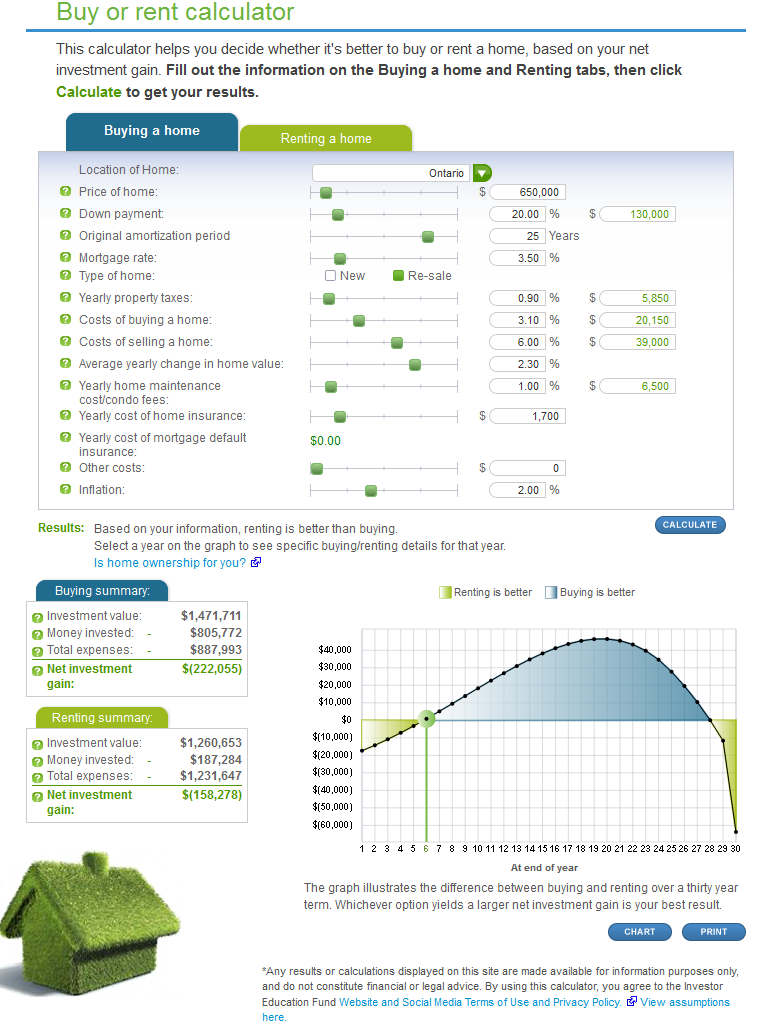
The beautiful thing about a spreadsheet-based calculator like that is that you can follow the calculation, item-by-item, and check it for bugs if you get unexpected results. Earlier this week, B&E posted a list of calculators out on the net, and rather than linking to my supremely excellent calculator and associated post, Robb linked to a Get Smarter About Money calculator. Ok, it’s web-based and a little more user-friendly than a spreadsheet, and has graphs and sliders (though why you need house price to go up to $10M is a question left unanswered)… but was it accurate? I’ve seen many, many terrible buy-vs-rent calculators (even some seemingly excellent ones like the famous New York Times ones that just doesn’t work for Canadians due to tax differences). So I played around with it. And I quickly saw wonky results like this:

Weird behaviour from a buy-vs-rent calculator: the curve simply should not be shaped like that, there's nothing to drive the differences in the last few years. Click to enbiggen.

In the comparison I have there, the price-to-rent multiple is 260X ($2500 monthly rent on a $650,000 house); as we’ve learned from previous posts in realistic scenarios it should be better to rent with prices so detached from rents. Yet here the calculator is showing a rather large benefit to buying if you can only wait 7 years or more. Then, strangely and inexplicably, renting rapidly takes the lead in the final few years of the comparison, with some sort of apparent discontinuity at year 30. If you look at their “chart” you can see more errors immediately: I had entered $2500/mo in rent, which is $30,000 per year, yet the “total renting expenses” came to just $12,360 in their chart, a factor of three too low. The buying expenses were only about $31k in their chart, whereas the mortgage alone is that much, with a total cash outlay of nearly $45k each year.

Now if you instead do the same comparison in my calculator, you’ll find that renting beats buying right from the start (due to the high transaction costs), and is fairly flat in terms of net benefit for about 10 years, at which point the investment portfolio starts to get large enough that investment returns become comparable to rent and the exponential growth becomes truly noticeable. There is no big “buying is better” hump in the middle. Moreover, the magnitude of the difference is notable: in my calculator renting beats buying in such a scenario by over $600,000 in year 30, versus the nearly break-even result from this scenario in the flashy online tool, with the same assumptions regarding investment returns, inflation, mortgage interest, and other sundry costs.

It’s a bit distressing, as other online calculators have recently been found to have serious errors as well. For instance, Michael James uncovered one on the Globe & Mail’s site, and just today news broke on retirehappy about the government’s CPP calculator over-estimating your future CPP benefits and not at all handling early retirement scenarios correctly.

Footnote: let’s say you’re not convinced that my spreadsheet is the gold standard to which all other rent-vs-buy calculators should be held. To then check the accuracy of the online calculator, let’s run the first year’s numbers manually:
Buying: mortgage $31k, property tax $6k, insurance $1.7k, maintenance $6.5k; total cash cost: $45.2k. Principal paid down: $16.5k. Net cost of owning: $28.7k.
Renting: rent $30k, insurance $0.4k; total cash cost: $30.4k. Investment portfolio gains: $10.5k. Net cost of renting: $19.9k. Cost to sell house: $39k. Gain on house: $15k. After year 1, renting ahead by: $49.3k. Online tool says: $16k.
If you notice any errors let me know.