Interesting Patent Facts

September 2nd, 2012 by Potato

Did you know that there are separate categories for patents? Odd ones include a separate category for flexible bags (almost 50 patent applications per year!), knots and knot tying (8 patents issued last year), railway mail delivery (zero patents since 1971 – it’s a wide-open market! Must think about patentable railway mail delivery technologies now…), button making (one patent every other year on average – think of the archaic buttons we must be using now), and baths, sinks, and spittoons (259 patents last year – somehow I suspect more for the first third of the category than the last third). Reading that, you may be thinking that there must be tens of thousands of categories to have such specific categories. While there are a lot of categories, this isn’t because of a ridiculous level of comprehensiveness — there’s only about a hundred or so.

I thought the guy with the drugs and bioactive compounds portfolio must have it rough with over 5000 applications last year, but telecommunications blows that out of the water with over 12,000 combined between telecommunications and mechanisms for multiplexing signal transmission.

Ordnance I had assumed would fall under military secrets, but managed to rack up over 100 [public] patents per year for the last three decades running. Unless that’s a misspelling of city ordinances, in which case yeah, there’s a lot of new ways to ticket people being dreamed up… though I didn’t think you could patent that.

Finally, 2011 seems to have marked a sudden end to the innovative efforts of the world’s farriers: consistently coming up with 5-20 patents even decades after the horseless carriage made the trade all but obsolete, suddenly 0 patents were issued in the field in 2011. Yes, even as recently as 2002, when Firefly showed us that space cowboys would still be herding cattle on horseback in the future, farriers managed to come up with 18 patentable inventions for shoeing horses.

Blueberry Girl

August 29th, 2012 by Potato

When we told Wayfare’s parents we were expecting, the fetus was roughly the size of a blueberry. The name stuck.

When the ultrasound later told us we were going to have a baby girl, Wayfare ran out and bought a half dozen copies of Blueberry Girl by Neil Gaiman. Wrapping one up and placing it into the hands of our parents was our way of sharing the news: Blueberry is a girl.

When she started kicking around inside Wayfare and we wanted her to know her daddy’s voice, when it was bedtime and everybody needed to settle down to sleep, I read Blueberry Girl to them both.

When the delivery was complicated and she came out as blue as her namesake and the doctors were working on her, Wayfare was whispering. The words weren’t for me, she was away in some other place. If we were religious, I would have said it was a prayer… and in a way it was. She told me later: she was reciting Blueberry Girl.

To the ladies of light, darkness and never-you-mind, the ladies of grace, favour and merciful night, and those ladies of paradox, measure, and ladies of shadows that fall: thank you for our Blueberry.

To Neil Gaiman, thank you for the lovely words.

Our blueberry girl. Click to embiggen.

Drinking in Pregnancy

August 20th, 2012 by Potato

A friend linked to an article on drinking while pregnant, which sparked a spirited discussion on Facebook. I thought I’d go off on a bit of a tangent here, where the discussion is a bit more open (and where I can add in graphs).

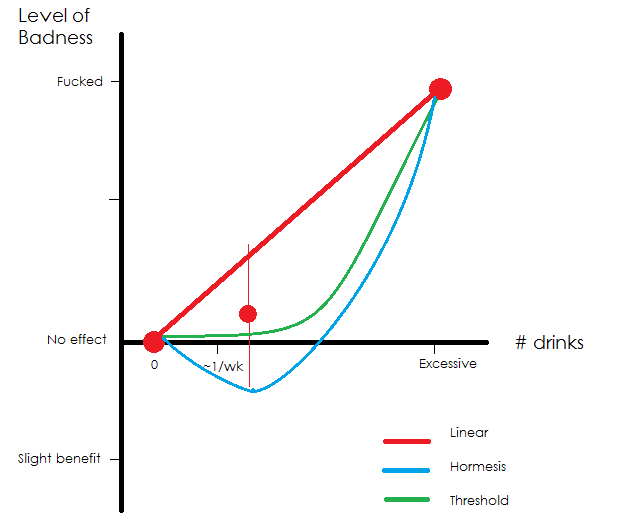
I don’t have the free time these days to dig around in the literature to get fully up-to-speed, but basically here’s the science as I know it on drinking in pregnancy: it’s bad. We know that completely abstaining is our baseline: most moms-to-be are cautious and do this. And, we know that drinking a lot is bad. In-between, there isn’t a lot of good data: it may be a little bit bad to drink a little bit, or it may have no effect until some threshold has been hit, or it may even be slightly beneficial (as this recent article suggested). So there are some big error bars in the middle there.
To pick on this study in particular, it was a retrospective study that asked women what they drank during pregnancy many months after they had given birth. Though this kind of study can be insightful and guide further research, I wouldn’t be overturning a cautious, conservative hypothesis on that kind of data. I would caution moms-to-be out there to not go out and have a drink or two on the basis of a study like this.

This is how science works, generally: you get a weak-ass study that nonetheless is cheap to do and suggests something interesting, so you get some funding and ethics approval, and do a better study, and change your ideas of how the world works as the data comes in. But real-world considerations do get in the way sometimes.

A stronger study would be one with randomization, controlled variables, etc. The thing is, it’s unethical to run that kind of study, and I don’t know if there are good animal models for the more subtle forms of alcohol-related damage, due to the unique nature of frontal cortex development in humans. Plus, there isn’t really a demand for such a study: it’s not hard to abstain from drinking for 9 months. No serious scientist wants to spend time trying to find out what the safe limit is for alcohol in pregnancy when there are so many more pressing problems to address. Nobody would want to fund it: even the brewing companies wouldn’t touch it since even if you did show beyond a doubt that drinking some amount was safe (nay, beneficial), there would be a negligible effect on alcohol sales (if it found 1 drink/week was safe, that’s not even two cases of beer for the whole 9-month pregnancy). And it could be an expensive study if you were to follow a cohort of several thousand kids to age 10 or something in order to detect potentially subtle changes in IQ and social development.

So we’re stuck with imperfect information. We know the two ends of the curve fairly well, but have imperfect information for what lies in the middle. Our simple linear assumption may not be correct, but guessing wrong has consequences. In that case, the conservative thing to do is to assume that there is no safe level, and abstain completely. Which is what the current recommendations are.

An analogy would be radioactive materials: we know that a large amount of ionizing radiation is bad: it causes cancer, radiation sickness, necrosis, and death. We’ve seen it in accident victims and those near the WWII-era bombings and tests. But even with good animal models it’s hard to study the in-between doses. Once again we have a case with really good data at the extremes of the chart, but gaps and poor data in the middle leaving open the question of what the response looks like at intermediate doses. There is a hypothesis (called radiation hormesis) that small amounts of radiation are actually good for you, and there are some people testing that out… but there isn’t really a market for that study, either. So the principle of keeping the dose As Low As Reasonable Achievable (ALARA) is employed for those working with radioisotopes. For drinking, ALARA is zero: there is no “background level” of alcohol exposure; being pregnant is very unlike being a nuclear medicine technologist. It is very easy/achievable to just not drink while pregnant. I have no sympathies for someone who can’t abstain when presented with a good reason to do so (e.g.: someone who needs to drive somewhere, is pregnant, or is on call for some demanding job).

Now the point was raised in that long Facebook back-and-forth that women suffer a lot of second-guessing and judgment by people for what they put in or do with their bodies while pregnant. It can be harsh and unfair. For many things, yes, yes I think it is, especially since there are so many little things you’re supposed to do these days, and no one can ever be perfect (not even a pregnant woman).

One person suggested it was a double-standard to criticize a woman for drinking but not for a midnight ice cream pig-out. To that I say: there isn’t fetal mochaccino syndrome, or infant chocolate disorder (indeed, chocolate consumption seems to be beneficial), while there is fetal alcohol syndrome (and just as importantly, widespread knowledge thereof). So it’s a totally different thing to look down on someone drinking, smoking, or shooting heroin than it is to judge someone for pigging out, drinking caffeine, using a cell phone, or skipping the seafood portion — I wouldn’t consider it a double-standard at all.

As much time as I spend here turning over conventional wisdom with evidence, in this case I think the evidence is not definitive and the best course of action is to continue to abstain from drinking while pregnant.

Freddie Mac: Political Risk

August 18th, 2012 by Potato

When I first talked about Freddie Mac, political risk was one of the things I highlighted that might undermine what otherwise looked like an attractive long-shot bet. The US government has been requiring that Freddie Mac (and its sibling GSE, Fannie Mae) borrow more money than they need, and pay a punitive 10% interest rate on that — a worse deal than the TBTF banks who arguably had more to do with the cause of the global financial crisis. Part of what lead to the excess borrowing was the fact that Freddie’s been over-reserving for years now. It looks as though they’re getting to the point where even the most conservative accountants realize that those excess reserves will start unwinding, which will enable Freddie to start paying back the government — and after that, the preferred shareholders.

So it looks like the main investing thesis was playing out.

Unfortunately that political risk reared it’s head this week as the government announced it would change the deal to instead confiscate all future profits. I have no idea why the government decided to nationalize the GSEs but not AIG or the TBTF banks, or why they decided to change the deal at this late stage, just as the profitability was re-emerging. I suppose I’ll just have to pray they don’t decide to alter the deal any further.

I’m not quite sure what that means in terms of the preferreds being paid back, but my first take on it is that they’ll be worthless. The market seems to be equally panicked, as most issues were down about 60% on Friday.

Blueberry Portfolio Month 3: Capital Gains

August 13th, 2012 by Potato

This is a monthly update from the Blueberry Portfolio. The events I mention below happened approx 8 months ago.

I started this update by providing a spreadsheet to the investors with the capital gains laid out. [Specifics redacted] It’s important to remember that realized gains in a non-registered account are taxable. Add the information from the spreadsheet to your schedule 3 for taxes (if you don’t ordinarily have gains to put in schedule 3, I can show you how, it’s really easy). In addition, you’ll be receiving some tax slips (T3s) in the mail around the beginning of March for the dividends that you enter into the appropriate boxes in your tax software.

Otherwise there hasn’t been much to say.

After spending some time without (m)any bright ideas, I put more cash into the ideas I did have. That broke an unwritten rule that I’d try to stay diversified with no more than 10-15% in any one stock (Chemtrade is close to 20% of the portfolio, and Canexus over 10% — and both are in disturbingly similar businesses). As soon as I do have a bright idea, these will be the first positions I look to trim to get cash to move around.

One bright idea was Poseidon: a high-risk, high-reward play on “fraccing” in the oil business, which also pays a lucrative dividend. Our timing there couldn’t have been much better: as of this message, we’re already up about 15%. I don’t know yet how much further I’ll let this one run before locking in the profits, but I imagine I’ll wait for at least double that return over the next year before getting out (unless something changes).

Since the last monthly update, the market has been more-or-less flat, while we’ve added a few percentage points. After the first day of trading in the new year, we’re up almost exactly 10%, vs the market at just about 1%.