On Presenting and Money 201

March 6th, 2015 by Potato

Last week Sandi and I presented Money 201: Planning and Investing at the Toronto Public Library and it was a blast. I think it was one of the best lectures I’ve ever given1. Sandi opened it up with a discussion about goals and direction, making money fit your life, and she did it all with only a few graphical slides. Then I picked up from there to go into investing in a bit more academic way. The room was nearly full, the audience was involved, the energy was good, the questions were great. I hope at some point we’ll be able to do it again.

In brief, my part started with the old fable of the grasshopper and the ant: we know we need to save for the future. Then I took it a step further: with inflation and long lives we need to not just save but to invest. Then a breezy breakdown of what investing is and how it’s kind of scary (discussing risk) and not scary at all (showing how easy passive investing is).

At this point I’m not quite sure what to do with the material — I can leave it alone for now, and if/when we do another seminar then the lucky people who come can see it anew, or I can put up the slides… but that loses a lot without the accompanying talk and discussion. I can also make a video/podcast out of it, but at an hour2 just for my part is a lot to listen to, and a lot of work for me if no one is going to watch it. Let me know in the comments if that’s something you’re interested in (also if you’d prefer to see a video of me standing and gesticulating with my hands as though it were a lecture, or a voice-over on the slides which is cleaner).

Speaking of lots of work, let me now give a behind-the-scenes glimpse at preparing something like this. It basically took about 15 hr of prep time for a 1.5 hr presentation — and I’m still buzzing from the energy of that day so let me go ahead and say that 10:1 ratio of prep time for a great presentation is about right in my experience from preparing other classes and lectures3. Of course, everyone is different: some people can write some bullet points on cue cards in the drive to the talk and be amazing, and my PhD supervisor famously gave other people’s talks cold (zero preparation time), just talking based on what he saw on the slides as they came up and rolling with it. Or check out this guide from TED, which suggests that if anything my 10:1 prep ratio is not practicing enough. IMHO you should always plan at least one real-time practice run, especially if you have a time window to hit — good talks don’t just materialize from being charming and winging it.

First, there was the idea stage: Sandi and I were psyched to do something for financial literacy month 2013; when that plan fell through we took our early discussions and wrote a proposal for the Toronto Public Library and submitted it. Yes, Money 201 actually pre-dates the Value of Simple — we submitted the proposal for it like two years ago now, thinking TPL would go a lot faster. Instead it was over a year before we heard back that there was a branch interested in hosting the seminar, and once they did get back to us they were booking 7 months in advance4.

Anyway, with this actually a go I now had the book in hand, so I set out to try to basically recapitulate it, with some more detail on planning to come from Sandi’s part. Well, as you can imagine, there’s way too much material to cover in that kind of time: I had to create something new that would fit. So I spent about 2 hr putting together a first draft slide deck which outlined a more focused talk, expanding on some parts of the book and ignoring many others. Then I spent about an hour doing a dry run on my own to identify problems with the flow and scope, which led to another 2 hours of slide revisions and rewrites (some of this was digging up a reference for a quote and double-checking some math).

Then because this was a joint presentation I had another 2 hours to discuss it with Sandi so that our parts would mesh together well, and to get her feedback on my early slides. That was followed by another 2 hours or so of revisions and rewrites.

After that I took about 2 hours to practice in front of Wayfare (though the talk was only an hour, there was lots of time to stop and ask questions, discuss what works and doesn’t, to accept criticism, see what’s too detailed, and where things come out of nowhere). I only had about an hour of revisions after that — mostly reordering and cutting slides rather than revising them or writing new ones.

Finally, another hour to practice the “final version” on my own, check the timing and flow — which includes creating a few mental checks, like where the ~1/3 and ~2/3 points are so I’ll know when I might have to hurry up or slow down if I get off my timing at the real thing. That inevitably leads to a last few tweaks of the slides, which with the other prep tasks like copying backups to my cloud drive, a USB stick, making sure I have a laser pointer and bottled water packed, etc., is another hour of prep time.

In all that slide prep I try to think of likely questions and a trick that has carried over from my academia days is to have question slides ready — if I have say 50 slides to present then slide 51 might be my ending “thank you, questions? contact me here:” etc. slide, but then past that I keep slides ready to help answer questions. Many of the extra slides I had to cut back on for time are kept there because I don’t like deleting things, as are a few slides I made just to be ready for questions. Even if I don’t have to bring them up to answer a question, that kind of advanced thinking of likely questions (and their answers) really helps the Q&A part go more smoothly.

A financial literacy event like this can feel really good to do — lots of happy people in that audience who walked away knowing more and feeling better about their money and how it intertwined with that future, which is affirming for us as presenters. But make no mistake that it’s a much bigger time commitment than just the hour or two spent up on stage.


1. and if I may toot my own horn, that is indeed saying something.
2. and to toot horns again, our timing was great — few people appreciate coming in on-time for a 1.5 hr lecture, but it is important and requires work and practice to nail it.
3. for my PhD defence it was naturally more, closer to 200:1 (and that’s not including data analysis tasks like making graphs — just presentation prep). I had a very indulgent and supportive lab group who critiqued me through three full-length practice runs.
4. so using that as a guide, if you’re interested in seeing another Money 201/new title TBD with Sandi and/or me, it likely won’t be for another year or more, at least at TPL.

On MERs and Past Performance (Again)

March 1st, 2015 by Potato

A reader writes in, asking about a particular mutual fund manager. They’ve read The Value of Simple, but aren’t sure if they should switch to DIY index investing considering their particular funds have outperformed net of fees the past few years, and have won Lipper and Morningstar awards.

This was an interesting email to receive. The reader had four different ways of saying that past performance for the particular fund was good.

The Lipper and Morningstar awards are basically useless as indicators of a fund’s ability to out-perform their fees in the future. The Lipper awards in particular are completely focused on past performance, so winning one doesn’t tell you anything a screen of past performance wouldn’t already. The Morningstar award includes “style consistency” and “tax efficiency” as other criteria, but is again basically just a metric of past performance.

There are studies that show that past performance is not a criteria for finding winning mutual funds, so by extension, the Morningstar and Lipper awards shouldn’t have any bearing, either. Indeed, I went back and spot-checked the 2010 Lipper winner, and they badly under-performed in the subsequent ~5 years. Their 10-year average (including the out-performance that won them the award and subsequent under-performance) is now equal to the index. I then quickly checked all the 3-year winners in the Canadian equity category from 2007-2014 (the range data is available from Lipper), and all but one of them went on to under-perform the index. (I didn’t check all of the winners in all categories because they have dozens and dozens of categories to try to spread the love around)

So why is past performance not a good indicator of future performance, when it is for say, job performance for an engineer or a sales associate? There’s always a combination of luck and skill in performance and outcomes, but the proportions change for different tasks. The engineer’s outcomes might be mostly skill and a bit of luck, so a good one in 2010 will probably still be good in 2015. A sales associate might have an equal mix of factors affecting their past performance — finding the skill may not be too hard, but it may not be immediately apparent in past results. But for mutual funds the skill can be completely swamped by luck, so it’s quite hard to find, especially from the customer’s chair.

I’m not dogmatic about indexing and active management, but pragmatic: I think some people can out-perform due to skill, maybe even enough to beat their fees if they do it professionally. However, identifying that small percentage of managers is a task that’s comparable in difficulty to just being an out-performing active investor yourself, and that is very difficult in my mind. You have to have a good understanding of what skill looks like to be able to spot it amongst all the luck and marketing. And the MER acts as a huge hurdle: these guys might be very skilled, but out-performing by even 2% every year is quite an achievement, and that would be needed just get you back to even. In my opinion, going with indexing is the better bet.

Another consideration is what value you get for the MER paid. A big issue in the industry is that typical big bank/big firm advisors just sell funds and don’t provide the detailed plans, hand-holding, tax advice, or other services they claim in newspaper articles are reasons to avoid DIY investing. If you’re getting good service, then you have to decide whether it’s worth 2% — or whatever the fee difference is — to keep getting that level of service, or if you’d rather do it yourself and save on the fees and avoid the risk of their performance streak ending. If you’re not getting good service for what you pay, then paying the higher MER is purely a bet on their ability to out-perform, and historically that has not been a good bet to take. Demand better service to get your money’s worth, or take matters into your own hands (which may include paying fee-for-service for the expertise you need to supplement your own efforts in indexing).

The Toddler Morning Efficiency Curve

March 1st, 2015 by Potato

In all my years and all my learning, I have never quite got the hang of mornings. I used to be pretty good at sneaking up on them from the other side, staying up all night to get them when they least expect it, but waking up and facing a new day is just such an impossible concept. I know some people can basically just roll out of bed and be something called “chipper” and “alert”. I am not one of those people. I used to play snooze-button basketball with my alarm clock to gradually wake up over the course of an hour and a half, then search for caffeine before risking communication with other humans.

At several points in my life I have studied the evidence and become convinced of the utility of breakfast, and have woken up early to eat this mystery meal before leaving for work. Inevitably, after a few weeks of that I decide (consciously or not) to forgo breakfast in exchange for more time in bed, or less stress at cramming the rest of my routine into an unrealistically short period of time.

And time is the big problem with mornings: it doesn’t behave or flow right. I can sit there at night, when everything is sparkly and sleek and working as it should, and time myself as I perform the necessary house-leaving preparatory tasks to plan when I need to haul my ass out of bed for the morning. I can put two poptarts in the toaster, determine that it takes 90 seconds to toast them, 25 seconds to slather them with peanut butter, and all of 195 seconds to shovel them into my food hole and wash them down. Practice run done: 310 seconds for breakfast, add it to the morning time budget, set the alarm clock back appropriately and we will be able to squeeze breakfast in. But then morning comes and time stops working properly. My carefully practiced and timed breakfast routine goes horribly awry. It’s going on 12 minutes and I still have half a pop tart to eat and somehow there’s melted peanut butter dripping on my pants.

I cannot accept that this is merely a subjective time dilation effect, caused by my severe case of night owlism. My toothbrush has a digital timer so that I brush for precisely 2.0 minutes. Yet in the morning, even though it still ticks up towards 2:00, it takes five minutes to get the whole process over with — the morning effect clearly affects even piezoelectric crystal-based time measurement.

Anyway, all this is to say that I am “morning challenged” and pretty much always have been.

Then into my life comes a wonderful bouncing baby, who becomes an amazing little toddler girl. Now instead of an alarm clock I wake up to the sound of “Daddy! Come pleeeeeeeeeeeeeease!” Bopping her on the head does not get me an extra 15 minutes to snooze so I pretty much have to get up at that point. For a long, long while she was waking up too late for me to even see her before I left for work, but then over the last year that has flipped so that she wakes up crazy early, following the ancient toddler urge to be up before dawn so that they can watch the sun rise and ask “why?”

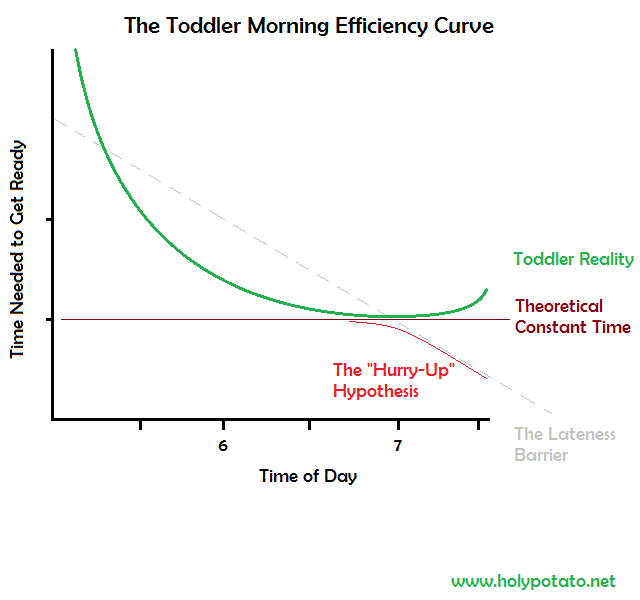
And while to me it all sounds universally crazy early, there is a big difference to waking up at 5:30am and 7:00am, and incredibly it leads to a totally non-linear relationship in the time to be ready for work, a function I call the Toddler Morning Efficiency Curve. You would think that it would take about the same amount of time to do basically the same sets of things each morning, no matter when your wake-up call happened to come in. Indeed, if there was a non-linearity, you’d expect to become more efficient as the time to get out the door for work came closer and you started to hurry or cut non-essential things out of the routine — the hurry-up hypothesis. But it’s not so simple.

The Toddler Morning Efficiency Curve, showing that the amount of time needed to get ready is not a constant -- as you get up earlier and earlier it takes longer and longer, in a non-linear fashion. At some point -- about 5:30am or so -- the inefficiency becomes so severe that even though you have an extra hour and a half to get ready you still somehow end up being late for work.

If she wakes up at a “normal” time (normal for her, not for me), let’s say 6:30 to 7 am, then things proceed reasonably well. We can spend 10 minutes or so where I am just a useless bag of shambling meat, a zombie barely able to greet her and see if she needs a diaper change immediately or if it can wait a few minutes for the strength and dexterity to return to my hands. At some point shortly after waking up, I can go potty, tell her that I’m about to go potty, reassure her that I will be back in just one minute, and then go potty and listen to her wail for daddy to come back because this is a surprising and distressing abandonment and not something we do every. single. day. that daddy always comes back from.

Then we’ll get her dressed, maybe have some time to read a few books, play for a bit, or watch an episode of Mr. Rogers, then we go wake mommy up so I can have a shower and get dressed myself.

If she wakes up later, we can cut down on the playing or TV watching, but then have to deal with the whining that happens around the severe and unfair deprivation we’re causing through that action. The bigger issue though is that sleeping in just a bit seems to activate the lazy sunday lay-in region of her brain (the posterior cingulate? it’s got to be used for something, and seems to deactivate with any other active behaviour) and she no longer wants to get dressed. She wants to wear her PJs all day.

Even more inexplicable and fascinating is the phenomenon of waking up earlier. So many early theorists in parental dynamics predicted that if you had more time in the morning, you would at worst be finished everything by the same deadline — that the lateness barrier could not be breached from the left-hand side of the curve. How wrong we were.

Instead, we have the case where daddy is a nearly-immobile shuffling zombie, eyes 75% closed (often one closed entirely and the other largely closed against the harsh light of a 10 W night light), while the toddler draws unholy manic energies from the predawn night and tears circles around him. When it’s time to get dressed, she becomes and impossible squirming octopus of giggles, pleased as punch that she can so easily avoid having clothes put on her, free to live out her dream of running around the house naked.

Add to this the propensity for shuffling-sleep-zombie daddy to collapse onto any bed, couch, or other soft-looking surface “for just one more minute” of “inspecting his eyelids for holes”, and the whole thing becomes non-linear: the delays and funny effects on the flow of time from the early morning start using up more time than the extra head start provided in the first place, and everyone ends up late for school and work.

Book Pricing and CAD

February 28th, 2015 by Potato

The Canadian dollar has declined a fair bit over the past few months, making things produced in the US more expensive for us, including books like The Value of Simple. The CAD has dropped over 12% since I set the price of the book, and almost 9% from the release date. I wanted to set the price in CAD because the book is intended for Canadian readers, and I don’t want the price to fluctuate with every little move in the exchange rate — even if I have to absorb those fluctuations from my margin. So ideally this should all be invisible to potential buyers — the price stays at $16.95 until the exchange rate gets so painful that a price increase has to be passed along.

I do not know what happens behind the scenes in the book distribution chain, but Amazon and Indigo have never had quite the right price for the print book, and their price fluctuates over time. Just two weeks ago Amazon had a sale on the book, selling it for less than I do when I sell it at in-person events with no shipping costs. Now this week they have it at $1.50 over the list price (and $4 higher than the sale price). To try to fix this I’ve lowered the (hidden to the public, but existing in the distributor’s catalog) USD price on the book to reflect the new exchange rate, in the hopes that that’s the source of the new, higher price and that the price will get back to where it should be soon.

In the meantime, you can always order directly from me using the online store at the correct price if the Value of Simple is all you’re ordering — if you’re buying more and are eligible for free shipping, then even the erroneous Amazon/Indigo price may work out better for you on the whole (and their shipping with Canad Post is somehow magically faster than my shipments with Canada Post).

Speaking of the direct purchase option, my inventory from the first print run is getting low. In the store software the print book alone and the print and e-book bundle are treated as separate products with their own inventory counts, so I’m trying to balance the remaining units between the two options so you can choose what fits best for you — if one ends up sold out while the other still has stock then it’s quite likely you can order the out-of-stock option and I’ll still be able to fill the order immediately.

Note that I do have direct control over the e-book pricing, even at Amazon and Kobo, so those prices have not fluctuated at all with the exchange rate changes.

Notes on the Investor Education Business

February 26th, 2015 by Potato

It’s buried in the blogroll on the sidebar, but for a few years now I’ve offered consultation services for personal finance/investing matters over at Robertson Investment Services. I mention this now because of this recent article pointing that out, yet people landing here might not see that little wee link and be confused as to how I made it into that list. So hello and welcome — that is a thing that I do.

Deciding what to call my particular services was a bit of a challenge — I’m not a licensed salesperson or CFP, and I don’t really do a whole lot of detailed planning. “Coaching” kind of fits, but I have not aimed to get recurring coaching clients — I’ve specialized in a niche of helping people become do-it-yourself investors. Most of my clients just need one or two sessions to bounce some ideas off someone who’s well-read on the subject, trouble-shoot some nitty-gritty issues, and get over the hurdles of brokerage systems and spreadsheets to fly on their own. Given that I started as I was finishing my doctorate and had a long series of conversations on the meaning of that (to teach), I settled on “educator” and named the business accordingly1.

After working with a few clients over the years I thought I had figured out some of the most common issues and barriers, and set out to address those in the Value of Simple.

I was conversing with Ellen Roseman about it back in November, and said that I had hopefully made myself obsolete with the book — with only a few exceptions, most of my clients’ concerns have focused on the material in there. Ellen had a great response: “In my view, you never get obsolete if you offer a valuable service people don’t get elsewhere.” I figured I could help more people with a book hitting a wide audience than sitting down with people one at a time — I actually expected client flow to stop after the book came out as it could answer so many of these common issues; instead I’ve had more queries (the rest of you probably saw that coming).

I don’t push the service much — as you may be able to tell by the link being buried below the fold on the sidebar. Somehow enough clients find me to keep me reasonably busy. Of course, I actually have a day job and a family, so an investor education side business that keeps me reasonably busy is not nearly as bustling as for someone who does it full time.

Update: A few years after this post, I launched an online course teaching people how to invest, and have gotten a lot closer to making myself obsolete as an investment educator/coach.


1. “Portfolio Doctor” was an awfully tempting runner-up.