Default Rate and Seth Klarman on Junk Bonds

March 1st, 2012 by Potato

A rolling loan gathers no loss.

I’ve long said that the mortgage default rate has no predictive value in spotting housing market trouble: it’s a lagging indicator. The reason is very common-sense: as prices increase rapidly, even someone with no equity to start with can refinance after a year or two, or sell and be able to cover the transaction costs. There is no reason to default in a rising market unless you’re particularly bad at arranging your finances and can’t even make it a few months to be rescued by the rising tide.

Then I was reading something about the junk bond fiasco of the 80’s and came across another interesting feature of credit bubbles. As you lend to less and less creditworthy people/businesses, your eventual loss rate will increase — those chickens eventually come home to roost. But firstly, rolling loans gather no losses: with loose credit, and increasing valuations on the underlying collateral, it’s very easy to just borrow your way out of trouble for the short term. Even then, the defaults don’t occur immediately except in the most egregious of cases (which did happen at the end of both the junk bond craze and the US subprime debacle). Another feature is that you increase the size of the lending pool as the credit bubble inflates. So if you look at the default rate, it may be flat even though the number of defaults is steadily increasing — just not quite as fast as the denominator (total credit) is also increasing. That makes the default rate look better than it really is, and doubly so when combined with the lag time before a loan defaults. Seth Klarman says that you could have spotted the junk bond crisis before the bust by looking at the default rate and adjusting for the increase in the denominator.

To give a quick example of how that would work, say your default rate is steady at 1% — this is a level you are happy with and for decades in your industry has been a level that indicates there’s no trouble. Then you rapidly increase the size of your loan portfolio, doubling it within say 6 months. You should have zero defaults on the new loans since they haven’t had time to default, so your default rate should be halved now. If it’s still 1%, you have a problem, and may not realize it.

So I went to look up some Canadian mortgage data. As expected, the default rate is low. It was rock-bottom when the 90’s first started, as prices were at their peak there. Then as Toronto’s bubble crashed out and the economy worsened, the default rate increased, topped out at about 0.7%, and then improved. Around the economic crisis and recession in 2008/2009 (also when Alberta prices started their “soft landing”) the rate increased modestly, but is still generally fairly low. That’s the blue line, and is a chart you’ve probably seen many times before.
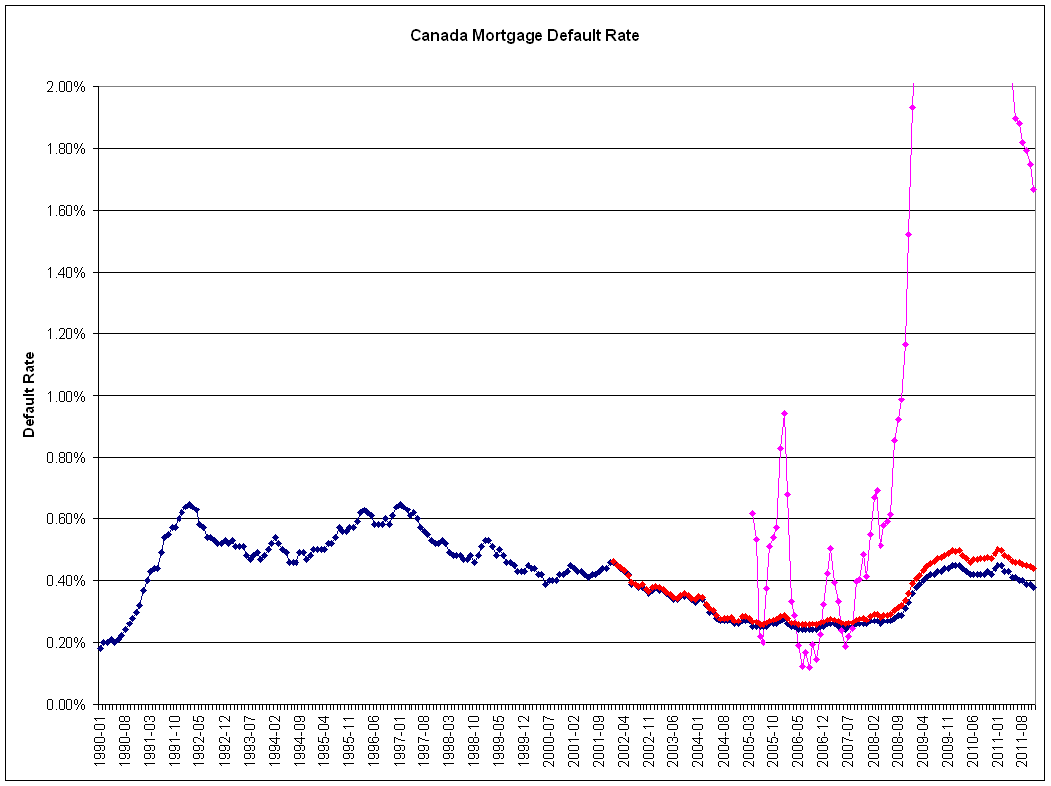
Canadian mortgage default rates, national. Blue is the traditional measure. Red is the current number of defaults to the traditional mortgage pool. Pink is the default rate on the bubble excess mortgages. Click to embiggen. For the image impaired, this ain't pretty.

But in that dataset is also the total number of mortgages, and that has increased much faster than the population growth rate: if you assume that the year 2002 is a “normal” period to start from, and increase the mortgage size with our population growth rate (1.1-1.2% according to Google), then in 2012 we should have just about 3.7M mortgages. Instead, that number is higher by about 16%. If you then take the number of defaults, and compare them to that denominator, you get an adjusted default rate in red — and that is, by the conservative historical standards of our country, fairly high. And this is still a lagging indicator. But on an absolute basis, it’s still pretty low: while the growth in the mortgage pool has been tremendous by mortgage standards, the dilution of the denominator isn’t as dramatic as it was with junk bonds.

To cut it up a different way, consider the situation as separate pools of mortgages. You’ve got say 3.7M mortgages that represents the normal, conservative Canadian lending market that everyone likes to talk about. These are the people that would own their houses no matter what the real estate boards were projecting, many have been in real estate for decades and have significant equity. With times being reasonably good and house prices being at record highs, we might expect the default rate on this pool to be near its lows of 0.1-0.2%. Let’s be generous and say it’s even higher than that — 0.25% — so this pool of mortgages represents about 9300 of our defaults today.

Then we have the 560k new mortgages that represents all the insanity of the past 12 years: demand pulled forward, low downpayments, long amortizations, teaser rates, fuzzy thinking — whatever it was that drew these people into the market that maybe shouldn’t have been there in the first place. Of that pool, 140k were issued just in the last year alone. Since we don’t expect defaults to occur immediately unless there is a huge problem in underwriting, we wouldn’t think of defaults as coming from those. That leaves 420,000 mortgages issued in the last 10 years that would be responsible for 7000 of the defaults, a rate of 1.7%. The default rate separated out for this pool is put in pink on the graph. As an aside, it goes off-scale in 2009 — in part because the fixed 0.25% default rate assumption simply wasn’t true for the regular mortgage pool (times weren’t great), and in part because that’s when house prices stopped going up and actually went down (briefly).

Now, this is all back-of-the-envelope and full of room for error. This is not the one peg I’d hang my housing bear hat on (that would be price-to-rent). But it is another way of looking at things that I hadn’t come across before.

Prius Year 2

February 28th, 2012 by Potato

The Prius just turned 2. Still love it, though we got pretty much the biggest infant carseat on the market (a Graco Snugride 35) because it will keep baby rear-facing longer… but it barely fits in the back, which is a bit worrisome. We have to move one of the front seats forward a bit to get it in. We did a test install a few weeks ago, and when the weather gets warmer I’ll try again to see if I can comfortably get it in behind me in the driver’s side (I know I’m never going to need to recline once I get my seat set), otherwise the passenger seat will just have to be a touch further forward than normal.

I still have to figure out what I want to do for protecting the seats from the inevitable baby mess. Any suggestions from the blogosphere? Some people swear by the wet okole neoprene fitted covers, but they’re pretty expensive. Canadian Tire has some much cheaper generic covers, and just scotch guard may be enough to prevent any permanent damage.

As you read in the summer, there’s only been one problem with the car: the plastic cover on the underside came loose while driving and had to be replaced (and somewhat more troublingly, removed while in the middle of nowhere). That was replaced under warranty.

For the past two years real-world fuel consumption has averaged 5.1 L/100 km, vs an expected ~9 L/100 km real-world for a comparable alternative (if I had gone with a Matrix/Accord/other). Gas has averaged $1.15/L, so I’ve saved about $1500-1600 so far, putting me on track for a ~5 year “pay back”. Of course, I’ll save that much again for the 5 years after that, and the 5 years after that, and reduce my exposure to these volatile/rapidly rising gas costs the whole while. So yeah, I’m still pleased with my decision.

The Wealthy Barber Returns

February 23rd, 2012 by Potato

I just finished Dave Chilton’s The Wealthy Barber Returns (and a big thanks to Nelson of Financial Uproar infamy for not only giving me a free copy of the book, but also eventually shipping it, too! [And a further aside: he gave me some free slurpees to make up for the delay in the thing he was giving me for free anyway, which shows that deep down inside, he’s really a super nice guy] ;)

I really enjoyed it. It’s a short read, just over 200 pages with block-formatted paragraphs and many blank filler pages to make it fly by even faster. He writes with a very casual, humourous, down-to-earth tone and conveys the simple yet important financial lessons we all need. The book is broken up into many short chapters of just a few pages each; in fact the whole thing reads a little like a well-put-together blog printed out and bound. It reads like my blog, or at least, what I imagine my writing voice reads like outside of my head (though that may go over about as well as how I imagined my speaking voice sounded outside my head before I had a tape recorder).

There are no complex calculations, just common sense (or uncommon sense) and some rules-of-thumb. I’m going to find this a very easy book to recommend and pass along.

About the first half of the book is spent on the basics: living within your means, controlling debt, paying yourself first. He does a good job of covering the psychological tips that can help people set and meet goals, and candidly discusses some strategies that have and have not worked for people he’s met with over the years. The second half is more on investing, and covers index investing, the importance of fees, reasonable rates of return (and how important the rate of return can be to final outcomes), and so much more. He very nicely hits the main points on the eternal RRSP vs TFSA debate, including two important behavioural ones that don’t fit into the math: what if you spend the tax return from your RRSP so you aren’t really contributing pre-tax dollars, or are tempted to raid your TFSA for non-emergency spending?

Other random take-aways: he calls the Vancouver and Toronto housing markets crazy. It was just one paragraph, but I was glad to see it — the bubbles really do impact the financial planning in the rest of your life. He didn’t have a definitive position on emergency funds or LoCs either: EFs are great, but entice people to over-spend. But so does having a LoC at the ready. He’s got a very sensible answer for the eternal question of paying down the mortgage or investing (yes, and right away!). Mentioned at several points, living within your means and saving for the future actually leads to people being less stressed and happier, even though they don’t have as much stuff to enjoy right now. Stuff isn’t that awesome, anyway.

All-in-all, good points.

Now if I may be permitted to wander off into unnecessary criticism land (where I spend enough time to be a dual citizen), the lack of math and scary details cuts both ways. It’s a very easy read as it is, and not at all intimidating, which makes it easy to recommend to the financial novice in your life or the financial expert who will just enjoy it as a breezy bedtime read. But the lack of details mean people are going to have to fend for themselves or go off and do some further reading before they get into the tricky business of actually following through on creating a financial plan and investing. That extra step may slow them up, and some details, tucked safely away in a protective appendix where no one could accidentally hurt themselves, might have helped with the get-up-and-start-now aspect. Or it might have doubled the length of the book for no good reason.

Anyway, that leads me out of unnecessary criticism land and into the kingdom of self-promotion (whose customs I find strange and foreign). As you may recall, I wrote a book called Potato’s Short Guide to DIY Investing (one I now have to update, if only to include The Wealthy Barber Returns in my reading list for what you should have read before reading my book to get the basics of having money saved and ready to invest down). It is a short book, written by me, about do-it-yourself (DIY) investing, and it was written by me! Wait, I’m doing this self-promotion thing all wrong.

What I was thinking as I was finishing off this book is how well my book complements it. David’s book does a good job of telling you that it is important to invest for your future, explaining the ways you can invest, and most importantly, prefacing all that with a lot of good advice about how to budget and save enough so that you’ll actually have money left over to invest. He tells you about the importance of fees (though I have a graph), and does a better job than I do about explaining why indexing is the way to go. From there, my book picks up and tells you how to do that: what a few examples of low-MER index-following investments are and where to find them. Step-by-step instructions on how to open an account and actually buy or sell the bloody things. A bit about basic asset allocation (though admittedly, that could use a bit of spit-polish in v1.1). What you need to write down as you go along so that you have a head start on panicking at tax time. Basically all the stuff that’s not in the other personal finance books.

I wrote my book intending for it to be so short, so easy to read, and so practical that it could be the first book you read on investing, and use it to get started so you could get the power of compounding working for you as soon as possible while you continued to educate yourself. I was clearly wrong on at least one point: it should be the second book you read.

Housing Bears Must Be Patient

February 15th, 2012 by Potato

Over at CMF user Uranium101 asks when the correction to Canada’s housing bubble will come. He wants to buy a house. I’ve seen similar questions around, or people saying things like they’ll wait a year or a few months or whatever before buying. I’ve been fairly vague on timing for the most part, focusing more on valuations, but it’s a topic worth addressing.

You’ll have to be very patient. On the one hand, we don’t have jingle mail and all the other positive feedback elements that sped up the US crash; on the other, after witnessing that wreck the common buyer may be a little quicker to slam on the brakes, slowing things faster here once the correction does start. Assume the two factors roughly cancel and our unwinding will proceed at about the same rate as the US.

So if you’ve spotted the bubble with good timing near the top (and weren’t early like myself or Mike Burry or whatever), then for the US experience that would be sometime around 2006, maybe even as late as 2007. When is the time to buy? It’s still not clear if the US market has bottomed yet, but maybe around 2011/2012 you agree that even if there is more downside, the fundamentals are back in line and that it’s worth the risk to buy again.

That’s a good 5 years or so. More if you were early in spotting the trouble. Maybe you figure once the major declines started to peter out in 2009 was close enough; that would still be 3 years from the peak you’d have to wait.

Similarly, if in Toronto you had spotted the problems close to the peak in 1989, you’d have had to wait 3-4 years before you’d want to pencil “house shopping” into your day planner.

Real estate is not a fast-moving, efficient market, so patience will be required. But a 30% correction on a $600k house is $180k, and that savings can be even greater if renting is cheaper while you wait. Plus you expose yourself to less risk. Sitting out the insanity will require finding a nice rental you’ll be happy in for several years and patience, but you’ll be very well rewarded for it.

TD Waterhouse Removes TFSA Admin Fee

February 15th, 2012 by Potato

Just a quick note: TD Waterhouse has removed the $50 admin fee for TFSA accounts as of 2012. Previously, this fee was easily avoidable by signing up for their “e-services” electronic statements program, but now you don’t even need to do that. IMHO, TD Waterhouse still remains a great option for passive investors: use TD e-series until you get up over the $50k mark, at which point you qualify for $10 commissions and can start switching to even lower MER ETFs.





