Expensive Advice

December 31st, 2011 by Potato

There is some truly bad advice out there on the internet, some of which can be expensive. I see a lot of it in the fall as pertains to the seemingly mandatory “list of things to do to your car to get ready for winter” articles pop up. One particularly egregious example encouraged people to rotate their tires (but not change-over to winters), change their coolant every year (most cars only need a change every other year, and many newer cars have formulations that last 5 or more years, and a coolant flush isn’t all that cheap), add fuel line antifreeze with every fill-up (winter gas eliminates this need, and when have you ever heard of someone getting a gas line freeze-up in the last 10 years?), and get an oil change and inspection.

I put up my winter driving prep list last year, and as expected the number one tip was get winter tires. I should have bolded it then, too. The up-front cost is a little high (few hundred dollars, either for a dedicated separate set, or the incremental cost over all-seasons to get winter-rated all-weathers), but well worth it in terms of safety, and also saving some wear on your summer set of tires and rims. You can even get a discount on your insurance from many providers.

Then along comes Marianne, who earlier in the fall was on a tight budget, and somehow prioritized rustproofing, an inspection, detailing, and winter mats over a safety feature like winter tires (and don’t get me started on other things she decided were better uses of her money than snow tires). She complained of the cost, and of only using them for 4 months (though Nov, Dec, Jan, Feb, Mar seems to be 5 months to me, and possibly 6 if you do your driving at night and it’s chilly through half of October and April — and fully half the mileage if you do more trips by bike in the summer).

That attitude may have changed as she now relates to us a harrowing tale of a near-miss spin-out on snow-covered roads over the holidays.

I will say it again: I know people with all-season tires who don’t think the cost of winter tires is worth it, and people with winter tires who think it is worth it, but no one with winter tires who thinks it’s not worth the cost. They give you such a large margin-of-safety on cold and slippery roads, it is easily worth the few hundred bucks.

The other things on these perpetual winter driving lists are good, but can be expensive advice. Winter tires should be the #1 point on all those lists, and despite the up-front cost, are the least expensive advice there is. I won’t come out and say that regular inspections are a bad idea, but if there’s nothing suspicious happening with your car, the money is better spent elsewhere. For a car that’s driven regularly in most of the populated regions of the country, a gas antifreeze additive is a waste of money. Coolant is good for a few years; if you need to, you can push it a little bit (and it’s much cheaper to get tested than indiscriminately replaced). Rustproofing has its advocates, but if expenses have to be prioritized and deferred, it can be put off until the spring, or even for a few years. And as much as I love rubber winter mats — I leave ’em in all year long — no one ever died of salt stains on their carpet.

Rent vs Buy Sensitivity Graphically

December 29th, 2011 by Potato

I mentioned a few times that it’s important to look at a range of different assumptions before making a large decision, such as deciding whether to rent or buy. It can sometimes take a fair bit of research to get to those assumptions in the first place (what’s an appropriate range? Why can’t I just assume 20% returns or no inflation?).

But as handy as a spreadsheet/calculator is for figuring that stuff out, it’s hard to show multiple outcomes, so here is a little graphical depiction of when it’s better to rent vs when it’s better to buy after 20 years, and by how much, under various assumptions — holding the others constant with the “base case” numbers. It’ll give you an idea of how sensitive the analysis is to various factors.

The “base case” being the numbers I put into the rent-vs-buy calculator spreadsheet in this post: namely, 2% rent inflation, 2% house appreciation, 7% investment return, mortgage rates of 2.8/4.5/5.5% over the first 5, second 5, and remaining years, and of course, a price-to-rent multiple of approx 215X.

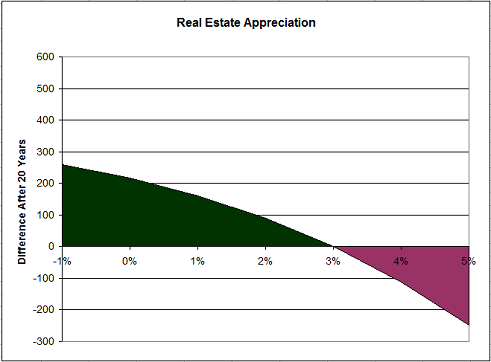
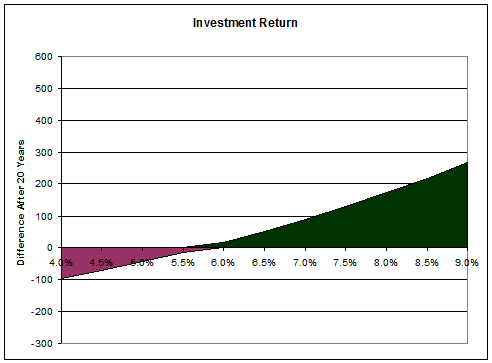
The shaded green areas show where it’s better to rent, and by how much, while the shaded purple areas show where it’s better to buy, and by how much. I’ve put them all on the same scale for easy comparison. You can see there’s a lot more green than purple. Yes, purple does exist, and there are scenarios where buying is better (high house price appreciation, high rent inflation, low investment returns, low price-to-rent, etc). But based on what I think are the likely range of outcomes, it is much more likely that renting will be better for us, and by fairly significant margins.

Here’s the impact of different outcomes for appreciation, with all the other factors as in the speadsheet posted before (i.e. 215X price-to-rent multiple, etc). You need to be quite bullish for quite a long time to get into the purple region at the right side of the chart (in effect saying that you think a $500k house today will be $1.3M 20 years from now).

The different outcomes for investment returns:

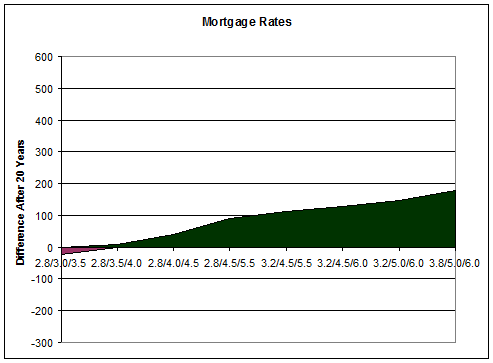
With several time points to pick from (0-5 years, 5-10 years, 10-20 years) it’s tough to make a fully-featured chart, but here are a number of options. Even assuming very low rates lasting for a very long time (2.0/3.0/3.5) only barely nudges owning ahead; in the green triangle, no truly scary rates are featured (nothing above 6%). The impact of mortgage rates:

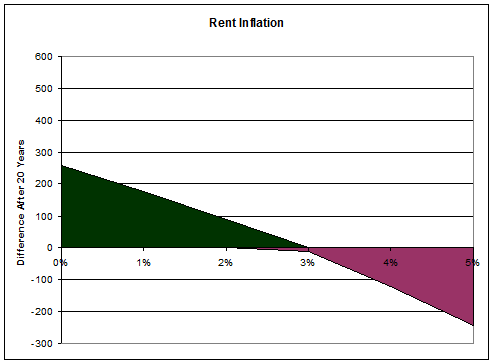
I was a little surprised to see that the outcome was so sensitive to rent inflation:

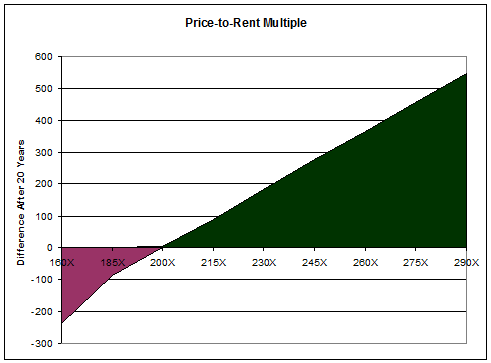
And how the outcome changes with different price-to-rent multiples (the base case was 215X in the previous posts, more on that below the figure):

Perhaps unsurprisingly the biggest single factor is the price-to-rent ratio. Fortunately, this is the one with the least uncertainty: identify your comparables — your living arrangement options — and then you’ll have the two prices to use rather exactly. I was attempting to be generous in the original post, using “just” a 215X multiple when I have seen plenty of examples in the 250X-275X range, and could probably cherry-pick even higher. I thought 215X was more defensible: though there may be some outliers, that seems to be about the floor in Toronto, so I could trust that you could go out and do your own comparisons and find similar or higher multiples. The original point was that even with generous assumptions, it’s hard to make the case for owning.

So maybe even though I thought I was being realistic, you thought the investment return assumption was a little high, or the long-term appreciation a little low — that’s fine, since the price multiple is a huge factor that may trump those smaller quibbles. Especially when a more realistic multiple for Toronto may be 250-275X.

Oh, and BTW: Wayfare has found out from the old landlord that indeed, the place did not get rented out at the original asking price of $2100, but rather $1950 (after a few months of vacancies chasing that higher rent). Plus she also says I’m way too conservative on the valuation (that was the lowest priced listing in 2010, again to be conservative/generous) and that $550+k would be more fair, i.e. a price-to-rent of 280+X. Our current place would be about 270X.

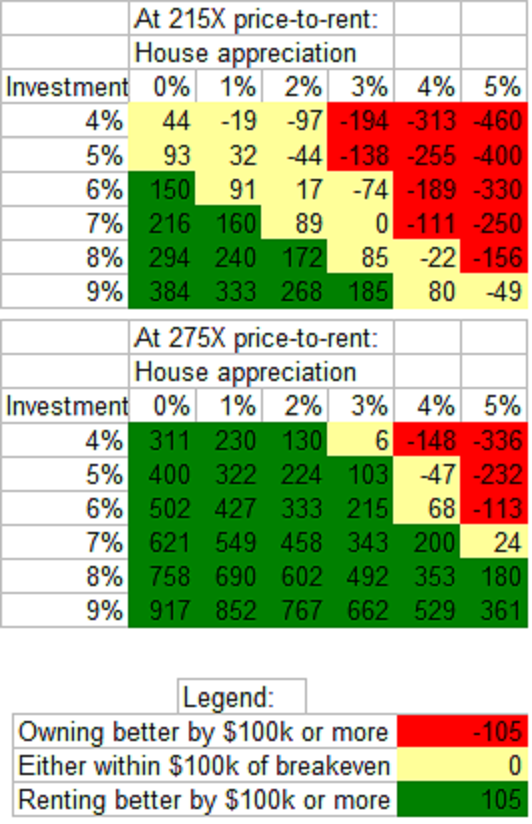
So how big of a difference does that make? Below I’ve created a little matrix looking at how the outcomes change based on different scenarios, here focusing on different house appreciation assumptions across in columns, and different investment portfolio returns down the rows. The cells have been colour-coded green (renting better by $100k or more after 20 years), yellow (either choice within $100k of the other), or red (owning better by more than $100k).

You can see that for a 215X multiple — the example used in the previous post — my base case scenario would be in yellow (2% appreciation, 7% investment returns). Being off by just two points (5% investment returns, 4% appreciation, or one percent to each) can flip the outcome from renting being better to owning being better. Enough that if you’re concerned about negative equity, or a flat-lining housing market, renting may indeed be a better choice. But not the hands-down outcome you may have been expecting given how important I feel the topic is. Perhaps I shot myself in the foot with my “even being generous to owning” strategy by giving people an out there.

So then look at how it all changes with a 275X multiple: very few scenarios where owning is better. At that price, you need to be both very pessimistic on equities and very optimistic on house prices to be dipping your toes into the real estate market. Again, you can find parameters where owning will yield a superior outcome, but how likely are those parameters? How big is the pain if you’re wrong?

What Is a Good Expectation of Future Stock Returns?

December 26th, 2011 by Potato

In my rent vs. buy analysis, one of the factors that has a particularly large impact on the outcome is investment returns. I looked at a range of nominal returns of course, but the one I chose as my “most realistic” scenario and highlighted as the default value for the calculator was 7%/year. It could be 5 or 6 percent, or maybe even 8 or more, but for a mostly equity, low fee investor like myself with a time horizon of several decades, I figured that was pretty reasonable.

Now, that little rent vs. buy calculator (though it may take the form of a spreadsheet, at its heart it’s just like the other web-based calculators around, except you can see the formulas, and tinker a little more) has got a few people talking. Some are bashing the very notion of attempting the analysis. Others are raising very salient points, and one that keeps coming up in multiple forums is what an appropriate expectation of future investment returns should be. A surprisingly large number are saying that 7% is too high, and so far none have stepped up to say no, it may be too low and that 8 or 9% should be used instead.

So, did I aim too high? Is that not a realistic expectation? Yes, the world may be facing problems now, but it has faced problems before, and two or three decades is a long time to right the ship. But if I’m making a huge mistake by somehow vastly over-estimating market returns, that’s something I need to know. Tell me what you think is reasonable, and why.

What is your expectation of an appropriate long-term equity return?

Some data to have before voting: according to the Libra total returns spreadsheet, both Canadian and US markets have returned about 10% per year nominal CAGR over 40 years in Canadian dollar terms (vs. Canadian inflation of 4.5%). The 20-year returns up to 2010 — so including the tech wreck, 9/11, the 2008 market meltdown, and appreciation in the CAD — are about 8% from both Canadian and US markets, vs inflation at 2%. CC links to a few other reports, like a recent one in the WSJ that suggests 6.5%. Or another that says that moderate returns are in our future: 3-3.5% above government bonds. Depending on which bond is meant by that paper, that could imply stock returns of 4-6%.

Let me know in the comments, and/or visit the quick online survey.

Create your free online surveys with SurveyMonkey, the world’s leading questionnaire tool.

Should I Sell My House And Rent?

December 22nd, 2011 by Potato

*Wall of text hits for 500 points. It’s super effective!*

Ok, as long as I’m on a roll, Mike asks via twitter: “Should I sell my house and rent?”

I responded: “I am physiologically incapable of answering that in 140 characters. Yes, possibly, or no, maybe. Beware the wife always.”

To put up another wall of text:

TL;DR: Yes, sell and rent.


In truth, it depends. First off, the situation is not quite symmetric with the earlier case of someone starting out and deciding whether to purchase their first place or to continue renting because there are significant transaction costs — financial and otherwise. As a young person if prices decline even just 10%, that’s huge — you may not even have 10% as a down payment as a first-time buyer, so that’s more than your entire life savings to date. For someone who already owns, 10% is a transaction fee. It can also depend on what your opinion is regarding using your house as an investment: do you want to get the most value out of it, or are you content on missing out on opportunities if it means you get to stay put? Your family situation can really play into that.

So let’s say you run through some calculations, and find that you live in an area where housing is significantly over-valued, and that you’d be better off renting. Further, let’s say that you go through some rental listings and find a nice place that you could see yourself living in. What do you consider next?

Well, first off, think of what you paid for your house. That figure does absolutely no good when discussing whether I should buy or rent, because I have to pay today‘s price, but you got to pay the price of whatever time you bought at. So let’s say that you managed to buy at some point where it would make sense to buy rather than rent, like 5 or 10 years ago. This is important because one of the benefits of owning is that you get to quasi-lock-in some of your housing costs at the time your purchase. I don’t mention that much because it’s a con, not a benefit, when prices are high — you’re locking yourself into being house poor. But if you’ve already locked in a low house price (e.g.: your current monthly cash costs may indeed be lower than rent), then your risk tolerance will come into play: do you want to take on the risk of higher shelter costs for the ability to lock in your gains, and make more by investing in equities?

It’s also a little different if you bought before the boom than the situation now: if house prices do go down, then for you, it would be like you bought low, it went higher, but then came back down. A missed opportunity, but other than some paper gains and reminiscing it doesn’t really affect your day-to-day life. On the other hand, buying high does: your daily costs are higher because you paid more, impacting your ability to save and afford other things in your life; and after prices go down you may find you’re underwater and can’t move, or can’t get favourable rates upon refinancing.

A list of considerations:

  • If you do sell your primary residence, any gains will be tax free.
  • You just won a leveraged bet. That’s a hell of an opportunity.
  • On the other hand, opportunity costs are psychologically different than cash costs.
  • The future path of prices: selling is a hell of a smart idea if a crash is coming. Could set yourself up for life. But over-valuation could fix itself via a long period of stagnation. That can still work out well for you — and for someone who has to pay today’s price, the path doesn’t matter as much. Nonetheless, soft landings a rare. If there is a crash and you chose to hang on, how will you feel? Even mortgage-free with no plans to sell, the knowledge that your house is depreciating can be trying.
  • Are you at risk of negative equity if there is a correction?
  • Risk tolerance: you’ll be trading partially locked-in housing costs and real estate investments for stocks and rent inflation. IMHO, a smart bet, but not one undertaken lightly.
  • Subjective factors: emotionally, it’s a lot easier to choose between renting and buying when you don’t already live in your “forever house”. If you’ve been living somewhere for years, it can be hard to decide to pack up and leave it.
  • Renting stigma: it’s undeserved, unfair, and perhaps doesn’t actually come up all that often in your life, but to some there is a social status hit when renting rather than owning.
  • Where you will go. While you only need one rental, they are admittedly rarer than houses for sale in the detached house market. You could try to find a speculator who wants to buy your house and lease it back to you (in many respects, the ideal situation). Or, you could sell and move to a cheaper area. That may be particularly appealing to those who are in a position to take (early) retirement.

So what are your basic options?

  1. Sell and rent (which may include finding an “investor” to buy your house and rent it back to you so you don’t even have to move). In this case, you get to take out a potentially huge tax-free profit, and diversify into equities, bonds, etc. You may face higher cash housing costs, especially if you were mortgage-free, but the returns of your investment portfolio should, in the long-run, more than make up for that. If house prices go up a lot more, you’ll feel like a dummy, but IMHO the risk of that is very small now. If house prices stagnate, you’ll come out ahead with your large investment portfolio. If housing prices go down, you can buy back in after a few years, and keep the profits. You become famous for your daring putting-your-money-where-your-mouth-is attitude and timing, and may get invited to write a book or give lectures.
  2. Stay put. If prices go down, you missed out on an opportunity to sell out, but it doesn’t really affect your day-to-day life, since you were already paying the same or less than current rents. Best of all, the wife will be happy, which may be worth a few hundred grand.
  3. Sell and move. So you like owning, but you don’t want to own in bubbly Toronto or Vancouver. That’s fine, you still have options. Let’s say you bought 10 years ago at $400k, and your Toronto house is now at $750k. You could sell it and move to a less-bubbly outskirt, like London, Hamilton, Guelph, etc. and get a nice house equivalent to what you had in Toronto for $300k, and pocket the $450k difference. Sure, you have to uproot a bit, but it’s not so far to go and visit your friends, and several hundred thousand dollars is a hell of a lot of money, tax-free. It would take the average person years to save that much. You may still have to work, or, depending on the rest of your situation, may be able to take early retirement. If the bubble pops, you may suffer as well in the outskirts, but odds are not as much, and then you may be able to buy back in Toronto if you really want to — though once you escape the traffic congestion, and see how much cheaper car insurance and other expenses are outside the city, there may be no dragging you back.

There are options within each of those scenarios. Once you’ve decided to move, you can choose to downsize for instance. I’ve talked with my parents about that a bit: with my brother and I moved out, and my sister at university 8 months of the year, they really don’t need a 4-bedroom house, let alone one walking distance to the subway when they never go downtown. They could sell now and downsize (either rent or buy). Even if they buy, having $800k in stocks and $400k in real estate is better than the other way around if/when the correction comes. If they downsized and rented, the rent may be less than just property tax, insurance, and maintenance now.

Or, you can choose to upsize. Sell your house and rent a nice luxury mansion, or a place closer to the subway, or better on whatever metric you want to pay up for for a few years. Even at $5500/mo, it’ll take years to burn through that tax-free gain on your old place; like a HGTV extended vacation. Especially nice if you had been planning to move up, but found the ever-increasing prices made it hard to make the jump. Live like damned hell-ass kings for a while: you deserve it, you made a fortune in accidental real estate speculation!

So, what do I think Mike should do? Sell and rent. I’m pretty sure he lives in Toronto, and I know that he bought his place 12 years ago and owns it free-and-clear. Toronto prices have doubled since then. The average price of a detached house in the 416 is approx. $750k now, which means he’s likely sitting on a not-insubstantial tax-free gain of something like $375k (depending of course on where in the GTA he lives, how far above or below the average his house falls, etc). It took him 12 years to pay off that mortgage: I’m sure it was 12 years of scrimping and sacrifice, since that’s a very short time to get it done in. And he could double it in just one quick move by selling now. Assuming the mortgage payments now go towards the retirement fund, that could cut something like 7 years off the retirement timeline*. A nest egg of $750k using even a very conservative 4% rate of return would produce $2500/mo, which gets you a pretty decent family home in Toronto (i.e.: about equivalent to one that costs ~$650k). Any return above that, plus all the money he’s spending now on taxes, maintenance, and insurance, is gravy — or money that can be used to rent an even nicer place. If those costs of a paid off house run another ~$1000/mo, that’s real money.

I made another spreadsheet for Mike to play around with, looking at how a renter would do vs. continuing to own over the long-term. Assuming $3k/mo gets you the equivalent of a $750k place; using a generous 3%/yr appreciation in house prices, and 6% for the investment portfolio, you come out ahead by several hundred thousand by bailing now. And that’s with the ~7% it’ll cost in transaction fees to get out. Any decline in prices just makes that look better.

There are risks and emotional costs. He avoids the risk of a housing downturn (indeed, as a blogger he can profit from it by driving traffic to his site with stories of his brilliance), and gets away from the usual risks of ownership (mostly repairs, since he no longer fears negative equity or lack of mobility). But he trades housing risk for stock market/bond market risk — Mike’s a smart guy, and a personal finance blogger to boot, so he probably doesn’t see that as much of a downside, but you do need the stomach for it.

He trades having most of his housing costs locked-in for the vagaries of the rental market, and also that intangible benefit of being able to be in one place for 12 years (not that renters can’t stay put, but it’s not as certain) — again, something that is not necessarily of benefit to a young person without an established career like myself, but may be to someone with a family like Mike. I’m more likely to need to move than to be annoyed that my landlords sold the house out from under me — as small as that risk is.

And of course, he has to convince his family to move, which can be emotionally taxing, especially if there’s a lot of sentimental feelings about the house where the kids grew up. Sure, you can bribe them: “Honey, I’ll buy you a bloody car if you just pack up your things within 60 days”, but it’s still going to be an upheaval. That said, people move all the time, and for worse reasons. You’ll adapt. It’s been 12 years, you’re probably about ready anyway (my those kids must be getting big… do they have their own rooms?). Or maybe you’ll get lucky and find an investor that wants to keep you as tenants in your own home.

On the other hand, maybe he paid off his mortgage in 12 years because he makes $500k/year, and realizing a $400k gain is not worth it to him: while it’s a tonne of money to me, it may be peanuts next to his investment portfolio, and not worth the hassle of hiring movers.

As for my parents? We had this talk, and they decided not to sell and rent or downsize. Primarily because my mom is emotionally attached to the house: they’ve been there 25 years now. Partly because they don’t need the money: they’ve been retired for years (if you ask, my dad won’t say he’s retired, but he has at least long since hit findependence**), and they’re not the type to take exotic vacations: if they’re not spending their money on their house, what would they spend it on? Now, if the stock market had stayed as bad as it got in late 2008/early 2009, that would have been a different story, and if the market gets bad again there will be a downsizing. But you can see how even if it’s the financially optimal thing to do, they may choose not to.


So, what does the future hold? That’s very tough to say. In the near term, damned near anything could happen. My opinion:

  • Equity returns will be decent in the long term (20+ years), 4-5% real returns should be very realistic (6-8% nominal with 2-3% inflation).
  • Rent increases will be in-line with inflation: the current overvaluation is not due to abnormally low rents IMHO.
  • House prices will increase very modestly when averaged over the very long term, basically in-line with inflation over 20+ years.
  • There is a good chance in the medium term (next say 7 years) that house prices will be lower in Toronto: I think it’s the most likely way to correct the current over-valuation. I’d say a 90% chance that prices are 10-20% lower 5-7 years out. We could have stagnation or a soft landing, but I just don’t see it as terribly likely. There’s a decent chance of a spectacular crash, too, particularly in the condo area: say a 50% chance that prices are 30-40% lower in 5-7 years. I’d say with very high certainty that 7 years from now, house prices will not be higher — we’ve done 0-down, we’ve done government mortgage guarantees, we’ve done first-time buyer tax credits, and we’ve done low interest rates. Other than direct subsidies, lowering the age of majority, fully mature adult cloning, dissolving marriages, massive lifespan extension, and forced relocations, there isn’t any more fuel to throw on this fire. That said, it’s not going to be quick — there are people asking if they should wait 8 months, or maybe 12 before buying a house, and it’s just not going to play out that quickly.
  • The opportunity cost of holding real estate in Toronto is very high: the rent savings of having all that capital sunk in your house is only yielding 2-3% — about what you can get in safe fixed income (though granted, tax free) — while you may expect double that from other investments that really aren’t any riskier than a house.

Add it all up, and selling and renting/moving out of the city is a smart move. If prices do go lower — which I think there is a very good chance will happen — you’re a hero. Even if they don’t, you’ve got a good chance of out-performing housing. And you can set yourself up for some interesting opportunities, like early retirement, freeing up capital to start your own business, or escaping the city and finding a house with a conservatory***. Just be ready to stick with it for a long time: the stock market could crash again next year, and it may take six years for even the smallest correction in Toronto house prices. The future is always uncertain, but the long-term expectation looks heavily skewed in favour of those who sell to invest and rent.

* – Less than 12 because now compounding is working for you instead of against you. Plus if he has other savings (i.e.: it’s likely Mike was saving before in addition to paying down the mortgage aggressively) then the retirement timeline reduction isn’t quite as dramatic.
** – Damnit, now I owe Jonathan Chevreau a nickle.
*** – Some time ago, Wayfare was looking at house porn in London. For what a middle-of-the-road house in Toronto costs, you can get a mansion in London, with a living room, dining room, den, solarium, library, and conservatory. I couldn’t even really say what a conservatory was — a music room maybe? — but we knew that it meant this house had so many rooms they must have started to run out of things to name them.
Rent vs. Buy: The Investment Spreadsheet

December 21st, 2011 by Potato

TL;DR: Here is a spreadsheet based rent-vs-buy calculator I put together in Google Drive (or, download for Excel). You can save your own local copy to play with your own numbers. The long post below helps explain some of the calculations and what to consider when entering values. Thanks go out to Matthew Gordon who did a lot of work on my original to calculate out the full mortgage amortization and to really clean it up!

For more on why this is an important decision and to put the numbers in context, see this post.

2023 update: I created this calculator way, way back in 2011. I thought it was important to model a future increase in interest rates in the rent-vs-buy decision, and now that over a decade later interest rates have finally increased it’s starting to look like an important factor after all. I’ve updated the base assumptions for the new interest rates, as well as price:rents in the northern GTA. In addition to helping people make this very big, important decision, the tool was also designed to explicitly show what happens when you rent and invest the difference — while the last decade has seen incredible real estate appreciation in Toronto, making buying look pretty good post hoc, a crash was never needed for rent-and-invest-the-difference to come out ahead.

—

In a recent post I was trying to simply get across the concept that there is some point at which it makes sense to rent rather than buy, even if you don’t assume something like a crash in housing prices on the horizon. I used the extreme example of renting a million dollar house for just a dollar a month: it makes no sense to want to buy in that case, as it’s so much cheaper to rent. As the rent gets cheaper and the house more expensive, there will come a point where we cross over from what we’ve known most of our lives — that buying a house is a solid financial move — to a region where that is not true any more, and it’s wiser to rent.

Once you grasp that simple concept, then the question becomes where that cross-over point is. There was a long discussion in the comments about that, out of which came this Rent vs. Buy Investment Spreadsheet (it can also be downloaded for Excel).

About the analysis: there are many moving parts when trying to decide whether it is better to rent or buy in the long term, most of which require that you make estimates and assumptions about what the future will bring. At the end, I’ll go over some of the cases, and the difference between a long-term expectation and a short-term result.

Basically though, what this is showing is what would happen if you chose to rent a house and invest any extra money that you saved vs. buying that same house. The common refrain is that by buying you “build equity” as you pay off your mortgage (and if you’re lucky, the house appreciates), but as a renter you can also build equity by saving and investing. If house prices are high enough, and rents low enough, then you may indeed be better off by renting and saving the difference. The spreadsheet explicitly includes the buildup of equity for both parties: paying off the mortgage for the owner, and saving and investing for the renter. Both start with the same amount of money, both have the same monthly budget.

At the difference between rents and prices in Toronto right now, you’d be better off to the tune of hundreds of thousands of dollars to rent for the next 30 years — even if house prices don’t crash. If you really wanted to own your house going into retirement, well, you’d have enough money to buy one with cash at the end, with plenty left over.

Factors:

Annual figures: all numbers are for the year: the monthly rent is multiplied by 12 to get an annual figure, etc. For the investment portfolio and the owner’s equity, the value is for the beginning of the year.

Investment returns: I’ve assumed 7% 6% nominal returns, which for a young investor (i.e.: someone in the age group where they would be about to buy their first home) with a long time horizon and risk tolerance to invest in a heavily equity-weighted portfolio should be realistic [lowered assumption in 2023]. The spreadsheet takes the amount of money you would have at the beginning (in this case, your 25% down payment plus closing costs) and compounds that at 6%, adding in the savings vs. owning each year (which, for the year its added, is compounded at half the rate to reflect the fact that it’s not present all at the beginning).

Rent, rent inflation: In this case, I’ve used 2% 4% rent inflation, which is approximately what non-downtown Toronto has experienced over the last decade [updated in 2023 incorporating our well-above CPI rent increases of the last few years].

Mortgage: I’ve taken the currently available fixed-rate mortgage rate of 3.49% 5.9%, and used that for the first 5 years. Then, I assume that rates go up a bit, to 4.5% settle to 5.5% for the next 5 years, then to 5.5% for the remainder. 25 year amortization. Interest rates are very difficult to forecast with any accuracy, but I would bet that this is being very generous to the case for owning. Thanks to Matthew for making the mortgage information auto-update, and removing the need for an external mortgage calculator.

Maintenance: I’ve used 1.1% 0.66% as the figure for the maintenance/repairs budget [updated in 2023 to reflect much whining about this factor and that house prices have outpaced maintenance costs so the old rules of thumb need a tweak]. This comes from much reading around the web as to good rules-of-thumb to use, as well as back-of-the-envelope budgeting of how much a house costs to keep in good repair. The maintenance costs will not in real life be as smooth as this: you may have to pay for nothing for 5 years, only to get hit with a roof repair, new hot water tank, and a leak in the basement all at once. Nonetheless, it should average out to something approximately in this range. If you decide to re-run the numbers for your own situation and are using a condo, remember to add a bit to the listed maintenance fees for the condo to account for repairs not covered by the condo corporation, like replacing your units’ appliances, repainting the walls, replacing the flooring, and of course, the occasional dreaded special assessment. Also keep in mind that many new buildings have maintenance fees that are lower than might be sustainable — maintenance fees often spike after a few years. Note that this is being very fair to the buying case: for the real-world example I chose for rents, the condo fees alone came to 1.4% (which doesn’t include interior maintenance like replacing appliances or repainting).

Property Tax: [a rough estimate of] The Toronto property tax rate. I’ve used an increase over time that is above inflation figures used elsewhere (property tax increases by 4%/year) as that is what I’ve been reading the rates have been rising each year. If you have a better estimate, feel free to use that instead.

Taxes: It’s a tough to avoid taxes as they can be a big factor, so now the spreadsheet also includes an estimate for taxes upon selling the investment portfolio at the year of comparison. One of the big problems with trying to build in taxes is that they can be so complicated on investments: some can be deferred, some can’t, and there are different tax rates for different investment income types (interest, dividends, capital gains). On top of that, the investments could potentially be sheltered in a TFSA or RRSP. For the default number I put in 10%, which is assuming that the couple is in the $40k-75k income range, which would be an Ontario marginal tax rate of ~32%. Then about half the investments are sheltered (the excess is ~$10k/year, which could be put into TFSAs with two people, and still allows us to assume both renters and owners are maxing their RRSPs on top of that). Then of the half that’s exposed to taxes, it’s about 30% more tax-efficient than regular employment income. Plus, 10% is a nice, round number. If you prefer, you can just set the tax rate to 0% and then use an after-tax rate of investment return (or, depending on your own situation, if all the investments could be sheltered in a TFSA it gets easier).

Insurance: This is a very loose approximation, but it’s also the smallest factor, so it doesn’t matter as much if I’m off by a few hundred dollars per year.

Transaction fees: I’ve assumed that the transaction fees to buy are paid out of cash right away (and that the renter will instead invest that money). Matthew has updated the spreadsheet to also reflect transaction fees to sell in column R.

CMHC fees: The CMHC fees are calculated according to the downpayment set and added to the mortgage. The other closing costs (LTT, legal, etc.) are paid as cash, so the renter has the downpayment and closing costs to invest initially.

House value: This is the big one. Try to find a good comparison for your own situation: what can you rent, what would be the price of that place or its equivalent?

For appreciation, I’ve used 2%/year — that is, that the house appreciates in-line with inflation over the long-term. This is clearly not the case in the short term: houses were up something like 10% [in 2010], but down something like 10% in the middle of 2009. It is critically important to have a fair long-term estimate here: if you assume house prices go up 10%/year forever, then of course it’s going to make more sense to buy in almost any scenario: why wouldn’t you buy a baker’s dozen houses in that case? Though for the short term, that has been the experience: Toronto (and Vancouver, etc.) have had a hell of a run in the last few years. But the long-term history suggests something much more muted: basically inflation plus a bit. If we’re already at the point where you need to assume high appreciation for buying to make sense though, how much further up can house prices realistically climb? What will be the average return when you look back 25 years from now? If you are a believer in continued high appreciation of house prices for the long-term, I invite you to play with this spreadsheet some more: fast-forward a number of years, and look at what it would be like going forward if rents were up 2%/yr but prices up another 10%/yr — what rate of appreciation do you need just to break even at that point? Even if you don’t assume a crash, at some point the rate of appreciation will settle back down to a more moderate low-single-digit value. And to be conservative, that’s what you should pick in this kind of model.

Customizing it: At this point, the spreadsheet isn’t set up with forms and that sort of thing to just start typing your own numbers in. What you have to do is go to file->download as and save a copy for yourself. You can download it to excel and use it offline, or use file->save a copy to put a copy in Google Docs under your own account to play with it.

Discussion points:

There’s a lot to talk about, and this post is already fairly long, so I’ve made a separate post to go over some of the discussion points, and to discuss various scenarios. Then we can stick to the details of the spreadsheet analysis itself here.

There are a lot of assumptions and estimates involved, a lot. The question is what should you do for your life? And importantly, what are the consequences of being wrong? Don’t use this tool with unrealistic estimates to try to justify a decision you want to make, but rather try to use it to help you come to the decision you should make — and to see what happens if you’re wrong. Shelter is the largest household budget item, buying a house is the largest purchase a young family will ever make. Please, treat the decision with the respect it deserves and go in with your eyes open, the risks assessed, the options weighed — more than the handwaving gesture towards long-term averaging out and comfort that many make today.

Also check out the post a bit later in the series on how this analysis can change with changes in the various factors. And up next, the case where you already have a paid-off house in this market: should you sell and rent? It’s not quite symmetric.