Paris: Free Hugs!

June 27th, 2009 by Potato

Paris is a big city. It doesn’t really seem to have an identifiable “downtown core” like most Canadian cities do, no single major street or intersection that defines the centre. There’s the La Defense district, which we haven’t been to see yet, but seemingly the whole of the city is crowded with one-way alleys and 5-storey apartments with retail on the ground floor. It makes the whole city seem like a teeming downtown core, and I just can’t quite wrap my head around it all.

The stonework is impressive though, and Wayfare and I were wondering how it was that they managed to put so much effort into seemingly every building over such a wide area. Of course, the downside is that there’s very little greenspace to be found, and any little patch of lawn seems to instantly spring sprawling sunbathers in this summer heat.

Oh, the terrible heat. I don’t know how it’s so hot underground, but that has to be the biggest downfall of the metro system here. None of the trains are air-conditioned, which is especially bad when bathing seems to be as optional as it is here. They open the windows so there’s a bit of a rush of air when the small trains are moving, but the system is quite a bit different from the subway of Toronto. There are an enormous number of stations and lines, all criss-crossing across the city. It’s kind of nice knowing that up on the surface a metro stop is never much more than 300 m away, unlike the 20+ minute walk you could face in North York or London just to get from your house to the nearest bus stop, let alone subway station. However underground it means that the trains spend way too much time stopped at the stations, baking with no air movement, rather than making progress through the tunnels. There’s also no guard car like the TTC has — no one checking to make sure that everyone is off the train, that those boarding aren’t getting caught by the doors. The buzzer sounds (and it’s an unpleasant noise that does not help the claustrophobic nature of the situation), the doors slam closed and the train moves. The doors don’t even open on their own, you have to hit the release yourself. Of course, none of these issues stop it from being a very well-used service: even at night just before the system shuts down the trains are fairly busy; at one stop the people hadn’t even finished getting off, let alone given a turn to the hundreds of people on the platform to get on, when the buzzer buzzed and the doors tried to close.

Today we spent a lot of time walking and looking at buildings, including the impressive Notre Dame cathedral. However we were pretty baked by the heat and the sun and a slight bit of dehydration given that a bottle of water or can of pop runs us north of $3, so we haven’t been taking as many pictures as we should have been. We walked by the Louvre, where bizzarely enough a gang of people were giving out free hugs (with the signs to advertise it). Wayfare was quite excited by the free hugs, and got 7 or 8 on the way through the crowd.

“Yay, free hugs!”

We grabbed some crepes for lunch at a small restaurant in the shadow of Notre Dame, where there happened to be a small white kitten sleeping on the bench (until some American girls came in and decided to pick him up and tell him how cute he was). We now have more pictures of the little white cat than we do of the Louvre and Notre Dame cathedral combined.
Sommernaschtsball

June 21st, 2009 by Potato

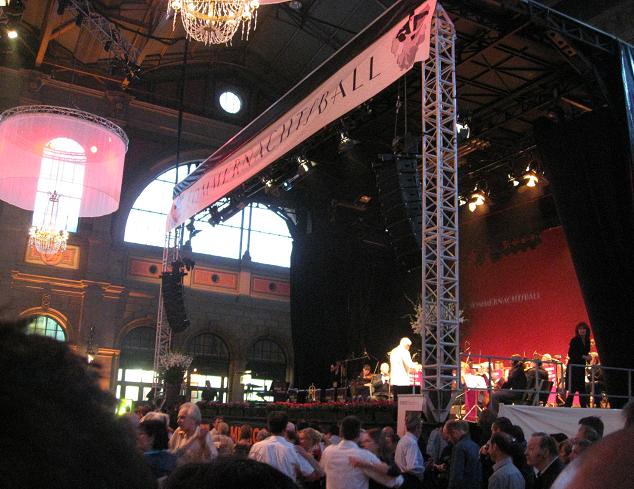
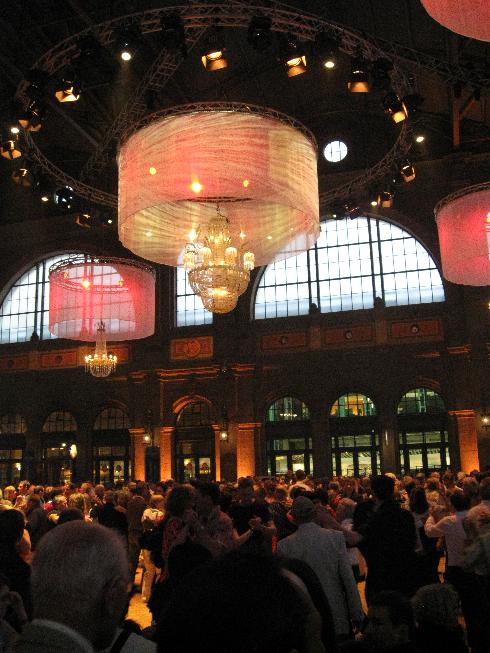
Imagine you step off the train coming in from Davos into the busy Zurich main station, and find yourself confronted by a full orchestra warming up. A dancefloor is in place within the airy main hall, gauzy chandeliers have been set up, and linen-topped picnic tables separate the hustle-and-bustle of the train-riding public from the other-world-ness of the dance floor. You think to yourself this must be some cool, swanky black-tie, invitation-only event.

Only when you see excited passengers in jeans and t-shirts run out to the dancefloor to join with those who dressed in tuxes and ballgowns do you realize that it’s free and open to any who care to dance on the shortest night of the year. Sounds too fantastic to be true, doesn’t it? Like something from a dream?

But that’s what we saw last night at Zurich HB for the mid summer’s night ball, it was quite the sight. Unfortunately, we were too tired after the conference and all the travelling to come out to dance (that, and at one point while watching it looked like someone was calling a particular dance in German, and there’s no way we’d be able to follow directions, or waltz as well as most of the dancers out there).

Mid-summer\'s ball at Zurich HB

Dancers celebrating mid-summer\'s-night ball

Permalink.

Prius Magnetic Fields

June 19th, 2009 by Potato

Previously, I wrote about the fear surrounding hybrid cars, specifically the magnetic field exposure:

For the hybrid car issue, we have the question “what are the fields?” and we don’t even have a good answer to that, from which point some people fall into hysterics (up to selling their car). The real issue is then several steps removed: the Prius may have higher magnetic field exposures than other cars, and those fields have an unknown but probably small effect on human health, and that might outweigh the positive aspects of the technology.

I was understandably baffled that some people would make a mountain out of a hypothetical mole hill, especially in light of the fact that there are many other EMF “risks” that are obviously higher in everyday life, such as using a hairdryer, cell phone, or riding on a subway, which may not offer the benefits of a hybrid drivetrain. I was upset that the few people that have actually taken the measurements have not published or shared them in any way. I figured that when I eventually get a Prius for myself, I would have to borrow the magnetometers from the lab and do the job myself (and possibly get a published paper out of the deal!). (Un?)fortunately, someone has beaten me to the punch: G. Schmid and colleagues from the Austrian Research Centres in Seibersdorf have measured the fields in a Gen2 Prius under various conditions and reported the results at an international conference.

The exposure frequencies can go up to 1000 Hz due to some of the power switching. They found that near the floor in the backseat the exposure was highest, averaging 10% of the permissable general population chronic exposure according to the ICNIRP guidelines (which are frequency dependent), and could reach 30% in the maximum case (a switch from maximum acceleration to maximum braking). Even just at lap level the exposure is <5% of the guidelines (since children have short legs, this is perhaps the more appropriate measure).

They accounted for the effect of the tires (rotating tires with steel belts/cables in the makeup produces magnetic fields of up to 4% of the guideline exposure), which would be present in all cars. They also compared to some conventional cars — and the Audi A4 and VW Passat both had significantly higher exposures than the Prius! In fact, the Audi A4 exceeded the ICNIRP guideline in some conditions. The main source of exposure in those cars was from the air conditioning systems, which are “not as sophisticated” in their electrical management as in the Prius. One factor in particular that they mentioned was that the conventional cars tended to use the chassis as a current return, wheras the Prius has dedicated, shielded wiring loops that return to the battery.

In other hybrids it was found that magnetic field exposure does not correlate with installed electric motor power — the Honda Civic Hybrid has nearly 3X as much magnetic field exposure as the Prius does.

For comparison, another presenter looked at exposures on British Rail cars (not the underground — the motors are in locomotives separate from the passenger cars) and found that the fields were also in the 5-10% of ICNIRP guidelines range.

Permalink.

Davos

June 19th, 2009 by Potato

“Do you have any open wishes?” is our new favourite saying after being asked by the waitress at a cute little restaurant.

The city is incredibly closed right now, I have no idea why they chose here for a conference. The vast majority of what few restaurants there are are closed for lunch (and almost half are closed completely — it’s the off-season here), yet there are a lot of tourists who really have nothing to do but eat at restaurants for lunch. For that matter, I can’t quite understand why all the restaurants and hotels are 20 minutes away from the conference centre rather than all clustered together. There doesn’t look to be much in the way of air conditioning, though for the most part it’s not really needed, but fans are. The air just sits and stinks and it gets sticky inside, even outside the breeze off the mountains seems to stop for a large part of the day.

I’m actually quite surprised at how warm it is here, since the weather reports keep saying it’ll be 11C or whatever, but the thermometers I’ve seen on the walls and the subjective feeling is that it’s between 25 and 30, with no air movement for much of the day.

The hotel (Sunstark Park) is so strange: it’s supposedly a 4-star hotel, but is just missing some basic amenities (not the least of which is air conditioning). The windows don’t have any screens, so it’s sometimes hard to even open those for air if the bugs are out. The washrooms have giant bottles of hand soap and shampoo, but no conditioner or hand cream. There is wireless internet in every room — but it costs up to $45/day to use!! (8 CHF, which are very close to CAD, per half hour) Despite being close to an international conference centre, the concierge thought I was crazy to think they might have a north american voltage converter to borrow/rent. Supposedly to avoid fire risks, the rooms don’t have irons or coffee makers.

Strange things in Switzerland in general is that many of the doors have a flange to them to seal up to the fram, rather than a jamb in the frame (i.e.: part of the door goes around the frame, rather than in it). There’s a toilet brush next to every single toilet. The toilets are crazy about sanitation! This sponge comes out to clean the seat after you flush and squirts some sort of cleaning fluid (or possibly just water, I don’t know). Many of the other public restrooms had disposable toilet seat covers available.

So, highlights: Mountains, of course. We went on a crazy long bike-ride up around the lake and partway up the mountain, almost 3 hours of pedalling, which is about 4 times longer than I typically bike for, so I was pretty wiped by the end. Great experience though, and my first time doing “real” mountain biking (i.e.: flying down tree-root-laden goat paths, and hitting hills so steep I had to walk the bike up many of them). I stuck my feet in the lake, and it was about as cold as you might expect glacier run-off to be.

We had a social event at a former asylum for tuberculosis patients at the top of a mountain, and we ran a little late and missed the last cable car down (actually, we just made it, but stupidly followed the person who said “oh, too late, let’s walk”). So we walked down the mountain in the dark, with only the lights of our cameras’ LCDs and one tiny LED flashlight to guide us. It took the better part of an hour. About halfway down, with the trees closing in on us, and us coming to the realization that we had walked ourselves into a horror movie, a small white kitten jumped out of the bushes and swatted at my foot, playfully.

Man, I’ve never been so scared of a kitten before, I must have jumped 3 feet in the air.

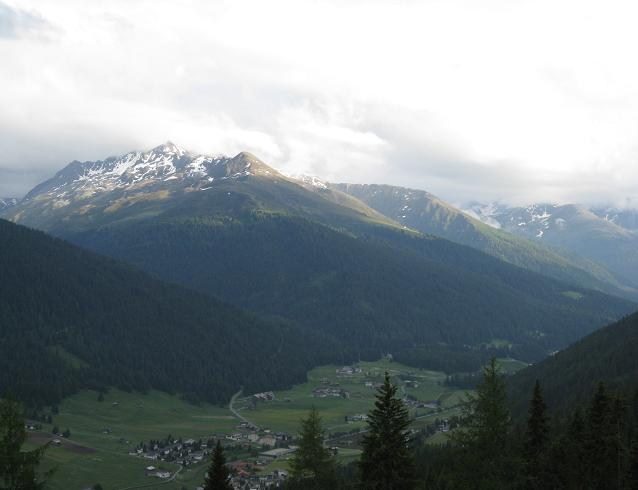
Davos as seen from the top of the mountain

Zurich

June 13th, 2009 by Potato

We’ve arrived in Zurich, and aside from the people beside us harrassing the flight attendants and knocking us over with the “snuggle train” it wasn’t too bad — even though we didn’t get our pre-picked seats in the 2-seat part of the 2-4-2 plane setup.

Wayfare’s brand-new Air Canada branded suitcase fell apart. Hopefully it’ll hold together long enough to get it home, where hopefully the Bay will take it back.

Our hotel room is great — probably bad to start with the biggest, nicest room, because it’ll spoil us for Davos and France, where the rooms will undoubtedly be smaller and less luxurious. But for now it’s fantastic, quiet, with our choice of 5 different types of pillows (goose down, duck feather, new wool, spelt chaff, ortho latex, or memory foam). The internet is free, but strangely enough the ice costs $5/tray.

We’re pretty beat from the flight, so we didn’t spend too much time exploring the city, but so far it’s been really good. I’m surprised at how many people speak English — I thought my broken French would have to serve as a lingua franca, but so far it’s been no problem. I don’t know if it’s the pale skin or what, but most people even greet me in English from the get-go. The main shopping strip is really cute with pedestrian and trolley/tram access only — many of the cars seem to have to navigate around.

One thing that’s really struck us about Zurich is that it has a really intricate trolley/bus/regional train system, which is amazing since the city is pretty much the same size as London, Ontario, which has pretty terrible transit (ok, I like the LTC and it’s not bad along Richmond or Oxford, which is surprisingly good for small-town Canada, but this is just a whole other league). Even on Saturdays the trams have been coming every 5 minutes.

The streetlights are suspended from cables strung between the buildings, which looks especially strange in the daylight when the lights are off and you can’t figure out why all the cables are strung all over the place.

Oh, and the river was a fair bit larger than I was expecting — I figured the (Ontario) Thames was a decent-sized river, but this one is a good 10-15′ deep, with fish snapping at bugs in the early morning!

Dandelion Snow

June 11th, 2009 by Potato

I was woken up this morning at 10 am by a knocking at the door. Crawling out of bed to answer it, I found a confused woman “This… this isn’t the Erskine house, is it?”

Damned Erskines, we keep getting their mail — same street number, one block away, both streets start with the same letter, and their postal code is only one (very similar looking) letter off of ours. Of course, I bring their mail up to them, but they’ve never had to re-deliver our stuff. I haven’t noticed anything missing, but I would be surprised if the mail was never lost in the other direction.

Now we’re getting their visitors, too!

Damned Erskines.

After slacking off for a (busy, rainy) week, I finally managed to hit the bike trails today on a lovely June evening. I managed to hit 10 k fairly easily, which made me feel good — hopefully I’ll have some time to rent a bike while on vacation and keep up with it. The dandelion fluff was sailing through the air, rather heavily in parts — like dandelion snow (which, BTW, WMAGNFARB — a Dave Barryism that has suddenly become very important in our world as all the names I can think of for Rock Band names are taken on Xbox Live).

All-Electric Cars

June 9th, 2009 by Potato

Tim from Canadian Dream made a minor mistake last week in his thoughts on electric cars. “Where are you getting the power to fuel the cars? …Depending on…”

Ah, “Depending on”. I love those words, they open up so many possibilities for playing with numbers and outlining scenarios. They can make life so interesting.

Really the only factor Tim discusses is where the power comes from: coal is dirtier than other sources like hydroelectric or natural gas, so, he concludes, maybe you shouldn’t get an electric car if you live somewhere where there’s a lot of coal generation. After all, electric cars aren’t completely clean, they get their juice from the grid. The thing is, that’s one of the few variables that isn’t a factor in making the decision to go to an electric car — several studies I’ve seen have said that electric cars are so much more efficient that they always beat out regular gas cars, even if 100% of the power comes from coal [though other studies, such as the german WWF one, indicate that for real-world power mixes electric cars beat out gassers, but may narrowly emit more CO2 on 100% coal — but that’s with a highly optimistic 6.6 L/100 km fuel consumption assumed for the gas car; they figure an electric car on coal would produce 200 g of CO2/km, and a gas car only 160 g/km — but for the US, the average is 210-250 g/km, and probably higher for real-world driving]. With the really efficient hybrids it becomes more of a toss-up, but still not something you need to worry about with all the other factors to consider.

Why is that? Well, first off thousands of tiny internal combustion engines on the road is a fairly inefficient way to move people around: in the best case, a conventional car is only about 25% efficient (at most). That is, only about 25% of the energy in the gasoline gets translated into actually moving the car (and none of it when you’re idling/creeping in construction season). Hybrids do better (especially those with atkinson-cycle engines), topping 30%, to as much as 37% efficiency (and perhaps touching 40% for the 2010 Prius). Now, here’s where my numbers differ from Tim’s: I’ve heard that properly run coal power plants can top 50% thermal efficiency, whereas Tim says in the comments it’s 30-40% — if that’s the case then a hybrid can beat out an all-electric in cases with high levels of coal use.

Now of course, even if the thermal efficiency is higher, you have to consider that coal has more carbon emissions per unit of energy than oil does — but then, even Alberta isn’t a 100% coal-fired province (though it is up around 75%).

Plus there are other pollutants to consider beyond just carbon dioxide: just like having a tiny engine is inefficient, having a tiny exhaust scrubber is also inefficient, so you can generally get fewer bad things out of a centrally-managed power plant than a distribution of cars (pollutants like nitric oxide, carbon monoxide, etc). You also shift those pollutants from sidewalk level in the downtown core to a distant location where the power plant is — good for the people living in the cities, even if it’s a wash to the atmosphere. Coal may have more sulphur and mercury though. By charging off-peak, the extra demand can actually help improve the power grid by smoothing out the demand (and with a smart grid, electric cars could give back power when needed).

Now that’s sort of the worst-case scenario for electrics, and even there they might lose out to hybrids on some counts, but at worst it’s a wash with a gasser. But most provinces do have cleaner energy mixes than that in real life (and Albertans aren’t reading this anyway) — this a no-brainer factor.

So what are the other “depending on” factors?

Cost: hey, batteries are expensive, and at this point electric cars are limited-production items, so the up-front cost is often steep. Since electricity is cheaper than gas, joule-for-joule, in every locale I know of (or at least, mile-for-mile), you can do a lifecycle analysis and may find that in the long-term an electric will be a wash or even cheaper, but the upfront cost is a hill to overcome, especially if you need to install 220V service or a special charger in your garage. That analysis gets worse if you move a lot.

Access to charging: It might be nice to charge at work or the mall, but probably isn’t strictly necessary. However, if you live in an apartment building (or even a house with street parking rather than a driveway/garage), odds are an electric car won’t work for you just because you don’t have good access to charging.

Going Off-Grid: No one I know has their own oil refinery in their backyard (Reggie would, but it’s against the condo bylaws), but if you want to be self-sufficient (for instance, to get away from the coal use in your local grid), you can install your own solar panels or wind generator or other renewable energy source and charge your car at home.

Range: Electric cars will have a limited range, and until fast charging stations or battery swaps become common-place, that’s probably going to make range the #1 “depending on” issue for people considering an electric car. They won’t work for everyone, but the fact is most people do most of their driving in a very limited area: to work, to the mall, to the curling club, home again. For something like 95% of trips people make, the range on an electric will suffice. Many households also have more than one car, so an electric commuter and a larger, gas (or hybrid)-powered “cottage van” would probably work.

Practicality: Batteries have much lower energy density than gasoline, so they take up a fair bit of space. This makes the equivalent electric car slightly less practical than a gasoline one. Plus, electric cars tend to be tweaked for efficiency (small, often 2-seater commuter vehicles). This is not a requirement of electric cars — there’s nothing really stopping one from making an electric Cadillac Escalade, it’s just that the batteries and motors to make that behemoth move (esp. with any kind of decent acceleration) would be prohibitively expensive. Although it would greatly improve the handling and roll-over characteristics since you tend to put the batteries in the floor.

Maintenance: Even though it only takes seconds, some people just don’t like the idea of having to plug in every night. On the flip side, electric cars have much fewer maintenance requirements: no oil changes, no exhaust testing, no belts to replace, no spark timing to fiddle with, no air intake filter. You’ll still have to remember to do your cabin air filter and top up the washer fluid periodically, and eventually the friction brakes will need servicing, but they’ll likely last 4 or 5 times longer thanks to the reduced wear with regenerative braking.

Canadian Winters: I wish I could say for sure that batteries have no problem with Canadian winters, but unfortunately, your range will be cut down if only from the energy needed to run a heater (not a problem gas cars typically have since 75+% of their energy is lost to heat anyway). High-voltage batteries do look to perform better than the lead-acid starter battery in your car, and the car will run, but more real-world testing is still going to be needed. But other than that it doesn’t look like there will be any major problems.

Battery Chemistry: Nickel-metal batteries are a time-tested technology that have been working great in automotive applications, from the EV-1 and Rav4 EVs to the variety of hybrids on the road today such as the Prius, Insight, Civic, Escape, etc. They last essentially the life of the car with very few failures. However, due to some bad politicking, they are patent-protected by a company that seems to have little interest in selling batteries affordably, or possibly at all. So pretty much all electric cars are going with either older lead-acid batteries or new lithium-ion batteries. While lithium ion batteries are lighter and can put out more power, they don’t have the track record yet to say for sure that the heat issues have been solved or that they can last for a long time (they may have a time decay/aging as well as decaying with use/mileage).

Existence: For now, there really aren’t many choices for electrics. Most of the new ones (like the Zap and the Zenn) are “glorified golfcarts” or neighbourhood electric vehicles — low-speed cars that are not capable or safety-rated for highway speeds. That adds extra limitations, making it harder to settle for one — and of course, they’re only legal in two provinces. There are some Rav4EVs from the late 90’s CARB zero emission experiment rolling around, and from the sounds of things they seem to be in great shape still… but very few of them are offered for sale (hey, their owners were the fanatics who got an electric car in the 90’s!). The Volt, though a PHEV, is a powerpoint dream that’s perpetually just a year away… and that doesn’t look any rosier with GM in bankruptcy. Which pretty much leaves the Tesla. Their roadster has the usual limitations of a two-seater sports car, including a hefty price tag. They’ve unveiled their model S, a luxury sedan to come soon (and I desperately want to see how they wedged those kiddie seats in there to make it a 5+2 seater, ’cause I just don’t believe it from the exterior shots). A variety of others are in the works, such as a mystery car from Nissan (and I for one fully expect the Honda Clarity to surprise! come out as an EV in a few years, since it’s basically an EV now with a fuel cell where the battery should be… the hydrogen fuel cell test car is a clever smoke screen for the competition). There are a few do-it-yourself kits — I’ve seen a 1980’s-vintage Civic at Sunnybrook that was converted to electric, with the trunk and backseat replaced with an array of lead-acid batteries — as well as garages that will rip the gas engine out of a car for you and do a full conversion (a PriusChat member recently gave his Porsche that treatment).

PHEV: Plug-in hybrids, through conversions and maybe soon OEMs (Volt??) will let you have your cake and eat it too: you can have a reduced all-electric range (and reduced all-electric speed in the case of the Prius conversions), perhaps just enough for your daily commute, letting you run cleanly (and cheaply?) off the grid for most of your driving, while having the security blanket of a gas engine that gives you the essentially unlimited range our current cars and gas station infrastructure provide.

They’re not going to work for everybody, but if they work for even 50% of the 66% of families with more than one car then we’d off to a flying start.

Hmm, I don’t know how I have a whole post on EVs and didn’t manage to link to Darell’s EVnut page. There you go.

Permalink.

Drag Me To Hell

June 5th, 2009 by Potato

Sam Raimi’s Drag Me To Hell is a horror movie in fine form. It was genuinely scary (mostly startling with a decent level of suspense), accomplished almost entirely through music, camera angles, and facial expressions. The man knows his craft.

I don’t have too much to criticize one way or the other, except to say…

Spoiler warning!

…that the old gypsy woman was really over-used, especially once she was dead. Ok, the first time she showed up in the bed it was a dream so it was ok, but the next few visions of her (such as in the shed) while the girl was awake were just getting silly; I would have preferred at that point if the Ilyma spirit took over as the boogeyman at that point.

Peto’s Paradox

June 3rd, 2009 by Potato

Here’s an interesting question: if there’s some chance that any given cell in your body will turn cancerous per unit time, then if you have more cells, and you live longer, it follows that you have a higher chance of getting cancer. If you extend beyond a human to something big and long-lived, like an elephant or a whale, you wonder: why don’t all whales have cancer?

This is called Peto’s Paradox, and is an interesting one I just heard about.

In fact, cancer is not homogenous across species — humans get it at about 10 times the rate of any wild species. This is partly due to civilization: we don’t die as young from other natural causes, so cancer gets more of a shot to kill us, and of course our penchant for frolicking in toxins (pet dogs and St. Lawrence belugas also get cancer at a higher rate for similar reasons). But even then cancer is not homogeneous: various tissues have different propensities to cancer based in part on genetics, hormones, and environmental exposure (for instance, aside from skin cancers, there aren’t a lot of UV-light caused cancers). So in one sense part of the reason for the paradox is that one of the base assumptions — that any given cell has the same chance to turn cancerous — isn’t quite true.

But the special case of humans (and our domesticated animals) aside, why is it that a wild mouse and a wild whale still have fairly similar rates of cancer? Have whales evolved a resistance to cancer that we should investigate, or could it be related somehow to a fast/slow metabolism (there’s more than one research source that suggests a low-calorie diet for longevity). A recent paper suggests otherwise: that hypertumours (tumours that form inside other tumours) may come into play when you start dealing with larger tumours. After all, a golf-ball sized tumour can kill a person, but would probably go unnoticed in a whale, where it might take something the size of a volkswagen to sink it. In the time it takes that tumour to grow, perhaps a secondary tumour would spring up and feed on the first! It’s an interesting proposal, and the topic of a recent paper.

Complicating this is the interaction between cancer and infectious disease: certain viruses (such as HPV) can increase the likelihood of getting certain cancers. If viruses underlie more cancers than we think, it might explain why the cancer rate is so similar across species of such different sizes.

Permalink.