Housing Bear Rebuttal

January 29th, 2012 by Potato

There has been a real barrage of articles about the housing bubble in the MSM lately. Perhaps because January is both a slow news period and a slow real estate period, so it’s a good time to get it all out, or perhaps because the topping process has begun, and the awareness of the problem has started to spread from gloomy spreadsheet addicts like myself to society at large. Based on some very non-scientific mining of Google’s news search, mentions of a housing bubble started to increase about a year before the top in the US, and really were flying wild when the prices finally turned the corner. Here, stories about a Canadian housing bubble roughly doubled last year, to about 500 hits in 2011. There have been over 200 hits already in 2012 — just one month!

Alongside the stories that warn of the danger are ones that try to explain it all away, including two recent ones by Larry MacDonald (who I respect) and Mark Weisleder (who, well, let’s just say he makes these kinds of mistakes a lot). Together, they make a few basic points:

  • House prices have been stable.
  • Immigration.
  • Interest rates are low, and even if/when they do rise, they will be accompanied by job growth.
  • Recourse mortgages.
  • Low foreclosures.
  • High valuation metrics… but, like, so what?
  • Bears only call for a bust due to recency bias, because we just saw a housing bust in the US.

So, to the point-by-point rebuttal machine!

Though some are shared, Mark’s arguments are obviously much weaker than Larry’s. Only he would make the point that housing has been stable and the GTA is nice, so it’s an attractive buy. Of course the converse implies that if housing does start to turn, it will turn badly because that point in favour of buying goes away, and instead becomes a point in favour of selling.

Similarly for his immigration argument: we do get a steady influx of immigrants to Canada (and the GTA in particular). Beyond just immigrants, babies will still be born, teenagers will still turn into twenty-somethings, and people will still move out of their parents’ basements. That was as true in 1992 as it is today. For that matter, it was as true in 1989 as it was in 1992. These things are all true, have been true for a long time, and mean absolutely nothing when it comes time to deciding whether now is a good time to buy a house in Toronto. It means your house won’t be completely worthless, but doesn’t mean a painful 10-35% correction isn’t in the works — as witnessed first-hand by buyers in Toronto, 1989.

The point about low interest rates is also not particularly strong. Even with the recent deals on fixed 5 and 10-year rates, you will be exposed to future rates for a long time when buying a house. After all, the typical mortgage is 25 or 30 years long. It is much better to buy at higher rates and a lower price than to scramble to buy at high prices and low rates. Think of the possible outcomes: if rates move lower, you get a gift and can pay off your mortgage faster. If rates move higher, you face a hardship. If rates are as low as they’ve ever been, the odds are this is as good as it will get, with likely hardship to follow.

Now Larry makes a point about higher rates being accompanied by higher employment, which should offset the price declines that higher financing costs would bring. But to that I simply say: invert it. Prices were up 10% in Toronto last year, and apparently the economy is still just limping along, warranting low rates. So how big of a driver is employment vs interest rates for house prices? To me, that indicates that while there may be a bit of tempering if employment and wages gain along with increases in rates, those are not going to have a large enough effect to counter the decrease in prices that will come from the higher rates. Rates trump jobs when it comes to our housing market.

Recourse mortgages is a common reason thrown around to explain why Canada may be different than the US. It’s an interesting one, too. Sure, if the bank can come after you for your other assets you’re going to be less likely to strategically default and walk away from the house. That’s going to slow the positive feedback cycle, but there’s very good evidence that it’s not realistically that big of a factor. To point out the real-world evidence, again, just look at Toronto, 1989: mortgages were recourse then, too. Didn’t stop the bust. Many US states also had recourse mortgages (including Nevada, one of the few states to escape the housing meltdown — oh, no, my mistake, it’s one of the hardest-hit).

Let’s consider that point in a little more detail. Why doesn’t the recourse action save the housing market? At the core level, the simple answer is because it doesn’t fix anything in the fundamentals: the only way for price-to-rent and price-to-income to come back into line is for price to fall or rents and incomes to rise. So having recourse mortgages may stem the tide and positive feedback cycle of strategic defaults and foreclosures, but doesn’t bring any new buyers to the market. But even then, how much of the tide does it stem?

To answer that question, we have to get an idea of how many strategic defaults there might be vs. bankruptcies. If you can’t pay the mortgage, if you’re severely underwater, and if you have very few other assets, there is really no difference between a strategic default and a bankruptcy — and we still have bankruptcy here. You give the house back to the bank and you start over with nothing. Many people — far too many — have bought in recent years with nothing down and are house poor: aside from their house (with just a thin slice of equity in that), they have very few savings and investments. So to them, there’s no difference between a strategic default and full bankruptcy. If someone has a lot of other assets, then they may have considered a strategic default, but how many of those people are there who also have so little home equity that they’d be willing to trash their credit and walk away, if only it weren’t for that damned recourse mortgage? I’d bet not terribly many. Not enough to matter anyway.

So recourse mortgages aren’t going to stop a housing bust, and are certainly no reason to go out and buy now (if anything, it should give you pause as a buyer).

Hmm, low foreclosure rate. Let’s see, prices in Toronto were up about 10% year-over-year last year. Why are there any foreclosures? Even a 5%-down buyer could sell the place, repay their mortgage, and cover all the sundry transaction fees, taxes, and penalties if they ran into financial trouble in this market. They just had to stay solvent for a year. No, foreclosures are a lagging indicator: only when the housing market is already flat or going down and people are getting into financial trouble does the rate go up, because all other options have been taken away.

Both Mark and Larry touch on valuation metrics. Part of Larry’s point is valid: they don’t tell us about when the correction will come. I’ve been bearish for years precisely because the metrics have been out of line for years. But that said, severe over-valuations like this rarely correct neatly, with a long period of modest negative real returns — “crashes” or “corrections” are the norm. Mark’s point… does Mark have a point? If you don’t like averages, fine, use medians. But don’t compare the nominal number with one method to the nominal number from another: what was the median Toronto income to the median Toronto house price historically, and what is it now? You can’t try to hand-wave the fundamental imbalance away like that Mark, I’m too perspicacious for that.

Finally, to Larry’s point about recency bias: I disagree. I think the recency bias is not clouding the vision of the bears, but rather the bulls like Mark. The last crash in Toronto real estate was 1989, when many current first-time buyers were kids, or gametes. All they’ve known for recent history has been rapidly increasing prices with no risk.

Asides: Mark has a few other points that aren’t even remotely relevant, but I figured I’d rake him over the coals a little more.

His final bullet point about debt ratios shows how clueless he is about what these population measures are showing: for a given person, a debt-to-income ratio of 150% is nothing. Hey, a 25-year-old making $50,000/year who just bought a $400,000 house with nothing down except the closing costs would have an 800% ratio, and people still wouldn’t look at him funny. That person should be able to handle the payments and has lots of time. But what about a retired 70-year-old who has a pension of $40,000 and is $60,000 in debt? That’s only 150%, yet is clearly a much worse situation than the young guy at 800%. So the important thing with these population measures to see how they change over time. The Bank of Canada isn’t worried about one particular Joe having 150% debt-to-income, it’s worried that for a long time that ratio stood at 100% and over the last few years has climbed to 150%. I wonder how Mark would interpret a stat like the average family has 2.3 kids? He must be one of the ones envisioning whole neighbourhoods hiding kids with only a third of a body in the basement.

The closing message about the US not allowing the economy to fall apart in an election year is face-palm worthy. 2008 was an election year, Mark. The reality is that the US government, for all its nuclear missiles and predator drones, is helpless to stop a housing collapse. Ours will be even more impotent since we’ve already burned up the government mortgage guarantee, low rates, RRSP raiding, and extended amortization options.

In Which I Sell Out For Contests

November 30th, 2011 by Potato

Sometimes sites have contests where you just give your email address or whatever to participate, and sometimes they’re a little more ingenious and want you to link to them. Here are my entries for a few recent ones:

Celebrate the SPF 1 year anniversary giveaway at Sustainable Personal Finance where you can win an iPad 2 package (co-sponsored by Prairie Eco Thrifter), a bunch of green tech gizmos and cash.

Next up is Krystal Yee’s financial bucket list contest. My bucket list is pretty simple: I’ve already got the debt paid back, and fairly recently acquired a reliable & efficient car that will last me for years, so all that’s left is to beef up the emergency fund and continue down the long road to financial independence and retirement! Oh, and death ray research funding. Got to keep a well-stocked lab on the financial bucket list, it’s a must. The $500 Give Me Back My Five Bucks competition, sponsored by Life Insurance Finder, the life insurance experts.

Problem-Solving and Sleep

October 27th, 2011 by Potato

I find the most dangerous thing is to be close to solving a problem. Sure, not getting anywhere is frustrating and just generally no fun… But it’s when I’m just that close to finishing something or making a breakthrough that I find myself awake at 5 am, just needing a few more minutes to taste victory.

Macho Mania

May 21st, 2011 by Potato

If you’re reading this, then we’re saved. The world has not ended, despite the recent predictions of some. Macho Man Randy Savage died to save us, by keeping Zombie Jesus in a headlock through the appointed hour. Thus every year henceforth, followers of this sect will celebrate Macho Mania on or about May 21 (Canadians may do double-duty with Victoria Day), to celebrate the Macho Man’s sacrifice for all. Ooooh yeah.

Of course, others believe that the prediction was nonsense to begin with, so little to no supernatural mercy can be ascribed to Saint Savage. Potatoism (the way of the Holy Potato) does not contain any explicit teachings on eschatology, no hints as to whether the world will grind to a halt in the freezing darkness, be consumed by flames, drowned by unstoppable seas, or devoured by ravenous zombie dinosaurs — and has certainly provided no sell-by date for the planet.

So yeah, either no danger to begin with, or our continued existence is owed to an unlikely hero’s struggle in the hereafter. Either way, life goes on, and the devout have their new hero, and the rest of us have an excuse to party and eat slim jims in the nice weather of early spring (any recommendations on vegetarian slim jim alternatives?).

The New Thunderbird

January 7th, 2011 by Potato

The look of Thunderbird has changed a bit in the latest version. One thing I didn’t like too much was the moving of the “reply” buttons to the top of the email reader pane instead of the toolbar at the top of the overall program window, where it lived forever. However, there are two neat new features that I really like: there’s now an “archive” button to quickly move your mail into an archive folder (email takes up so little space compared to today’s harddrives that there’s little sense in ever deleting anything that you might want to get back to), allowing you to get something out of your main inbox without deleting it or doing the ever-so-slightly longer “move to…” process. I find I’m more likely to hit “archive” than I ever was to hit “move to…”.

The other major advancement is a quick key-word checker that looks for words like “attached” in your email. If it sees that and you try to send your message without an attachment, it’ll give you a quick “did you forget to add an attachment?” reminder before final send-off. This is the biggest, epicest, most important advancement to the email client interface since the invention of searching. I can’t believe it’s taken nearly 17 years since the invention of email attachments for someone to come up with this simple, handy checker. Yet, I didn’t come up with it, either, so there we have it.

Whoever developed this deserves an award of some sort, perhaps the Nobel Peace Prize.

“The Peace prize, seriously?”

Yes, imagine all the suffering and wars that could have been averted if people just remembered to include attachments on their emails! Picture it: the North Koreans plan an artillery test, and to set the South Koreans’ minds at ease, they send out a quick email to note the event, with an attached schedule and an invitation pass for an observer… except the attachment isn’t included! The SKs think it’s a deliberate ploy to keep it a secret and launch an attack, so they increase patrols to keep an eye out for suspicious activity. The NKs in their paranoia meanwhile, think that the increased activity to the south is really a prelude to invasion while their artillery is loaded with practice shells, so instead load live ammo into the guns… and it all quickly goes to hell in a hand-basket.

This won’t happen now thanks to the attachment checker in Thunderbird.

Spreading Fear

April 30th, 2009 by Potato

As if the economy and threat of a flu pandemic weren’t enough to inspire fear, the air force decided to do a low-altitude fly-over of New York with a 747 for a photo op.

I’m sure that didn’t trigger a PTSD response in anyone who lives in New York.

Rick Mercer This Week

February 4th, 2009 by Potato

Rick Mercer had a great segment on how Canada works this week, explaining how the coalition was not a treasonous separatist plot, and how exactly it came to be that Michelle Jean had the power to put up the gone fishin’ sign on parliament…

And of course, the Chalk River tritium giveaway days.

Eww… ice cubes

February 17th, 2007 by Potato

I just went to get some ice cubes for my drink, which around here is pretty rare. So, the frost free freezer, with its cycles of temporary heat, had evaporated (sublimated?) almost all the ice out of my ice cube tray. The few, shrunken ice cubes that were left were dirty. Eww, that’s just not right. Ice cubes shouldn’t get getting dirty in the freezer, especially not in one I fully cleaned out in December.

I haven’t had a chance to tell all my stories from the trip out to PEI, and I’m not quite sure I want to. But I do want to mention that it is traditional, perhaps universally so, to send food to mourners. Perhaps because food can be very comforting to our ape-brains, perhaps to spare us from having to cook for ourselves, or perhaps just because practically every get-together/tradition involves food in some way and it would just be wrong to not bring something. Anyhow, there was so much food waiting for us at my grandfather’s house after the visitation. The food was piling up at the front door, with more people stopping by with more as we were eating. Any flat, unsuspecting place that stood still long enough accumulated food. The kitchen table and counters, naturally, were nearly overflowing. A folding table set up in the living room accumulated food along with the coffeetable; some food even found its way on top of the TV. The stove had a few pots on it to keep warm, and then someone else came along and started piling food up between the pots. What I found hilarious though is that the washer and dryer were covered in food.
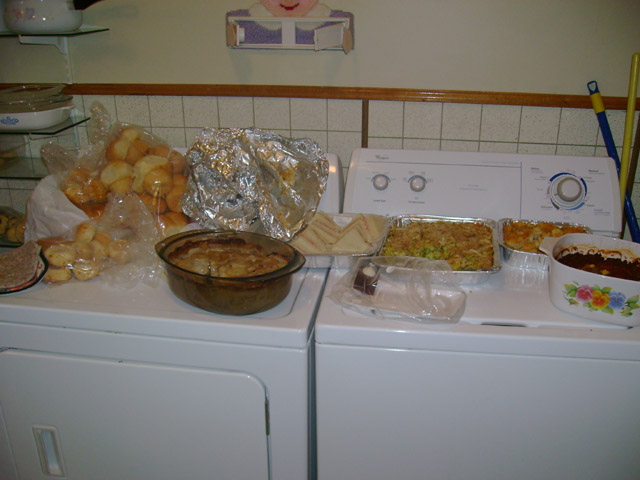
Food was everywhere, even on the washer and dryer

This of course meant that everyone had to eat in their laps with their good clothes on…

I Miss My Kitty

August 23rd, 2006 by Potato

So, without having my car, I had to leave my cat back in Toronto to be spoiled rotten a while longer. Back in London on my own, I find that I miss her — last night, I woke up for no reason at all in the middle of the night, and then ran around the apartment at full tilt. I ran to the kitchen, and got a drink of water, then sat there and breathed heavy for a few minutes, then I sprinted to the bathroom, then back to my bed to roll over and take a nap…

It’s just not the same.

Implanted Magnets

June 7th, 2006 by Potato

Here’s an interesting story about implanting magnets beneath the skin to give someone a magnetic sense. It dovetails nicely with what we’ve been talking about at work recently. I’ll just leave you with that for now, and come back to comment on it a little later.

Ooh, another good read. I love the line “What started strictly as a desire to play with some expensive equipment…” so true.

You can find insanity & pseudoscience fairly easily on the internet, but I’m specializing in my particular field of insanity (and even attending a conference next week where I will hold conversations, face to face, in a manner that is at least on the surface cool and rational, with people who are totally batshit fucking loco).