Xmas Shopping Round-up: EB Games & TTT

December 30th, 2010 by Potato

Not too much to report from this year’s round of holiday shopping. I managed to do about half of my shopping online, which was fantastic given the amount of snow we had in London, and how sick I was for a week there, both leading to a state of not wanting to leave the house.

A quick hiss at Toys Toys Toys in Fairview Mall (Toronto): they wouldn’t accept a manufacturer’s coupon for a boardgame, and they have a no returns policy. I may be a spoiled, decadent consumer for feeling entitled to a decent return policy, but right before xmas at a toy store? Toys may not be as hard to buy for someone as clothes, but it’s so easy to get the wrong thing for kids (or for a kid to end up with two of something), and have to take it back that a no-returns policy is just mean. On top of that, there was no warning from the cashier, just a sign posted at the check-out. (And to top it off, we do indeed find ourselves with a surplus Scrabble set - anyone know of any toy drives still accepting donations?)

A much longer fuck you goes out to EB games. Wayfare bought me a copy of Fallout New Vegas for the Xbox, which, unbeknownst to her, I played months ago on the PC. So back it goes. While they do have a return policy, the reality was that it failed. We got quite the run-around, which I’ll try to detail below, but the end result is that a full refund was not provided — Wayfare lost $5.50 just for the privilege of shopping at EB Games, and they were skeevy to boot. Fuck ‘em.

The longer version starts at purchase: the clerk offered Wayfare some variety of store membership card, which she declined. The clerk said it wouldn’t cost her anything, and she still declined, but the clerk put it on anyway. Then we go to return the game, and the new clerk mumbles and fumbles for a bit about having to manually alter the price — we assume because it’s now boxing week and the current price is lower than the price she paid before. But no, as he processes the credit card for the return, we see that it’s not for the full amount, and not for the new sale price, either. He starts to explain how the card was non-refundable, and we’re confused — what card? He explains the card, and how it was rung up originally so that the end price for buying the game was the same if we kept it, but for the return the game came out cheaper with an added charge for the membership, which is non-refundable. Wayfare explains how she said she didn’t want it, that she never goes for memberships you have to pay for, so there must be a mistake and why can’t we return that too? He’s adamant that there’s nothing he can do about returning the membership, and that we’re out $5.50.

He says one reason why it’s not refundable is that we could have bought it, then run out to another EB games and used it to save 10% on used games, then tried to return it… I’m like wait, the membership gives you 10% off used games? Yes, just used games. So why, I ask, was the discount applied to this purchase, of a new game? “Oh,” he says, “that was a used copy of Fallout New Vegas.”

This is where it goes from being a rip-off story to a major skeeve-out. He’s already put the returned game away behind the counter so we can’t double-check, but no, Wayfare is sure she bought a new game. I swear there was nothing on the packaging to indicate it was used when I opened it — it was even shrink-wrapped (usually the used games have open cases with just a sticker to seal them). Two sets of eyes saw this game and believed it to be new, and EB is saying that it was actually a used game they sold her. Plus, it was at the same price all the other stores were selling the new copy for.

To sum up: rip-off return policy with a bizarre mandatory membership fee, and passing off used merchandise as new. Avoid EB Games.

Tater’s Takes - Debt and Misinformation

December 19th, 2010 by Potato

Looks like the credit tightening may be taken seriously, as Mark Carney’s warnings are being widely picked up now. There are several other articles with similar themes this week, indeed it seemed to be the Globe’s major story for the week.

In one Globe round-up, the “As one economist puts it, Mark Carney’s warning on consumer debt is akin to leaving the cookie jar in plain sight but telling you not to touch.” analogy was put out there. I don’t think that’s accurate — the metaphor there implies that Carney is being hypocritical or just downright negligent in his expectations. But the children and cookies framework would be better phrased as “Those are for guests, don’t touch!” Because there is a good reason for the cookies (low rates) to be out — to stimulate the economy, capital spending, etc. But they’re not for the kids (housing market) since they’re already hyper enough. The cookies aren’t arbitrarily out, and can’t be easily put away just because the kids are getting into them.

Ed Clark of TD explains why regulation is needed: even though they recognize the problem, the banks don’t want to move first to tighten lending because it would be a competitive disadvantage to the bank that moved first (plus, systematic risk is beyond their business plan, and these loans are essentially risk-free to them thanks to CMHC). A good lesson for deregulation in lots of other areas: competition alone doesn’t always lead to a good outcome.

Michael James had a few good posts this week. another on index investing. I’m not a people person, so I think it’s much easier to pick stocks than to pick advisors/managers…

John Hempton has a post up about some statistics on Chinese ethanol consumption (provided by a controversial producer). There’s a discrepancy between the statistics the company provides, and what the WHO (and educated guessing) suggests is the status of alcohol consumption in China. Either the stats are wrong, or there’s a massive over-capacity building up… I’m starting to worry about stories like these. Don’t know what to do about it yet, but it’s got me thinking…

Jenn sends along this article in the economist about why doing a PhD is usually a waste of time. Speaking of finishing a PhD though, Netbug sends this inspirational video with the helpful tip: “the way to finish something on time and on budget is to ship when you run out of time or money.” Just finishing something and sending it along is the problem I’m wrestling with right now - and I’m long past out of time for sending a first draft to my committee… time to just “ship” something! :)

Jeffery Simpson has a column on misinformed people. Perhaps not surprisingly, “The people who were the most misinformed – in terms of having opinions that varied the most from verifiable facts – were those who watched Fox News almost daily.” I love learning things (I should hope so, as I’ve been a student all my life), and I like being an educator: not even necessarily as a teacher/lecturer, but even just helping to correct misinformation here on the blog. I’m deeply disappointed by (deliberate?) misinformation in the media…

Poor London Squirrels

December 17th, 2010 by Potato

The snow here has been just insane. I wonder sometimes if it’s not real, and just a product of my prolonged illness. Sadly, I can’t wish it away as some kind of fever dream, since I’m not all that sick (just a stupid cough that won’t clear up now).

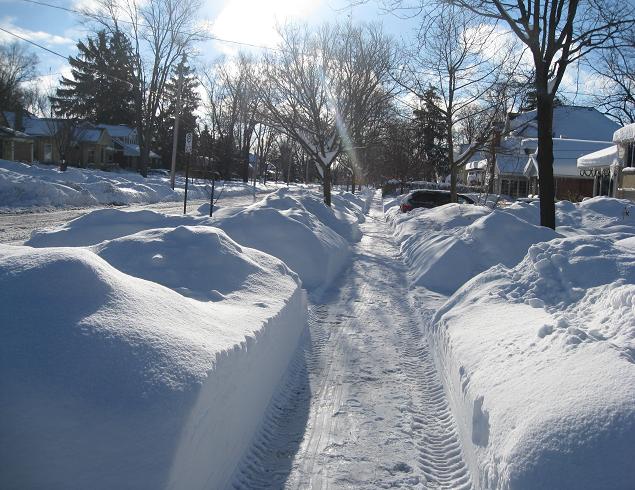
The city seems to have found some crazy new plows for the sidewalks that I don’t recall seeing in previous years. They cut through the drifts leaving a nearly vertical wall of snow on either side of the cleared path. Though by my reckoning we’ve had roughly 5 feet of snow fall in total over the last week and a half, the general snow accumulation isn’t nearly that high as it has been melting and compacting thanks to bright sunshine whenever it’s not an active snowsquall, plus a final dump of heavy, wet snow last week. Nonetheless, there is still a solid two foot wall of snow lining the sidewalks.

And as I discovered today, that is too much snow for a squirrel to bound over.

I was walking to work and saw a squirrel on the sidewalk playing in the snow. At first I thought he was just having fun, slipping and sliding and jumping around, the equivalent of pulling squirrel doughnuts. But soon I saw he was either very sick, drunk, or exhausted. He let me get very close as I was walking down the sidewalk, then tried to run away from me, but kept slipping over and falling into the wall of snow. I stood back to let him get some room, and then he tried to jump up and over the snowbank to get out of the sidewalk canyon. It took him something like 8 tries, some of which weren’t even close to getting up — he’d try one side, then turn around to go for the other but jump halfway across the sidewalk and land before even reaching the other snowbank, crash into it after sliding, turn around, and try again. I didn’t know whether to laugh hysterically, feel sad, or call animal control over his weird behaviour (I ended up splitting the difference on the first two). He did finally get up and over, and then basically swam through the snow drifts to a tree. Once on solid bark, he just hung there and wheezed.

The paths carved through the snow in London. Note that this was taken a few days ago, and we've had over two more feet of snow since, but the banks aren't much higher due to meltage and compression.

TFSA - For the non-CMF members

December 17th, 2010 by Potato

There are a lot of questions and confusion about the TFSA out there, which I find surprising since to my mind it’s basically the most straight-forward tax-sheltered account the government has ever created. You put $5000 in. You get to invest in whatever you want (plain jane savings/GICs, stocks, bonds, mutual funds of same, even split it up and do a bit of each at different institutions as long as the total is < $5k/yr) and it grows tax-free. You can take it out whenever you want, tax-free. The next year, you get $5000 more room, and any room you didn’t use in prior years (or got back due to withdrawals). That’s about it.

But still, people have questions, so on the CMF I tried to explain it in a different way:

Think of the TFSA like rabbits in your backyard. The government is your parents at the front door. They say you can bring 5 bunnies into the backyard every year. Beyond that, they’re looking out at the front door, so they don’t care what happens in the backyard.

You can have your bunnies reproduce like, well, bunnies, you can put them all in one big pen or a bunch of different ones. It doesn’t matter, as long as no more than five ($5k in) bunnies goes past your parents per year.

If you need to take a bunny out for some reason, like to bring it to show and tell at school, your parents will remember you took that bunny out and will let you put it back in the next calendar year and not count it against your $5k limit per year - it’s not a new bunny. (recontribute withdrawals) Even if you did really well at bunny farming and want to bring all 40 of your bunnies to school with you, your parents will count them up and let you bring those back in the next year without counting against your new year’s limit of 5 bunnies.

If you don’t handle your bunnies well and they all die, your parents don’t want to hear about it, you can’t bring in any more bunnies.

Priszm, Plus Another Crazy Month on the Market

December 14th, 2010 by Potato

It was a pretty crazy month+ on the market. The overall indexes didn’t have huge swings in them, but I saw a number of stocks I watch (but don’t own) swing all over the place +/- 10%, with several-percent changes day-to-day. Part of me started to freak out at the apparent increase in volatility, but for the most part I just rode it out. Some key points:

Let’s start with Priszm, the troubled operator of KFC restaurants in Canada. I’ve written about Priszm many times before, in large part because I think it’s an interesting story with a lot of lessons to learn (and in no small part because I lost a lot of money on it, so it’s a very personal, painful lesson). Today’s update to the saga is that they’ve sold off over half their locations. The Ontario and BC restaurants were the “core” of their business in many respects, as Quebec has always been a bit of an oddball, and there just aren’t many restaurants in the other provinces (432 total, 232 for sale). So it looks like this is about it for the Priszm story: this is quite likely the first step in a wrap-up of the business. The amount they’re getting for the sale lines up with roughly half of the P&E and franchise rights values on the balance sheet, so they’re likely getting nothing back for goodwill. If that’s the case, then there’s not likely any value left in the equity.

In an effort to conserve cash as the company prepares for the traditional KFC sales decline during the winter season, Priszm withheld its continuing fee that was payable to the franchisor on December 7, 2010, as well as its debt interest which was payable to its senior debt lender on December 10, 2010. […] Priszm is also in the process of obtaining a forbearance from its senior debt lender relating to the debt interest which was payable to its senior debt lender on December 10, 2010.

Here we go, the end times are nigh. I’m actually surprised that they didn’t make this payment: I figured the default would come at the end of the month.

Canexus (CUS.UN) had another good, consistent quarter — most critically for me, demonstrating that their new technology upgrade is actually working (it’s always a worry with me that big capex spending on new technology for plants won’t actually deliver the efficiencies promised — see Opti). Despite that news, the stock barely budged, so I went out and bought more. It’s now roughly 9% of my portfolio, has an 8% yield, and the payout ratio (now that all that capex is coming to an end) is down around 50%, which means that distribution should be quite safe going forward. The big open question is what the end-game is here for Nexen. Nexen owns the lion’s share of Canexus, and is reported to be looking to sell its share. Would that go to the public market, or would another player (one of the pension funds?) instead try to take the whole thing private?

Other than that though, I’ve been a seller as stuff has been rising. I had an ask in on Imris (IM), but then got blindsided by the sudden share issue and NASDAQ listing (I thought it would have taken way longer to set a price and open — or at least that it would happen one morning, rather than halfway through the trading day!). So my nice-looking gain there has been wiped out, but I’m fairly confident it’ll get back up there. I do worry about why they were raising more money after finally starting to turn a profit — leaving their core competencies? I’ve also got a high ask sitting on IPL.UN (kind of the opposite of a stink bid).

Basically, the theme is that the rest of the market suddenly has a hard-on for yield, and with many trusts dropping to ~8% yield, I’m happy to take the capital gains now, and plow the money into the broader index. Indeed, aside from keeping some money in cash to cover the costs for finishing my PhD (another semester of tuition, and hopefully soon a few hundred dollars in printing and binding costs), I haven’t really found anything else I like to buy in my active portfolio, so I’m sending the money off to the indexed side of things.

One final note for the active portfolio: Freddie Mac reported its third quarter, and the results were incredibly obtuse. The numbers looked very promising for the bull case on the preferreds: delinquency rates are improving, non-performing loans have stabilized, and though they took more provisions for credit losses this quarter, it looks like they should be fully reserved at this point (a ~30% severity should be in the ballpark). However, the politics are still terrible and looking worse: I’ve made the point before that capital reserves are there to keep a company out of the shit pile, and once its in government protection, it doesn’t make sense to borrow money at usurious rates to maintain that margin-of-safety: the government becomes the margin-of-safety. Yet here FRE came up $58M short, and for the dollar amounts involved here, that’s basically a rounding error on a neutral quarter — next quarter they should start making progress towards paying back the treasury. Yet rather than overlooking the immaterial deficiency in their capital ratio, or just making them borrow the $58M from the government, the conservator requested an even $100M. This makes no sense at all, except if indeed the government is trying to make a profit from FRE at the expense of the other stakeholders. So even though the credit numbers look to be getting better, I think that the political risk is alive and well, and if anything is even more clearly negative.

C&C 4: Tiberium Something-or-Other

December 13th, 2010 by Potato

I’m sick. Siiiiiiiiick. And it’s snowy here, so very snowy. I don’t feel like doing much of anything, but I can’t sleep anymore since I just got up from 14 hours of nyquil coma. I call up Wayfare to express my dilemma, and she suggests that I play a video game, which as it turns out is an excellent suggestion.

Now I haven’t played StarCraft2 for well over a month now, since I’ve been so busy not writing my thesis. And a real-time strategy game sounds like it would hit the spot… except I don’t want to play SC2 itself right now. I’ve already finished the single-player part of the game, and I’m too dopey and ill-tempered to keep up/put up with the “people” on battle.net. So I start searching for alternatives, and discover that they’ve come out with a 4th installment to the Command & Conquer franchise. Some single-player play with that sounds like it would hit the spot, so I go ahead and download it.

For those of you that aren’t familiar with the RTS concept, it is generally composed of three pillars of gameplay: resource collection & management, base building, and unit control/tactics. In the C&C tradition, you send out your harvesters to collect “tiberium” which magically gets transmuted into tanks, which are built at the factories of your base, which you defend with more base structures like walls and turrets, then you venture forth across the map to complete objectives, using strategy of some sort.

For C&C4, they decided to throw all that out the window: there are no resources to collect or manage. Just a simple unit cap, which is absurdly low (~6-7 tanks maxes it out), which of course limits the strategic options, taking out the 3rd pillar. As soon as a unit is killed, you can build another to replace it — no resources to manage, so it’s “free”. With such a small force, there’s really no way to split it up and try for different objectives, especially since the computer has you outnumbered all the time. Plus, there’s essentially no base-building either: gone are the factories, barracks, airports, and defense towers. Now everything comes out of one building that you get at the beginning. So the game is basically a dull grind of build your pitiful 6-tank force, go smash it against the first objective, lose 5 tanks in the fighting, replace them, then on to the second objective.

The game was so horribly pointless and dull that after the 3rd level I decided I’d rather go work on my thesis.

“We’re Not a Flyer Store”

December 11th, 2010 by Potato

I’m pretty miserably sick here. Sore throat, cough, fever, and vile fluids being produced all over the place. I think the combination of thesis stress and digging out from over a meter of snow just did me in.

My cache of drugs was pretty low to be heading in to a major illness. In particular, I was just about out of advil; I had to ration them yesterday so that I’d still have one to take this morning to get me out the door to the pharmacy.

On the bright side, I was going through the Pharma Plus flyer, and just about everything I wanted was on sale. Advil, vitamins, mouthwash, nyquil, and cold-fx all had pretty substantial sales on. Plus, it was a big bonus airmiles promotion if I spent $50 or more (which wouldn’t be hard to hit with all the stuff on my list). There was even a 1-day sale on 7-up ($2.22 per 6-pack of bottles! awesome!) today. I didn’t feel like driving, especially since we got another dusting of snow last night, and that would involve sweeping the car off. The Pharma Plus is only like 3 blocks away, so I walked.

And when I got there, there was no sale tag out for the Advil, just one of the “switch to the store brand and save X” tags. I figured I must have remembered the flyer wrong, put some store brand ibuprofen in the cart, and moved on… but the vitamins had no sale tag either. Nor did the mouthwash. The toblerone did, but not the door-crasher one-day sale price, and the 7-up wasn’t even available in the bottles. Something was definitely wrong, so I went to the front of the store where the flyers usually are to double-check (maybe I had the effective day wrong? Maybe I dreamed it all in my fever?), and there were no flyers. There wasn’t even that tray where they usually sit. I asked the cashier for a flyer, and he said they’re not a flyer store.

What? I know they were a flyer store just a few months ago, the last time I was there. How can they not be a flyer store? Can they do that, opt to use the Pharma Plus name and everything but then not follow their flyer? And also, if they’re not a flyer store, why is Pharma Plus sending a flyer to my house? The next closest store is 4 km away, and I have to pass by three Shoppers Drug Marts (and this Pharma Plus) to get there. Not a very effective use of the advertising budget…

I have to say though that given the amount of snow that was dumped on London, the city has done a decent job at cleaning up the sidewalks. This is particularly remarkable because the city usually does a terrible job at keeping the sidewalks free of snow — the sidewalk ploughs seem to take a day or two before they come around, and by that time the snow has been packed down into an irregular icy surface by the passage of what pedestrians there are, and that’s nigh-impossible to walk on. The one issue is that at many intersections the sidewalk ploughs went by first, and now the street ploughs have put up an icy barrier for pedestrians to hop over. Nothing new to anyone out there, I’m sure, but with the amount of snow we have, those ice dams mean that we’re going to have some epic meltwater ponds forming soon…

Tater’s Takes- Too Much Snow

December 9th, 2010 by Potato

It’s been a hell of a few weeks. Thesis progress has been exceptionally slow. Diet has been downright terrible for similar reasons. The snow is ridiculous here: something like 4′ has fallen since Sunday. The height of the snow on the lawn isn’t quite that high, as it’s settled and compacted, but I’m calling it 4′ as I measured 3′ of snow after the first day and a half of solid snowfall, and had to clear another foot or so after shovelling that away. And now to top it all off I’m sick. I think I’ll cry if I end up writing better while hopped up on cold medicine.

After the first 24 hours of snowfall, and halfway through the third round of shovelling:

A crazy amount of snow, here it is from the front. This was taken with still another night's worth of snow to fall.

Then, against all reason and goodness in the universe, it continued to snow all through the following day:

We got as much snow in the last three days as we got all last winter. About 4' total, though the snow compacted and settled so the snowbanks are only about 3' high.

And while the worst of it is over, it’s not completely over yet. It’s going to snow at least a little (up to a few inches) for each of the next 5 days, according to the forecast.

First up in the links, the 4th edition of the Canadian Real Estate Blog Carnival. As an update to my post in that, Wayfare tells me that the landlord has reimbursed us for most of the materials cost of the work we did (I believe everything we had receipts for).

Nova Scotia proposes mandatory organ donation. I tend to agree that the default should be “donor”, but it’s an ethical minefield for a number of reasons.

Another person (Prem Watsa this time) starting to question how far Chinese demand can take commodity prices.

A hilarious episode of BNN’s Market Call Tonight last night, as a real estate broker called in to rant about why rates can’t go up for 10-15 years. His logic is that a rate increase would cause a real estate crash, so it can’t happen. That reminds me of some other backward-thinking, such as the Globe article some time back that said Toronto rents were going to go through the roof in the next few years, because otherwise investors buying condos at today’s prices couldn’t make a profit. I find it hard to believe that some people are so wedded to the real estate only goes up meme that it becomes totally tautological as they use it as a justification for other calls… but there we have it.

Ellen Roseman reports on a case of a real estate agent abusing the buyer’s agreement.

I already had a quick note on the December TFSA strategy, but CC also has one for you.

David at Toronto Realty Blog points to an article about questionable spending at MPAC. He then comments on how wildly variant the MPAC assessments are relative to actual sale values in Toronto. I then point out that getting the absolute valuation of properties isn’t important to MPAC, since it’s only the relative valuation that matters (though perhaps it is fair to poke them for playing their tax-payer funded Wiis since they don’t do a great job there, either). The city doesn’t collect more tax when property values go up. Instead, the tax rate is adjusted so that their total revenue figure comes out: they basically take the total budget, divide it by the sum of all property values (assessments), and that gives them the tax rate for the year. The MPAC assessment is just for determining relative taxation. You can check that by looking up what the property tax rates were over the past few years. The tax rate actually went down from 2005-2006, and 2008-2009-2010. Under each of those boxes for the year is an example calculation, where you see that despite the changing tax rates and property values, the total tax grab goes up fairly consistently by about 2-3%/yr, which is I’d wager about what the typical Torontonian has experienced. When I am finally redeemed and property values do turn around… property taxes won’t. The mill rate will just be adjusted up to compensate for the lower assessed values so that the take remains the same.

Indeed, there’s a good reason for MPAC to consistently under-assess: there’s a cost of dealing with challenges. People who believe that the assessment should have some relation to the actual sale price will think that they’re getting a steal when the assessed value is below recent comparable sales, and not appeal the assessment when it comes in low. However, I don’t want to leave off with the impression that MPAC is doing all right — though they only need to get the relative valuations right, there are far too many stories out there about how they’re not doing even that much. And indeed, checking up on whether the relative assessments are correct would be easier if the absolute measures were at least close.

The Writing Process

December 3rd, 2010 by Potato

Was it a whole month ago that I wrote:

…today I seemed to pass through that psychological barrier where it goes from being this impossible wall to climb, to being something that ‘hey, I can do!’ There are still a lot of pieces to put together, but it’s starting to look like the pieces will go together in the end, so I will finish it.

Now just a few weeks later and that psychological peace and steady, incremental accomplishment has gone right out the window. The last two weeks I’ve had just terrible writer’s block. That happens disparagingly often with science writing in large part because I care. It’s important that I write something that communicates a complex idea well, and also that what I write is accurate and backed up by ample references to the literature. And by actually caring about the quality I seem to just get locked up in a writer’s block loop where I’ll start a sentence or paragraph, then decide I don’t like it, go back to the paper I was referencing, rewrite it, decide I don’t like it… ad nauseum.

It doesn’t make sense, people tell me all the time that I’m a good writer, (and try to trick me into co-authoring screenplays with them) and I don’t have any problem writing on the blog here (look! I’m doing it now!). That’s partly because I know that this kind of writing doesn’t matter: the whole future trajectory of my life is not going to depend on the content and quality of my blog. My PhD thesis… maybe. But I have to write something, so my process so far has been to not interrupt the brief productive runs that come except for the very most urgent of biological necessities — which does not include sleep. I get myself good and stressed and sleep-deprived and it becomes much easier to not care so much and actually get something down on the page.

But I’m sure you’ve spotted the delicate balance that must be struck: too sleep deprived, and there’s an obvious deleterious effect on writing output. I read a paper and forget what I read before I can even get a summary into my annotated bibliography or a few lines about it in my manuscript. I make grammatical mistakes, get sloppy. I actually don’t mind that part too much — if I can at least get something on the page, it can be edited later. But worst of all is when I get out to the other side of the productive middle ground and find myself losing time to staring at the wall and clicking the top of a clicky pen for a half hour straight (incidentally, this is why I’m not allowed clicky pens at work).

I don’t quite know what to do at the moment. There’s a big gulf between recognizing the source of writer’s block, and actually crossing over to getting stuff done in a healthy, productive way. Our work holiday party is tonight, and though I’ve already got seats reserved I’m thinking of skipping to just keep writing now and sleep then, rather than trying to grab some sleep now. I know that at this rate I’d probably only get 100 or so words out in the whole evening, but I also just don’t want to go and deal with people right now. I’m a mess: exhausted, twitchy, stressed, and vibrating on a level mortal consciousnesses will never truly comprehend as my body becomes one with the stuff that underlies our universe’s existence (that is: caffeine).

Tater’s Takes - Priszm, Depreciation, Puppies, and China

December 1st, 2010 by Potato

Winter has arrived: last night the wind was howling and the rain was freezing. A big swing in temperature from just a few days ago. Things are just going horribly right now: I’m not even halfway towards my writing goal for my thesis this week, despite spending all kinds of time staring at the screen and wishing it was over. The diet’s been shot to hell as I run out the last of the Halloween candy. Plus last night was a new low: with the rain and the cold and the wind I didn’t feel like walking to work, but driving seemed silly considering it’s only a 10 minute walk. So, I rationalized it by driving out to pick up a pizza, and then taking that to work. Two fitness goals killed with one stone!

Do you know what I like?

Puppies.

I’m walking in to work and it’s as cold out as it will be the day in hell when I finish my thesis (i.e.: frozen over), and I’m basically freezing my nuts off and cursing the very sudden arrival of winter winds. There’s this guy walking along at a perfectly normal pace, and trailing behind him are these two tiny puppies. They’re hauling ass just trying to keep up with him, falling all over themselves if they catch up and try to jump on his leg, and just generally enjoying the hell out of life. I’m freezing, that guy is freezing, and these tiny puppies who should have no body heat left to them are just having a blast out in the wide world, just super-excited to be outside.

Conclusion: Puppies are awesome.

Sometimes, life’s little lessons are both obvious and fantastic.

The Globe had an article on travelers choosing to head to US airports to take flights, and discussed/blamed airport taxes this weekend. There are a lot of people from here that go to Detroit for flights, as it is cheaper to drive down there than take a flight out of London or Toronto most times. Significantly cheaper, since it does take gas or bus fare to get down there, as well as the hassle of crossing the border. So, is that price difference attributable to taxes as the article suggests? “Pearson, which holds the dubious distinction of charging the world’s highest fees for planes to land, paid more than $140-million in rent last year.” That sounds like a lot, but Pearson saw 30 million passengers last year. The math is simple: the airport tax amounts to less than $5 per ticket. Believe me, I’m not driving to Detroit for five bucks. The price differential is coming from somewhere else. Maybe it’s the other fees the airport is charging, rather than the government, but I suspect more blame can be pointed at Air Canada than Pearson (though the article did discuss other government subsidies in the US).

Canadian Financial DIY shows that beta is not the best measure of downside risk.

In an aptly titled article, “Priszm’s recipe for disaster”, Canadian Business magazine looks at the troubled operator of KFC restaurants in Canada. You may recall that Priszm was my single worst stock pick since I started doing my own research (yes, even my zero-or-hero bet on Freddie Mac preferreds are doing better). IMHO, Priszm’s “recipe for disaster” was two-fold. First, they didn’t have control over vital parts of the company’s budget: Yum brands (the owner of the KFC rights) did. They had the usual trick of deferring capital spending (i.e.: renovations) and claiming that since depreciation was a non-cash expense, they could pay out so much of their cashflow. Normally, that works in the trust model, if the depreciation expense you can claim doesn’t reflect the reality, so you can indeed defer/reduce capital spending. Unfortunately, it turned out that to renew the KFC franchise agreements, Priszm had to agree to renovate its locations, whether they needed it or not. That put them in a bit of a bind, not having been saving up for that all along. The second issue was that they had an interest-only loan (something I did not catch when evaluating them earlier on), and it all rolled over at once. So when lending is tough (e.g.: now) they face a liquidity crisis. I wasn’t impressed with the communication to investors about that issue, but communication issues aside, that looks to be the biggest risk facing the company right now. Either they find a new lender (and the clock is ticking — they’ve already arranged for one extension, which runs out in a month), or they could find themselves defaulting.

I think the big take-away lesson there is to avoid balloon payment schemes: it’s much easier to roll small portions of your debt, even if you have to suffer high interest rate spreads, when conditions are tight. And, if it comes to it, aggressive focus on reducing the debt could mean a company could pay off the debt as it matured, as long as the amount maturing in a given year was within its capabilities. Many lending covenants will keep companies to something like a 5 to 1 debt to earnings/EBITA ratio, so if the loan maturities are evenly spread out over 5+ years, it should be possible to become debt free by paying off the loans as they mature (by suspending dividends/capital reinvestment spending/deferring maintenance etc). Priszm’s one big loan strategy deprived them of that option.

Back to the issue of depreciation, it’s really an interesting one, and something that’s fairly important when looking at whether or not a trust’s payout is sustainable. The accounting rules provide guidelines for what depreciation figures to use — and it is important to have some kind of standard, or it would be all too easy to manipulate the books by just choosing a figure for depreciation that suits your mood. But a standard figure for depreciation is going to be perfect for almost nobody. Take computers for instance. At home we have here a powerful desktop system I use for everything from gaming to doodling to running MATlab scripts (as well as blogging, checking email, etc). The price curve of computers is such that all that power didn’t come cheap, and two years later that computer’s likely worth maybe 30% of what I paid for it, as now it just has the power of a typical mid-range desktop system. Wayfare on the other hand just has a little netbook for doing word processing and surfing the internet (and because it’s light and portable), and even though it’s also two years old now, it’s probably still worth at least half what she paid, since it’s still perfectly suited to achieving those goals. Similarly, you’ve probably seen lots of workplaces with downright ancient technology that still serves their purposes fine, even though it was long ago depreciated to zero on their balance sheets.

So, one example to think about: Canadian Helicopters (CHL.UN) is one company I like a lot - they’re paying out a decent amount of cash, and they’re earning that even under GAAP earnings. They amortize their helicopters at 4%/yr, straight-line (that is, after 25 years, the helicopters are recorded as having $0 value). I’m told though that a helicopter is far from worthless, even after 25 years. Though they didn’t say how old the helicopters were, in 2009 CHL sold 11 helicopters (plus some land) for $30 million. It’s unfortunately not spelled out how much of that was for the helicopters, or how old the units were when sold (likely fairly old since the buyer is reported to be replacing them within 2 years), but the end result was a reported one-time gain of $1.4M on the sale. Anyway, my point is that here’s a company that’s likely getting close with their amortization figures, or potentially even over-reporting depreciation (that is, their assets may be worth more than their balance sheet indicates). Though I have a “full position” in CHL at the moment, and though it’s been up a fair bit this year (I generally prefer buying stocks when they’re down), I’m thinking of getting more for this reason. The biggest issue is that its largest few clients make up a large part of their revenues, and can be fickle — Ornge took over their own operations, and for the NWS work, CHL lost out in the last round of bidding. That was offset a bit by picking up more work in Afghanistan, but now a very large part of their business is focused there.

Jim Chanos makes the case to CNN that China’s in a construction bubble. What to do about it? How will that affect the fertilizer and oil stories for China?

Michael James reminds investors that a good reason to limit trading is because of the opposition. I have to wonder if they’ve got room for another almost-PhD on their team :)

The folks at CMT report that TD’s Ed Clark supports a return to 25-year amortizations being the maximum. I’d support that: though it might be nice to have a 35-year amortization as an option for when times get tough, it’s just too tempting for enough people to make it troublesome, plus, it’s a systematic risk issue. After the first 5-year term (about the amount of time the average person goes before picking up and moving again), a person with a 35-year mortgage has only paid off about 7% of their loan. Combined with a minimum 5% down-payment, and it doesn’t take much of a move downward in house prices at all for that person to find themselves in negative equity (or effective negative equity, where their equity is not enough to allow them to sell the house and cover closing costs without finding additional funds). On a more traditional 25-year mortgage, almost 13% of the principal will be paid down in that first 5-year term. [Note that this is an interest-rate dependent calculation: I put 4% into the mortgage calculator, but higher rates result in even less principal paid down: at 6%, the paydown becomes 5% and 10% for the 35- and 25-year amortizations, respectively]

The WikiLeaks release is making waves. I know that they are themselves very secretive about where they get their information from, perhaps to protect their sources, but I have to wonder how they’re getting so much information. I also wonder if they think through what they’re doing. Scott Gilmore had an oped in the Globe examining that issue. A commenter also pointed out that these kind of full, plaintext releases may compromise cryptography. I think that modern techniques in use by governments will still be strong even with a number of cases of cryptotext and plaintext to work with, but I think it may be a question worth asking, especially if there’s a concern of a player with a long memory breaking transmissions from long ago (the news says the releases date back to 1966).